
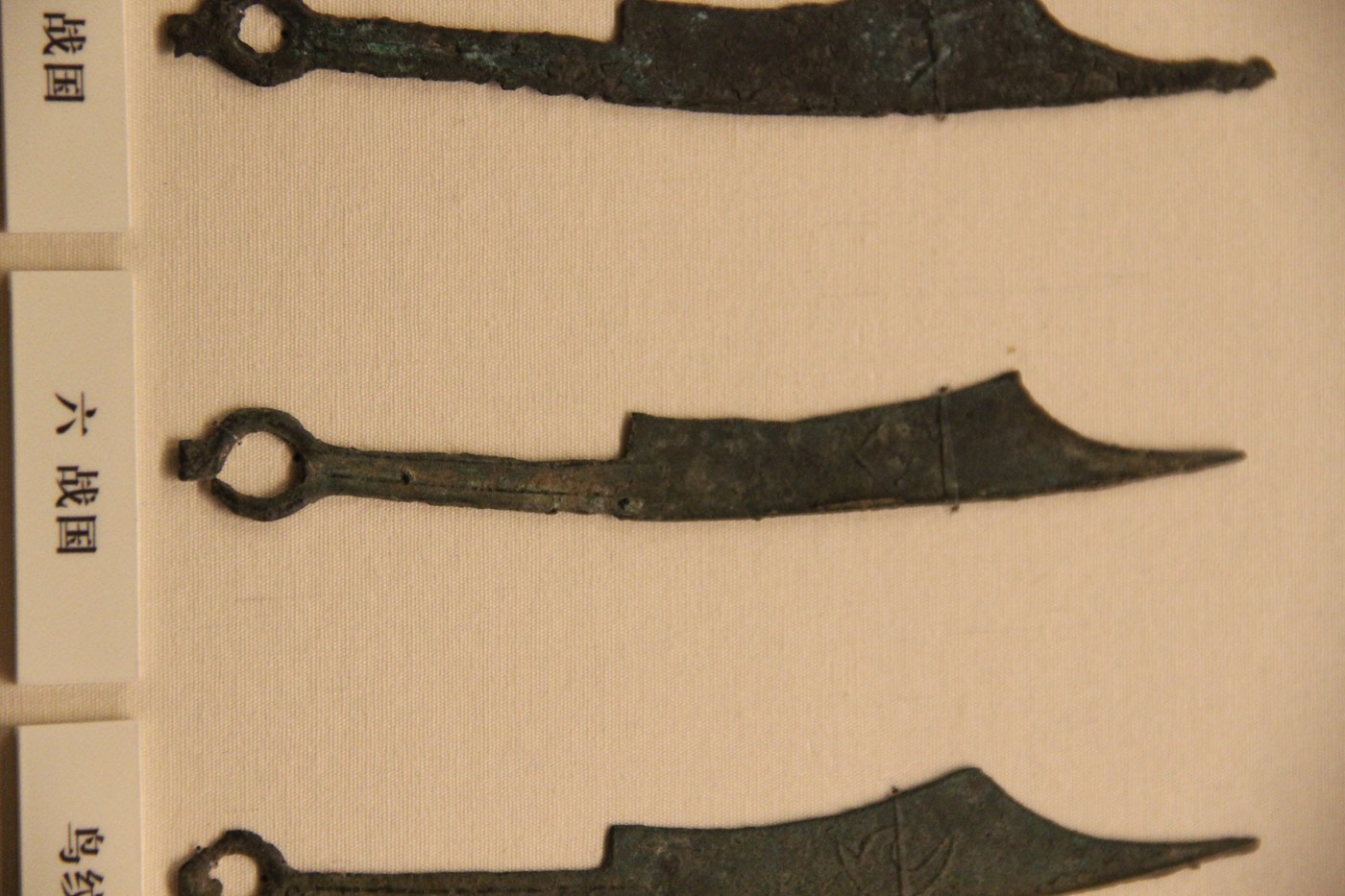
Warring States Knife Coin
A cast bronze knife coin (dao bi) of China's Warring States period, shaped like a small blade with a ringed handle and cast inscriptions.
- Country
- China
- Denomination
- Knife Money
- Metal
- Bronze
Got a coin like this?
Identify any coin from a photo, free.
Overview
This is a piece of Chinese knife money (dao bi), one of the distinctive cast-bronze currencies used in China during the Warring States period. Rather than a round disc, the object is shaped like a small knife or blade: a curved or straight cutting portion tapering into a narrow handle, which terminates in a ring at the end. The example here shows the characteristic ringed head and a slender rectangular handle carrying cast inscriptions, with the whole piece formed from bronze.
Knife money was cast, not struck, so its raised characters, ridges, and outlines were produced in a mould rather than hammered from dies. The inscriptions on the blade or handle typically record a place name, a value, or other characters, and are the main way collectors and scholars attribute a given knife to a state, region, or series. The bronze surface is usually covered in an earthen or green patina from long burial.
As an artifact of early Chinese money before the empire standardized the round coin with a square hole, the knife coin is prized as a tangible link to the experimental monetary systems of the pre-imperial states. It combines an unusual functional-looking form with genuine antiquity.
History & Background
During the Warring States period, before China's unification under the Qin in 221 BCE, the competing states of the north and east used a variety of metal currencies whose shapes echoed everyday tools. Knife money is thought to derive from the small utility knives that had earlier served as barter goods; over time these were cast in bronze specifically as money, in a standardized, thinner form no longer meant for cutting. Alongside knife money, spade-shaped coins and, later, round coins circulated in different regions, reflecting the absence of a single national currency.
Knife coins are especially associated with the northeastern states, and different series carry different inscriptions naming places or values. Because each issuing authority cast its own money, knives vary considerably in length, curvature, weight, and the characters they bear. They were produced in moulds, often many at a time, and finished by hand, so individual pieces differ in the sharpness of their casting.
When the Qin unified China, it suppressed the older regional currencies in favor of the round bronze coin with a central square hole, the form that would dominate Chinese coinage for the next two millennia. Knife money therefore belongs to the pre-imperial era and largely disappeared from circulation after unification, surviving today chiefly as excavated finds and collectors' pieces.
How to Identify
The defining feature is the shape: this is not a round coin but a blade-like object with a narrow handle ending in a ring. On the observed piece the ring forms a circular head at one end, while the handle is a slim rectangular bar carrying cast inscriptions. The presence of raised, mould-cast characters rather than struck lettering is characteristic of ancient Chinese cast money.
The metal is bronze, and genuine ancient pieces typically show a hard, adhering patina in earthen browns and greens rather than bright metal. Look for the seam or casting texture consistent with mould production, and for characters that sit up from the surface with the slightly soft, flowing quality of cast script. The inscriptions, whether on the blade, the handle, or near the ring, are the key to attributing the knife to a particular series.
Because knife money was issued by several authorities over time, size, weight, curvature, and the number and content of characters all vary. Identification rests on the combination of the knife form, the ringed handle, the bronze fabric with age-appropriate patina, and the cast inscriptions taken together. Precise attribution to a specific state or type is best done by matching the inscription and profile against specialist references.
Value & Collectibility
Knife money is a collectible category with a wide value range, driven mainly by the specific type, the legibility and desirability of the inscription, the completeness of the blade and ring, surface quality, and authenticity. Common, worn, or partial pieces sit at the modest end, while intact knives with sharp casting, clear characters, and attractive original patina from scarcer series command significant premiums.
Condition matters a great deal for cast bronze: cracks, breaks at the narrow handle, heavy corrosion, or losses to the blade reduce value, whereas a solid, uncracked piece with an even, stable patina is far more desirable. Because this is an ancient artifact rather than a bullion coin, the metal itself has little intrinsic worth; nearly all the value is numismatic and historical.
Authenticity has an outsized effect on price, since knife money is widely reproduced. Values are best confirmed against recent sales of comparable, correctly attributed examples of the same type and condition, and higher-value pieces benefit greatly from expert opinion or third-party certification before any figure is trusted.
Frequently asked questions
What is knife money?
Knife money, or dao bi, is an early Chinese cast-bronze currency shaped like a small knife or blade with a ringed handle. It was used during the Warring States period, before China adopted the round coin with a square hole, and its shape is thought to derive from everyday utility knives.
Was this coin struck or cast?
It was cast in a mould, not struck between dies. That is why the characters and outlines are raised and have the soft, flowing look of cast metal, and why genuine pieces show casting texture rather than the sharp, pressed detail of a struck coin.
What do the inscriptions mean?
The cast characters typically record a place name, a value, or other identifying text, and they are the main way a knife is attributed to a particular issuing authority or series. Reading and matching the inscription against specialist references is how the exact type is determined.
How old is it?
Knife money of this kind dates to the Warring States period, roughly 475 to 221 BCE, before the Qin unification of China. After unification, the round coin with a square central hole replaced these older regional currencies.
How much is a knife coin worth?
Value varies widely with the specific type, the clarity of the inscription, completeness, surface quality, and, above all, authenticity. Common or damaged pieces are modest, while intact, well-attributed knives from scarcer series are worth much more. Because reproductions are common, confirm authenticity before trusting any price.
Warring States Knife Coin guides
In-depth guides for identifying, valuing, and collecting Warring States Knife Coin.
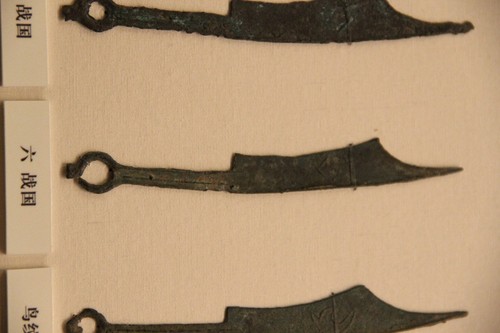
Other coins you may enjoy
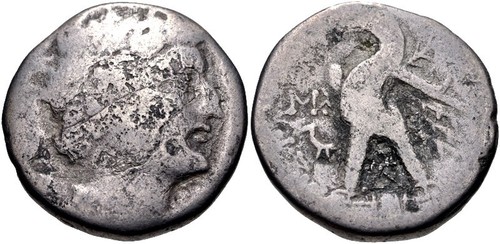
Tetradrachm of Ptolemy XII
80-51 BC
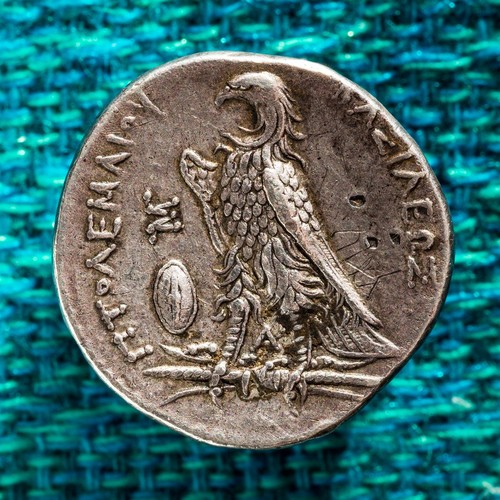
Tetradrachm of Ptolemy I
305-283 BC
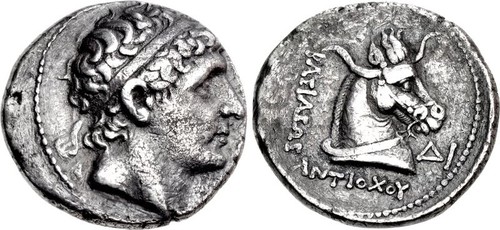
Tetradrachm of Antiochos I Soter
281-261 BC
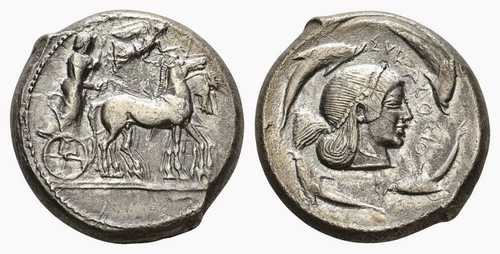
Syracuse Tetradrachm
c. 5th-4th century BC (Classical period)
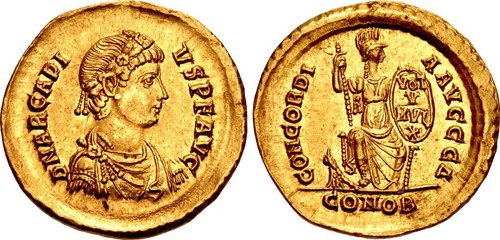
Solidus of Arcadius
AD 395-402
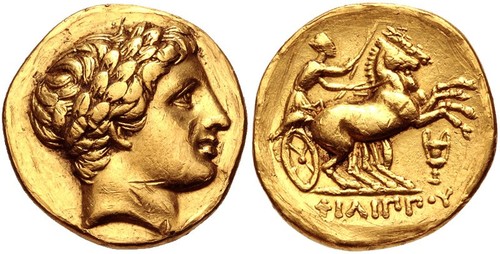
Philip III Gold Stater
323-317 BC
Siliqua of Gratian
AD 367-383
Sestertius of Maximinus Thrax
235-238 AD
Solidus of Valentinian III
AD 425-455
Seleucus I Nicator Tetradrachm
Late 4th-3rd century BC
Nummus of Magnentius
AD 350-353
Follis of Galerius
AD 308-310