
How to Identify the Warring States Knife Coin
A collector's guide to recognizing Chinese bronze knife money: the blade-and-ring form, cast inscriptions, patina, and cautions against modern reproductions.
Read the full Warring States Knife Coin encyclopedia entry →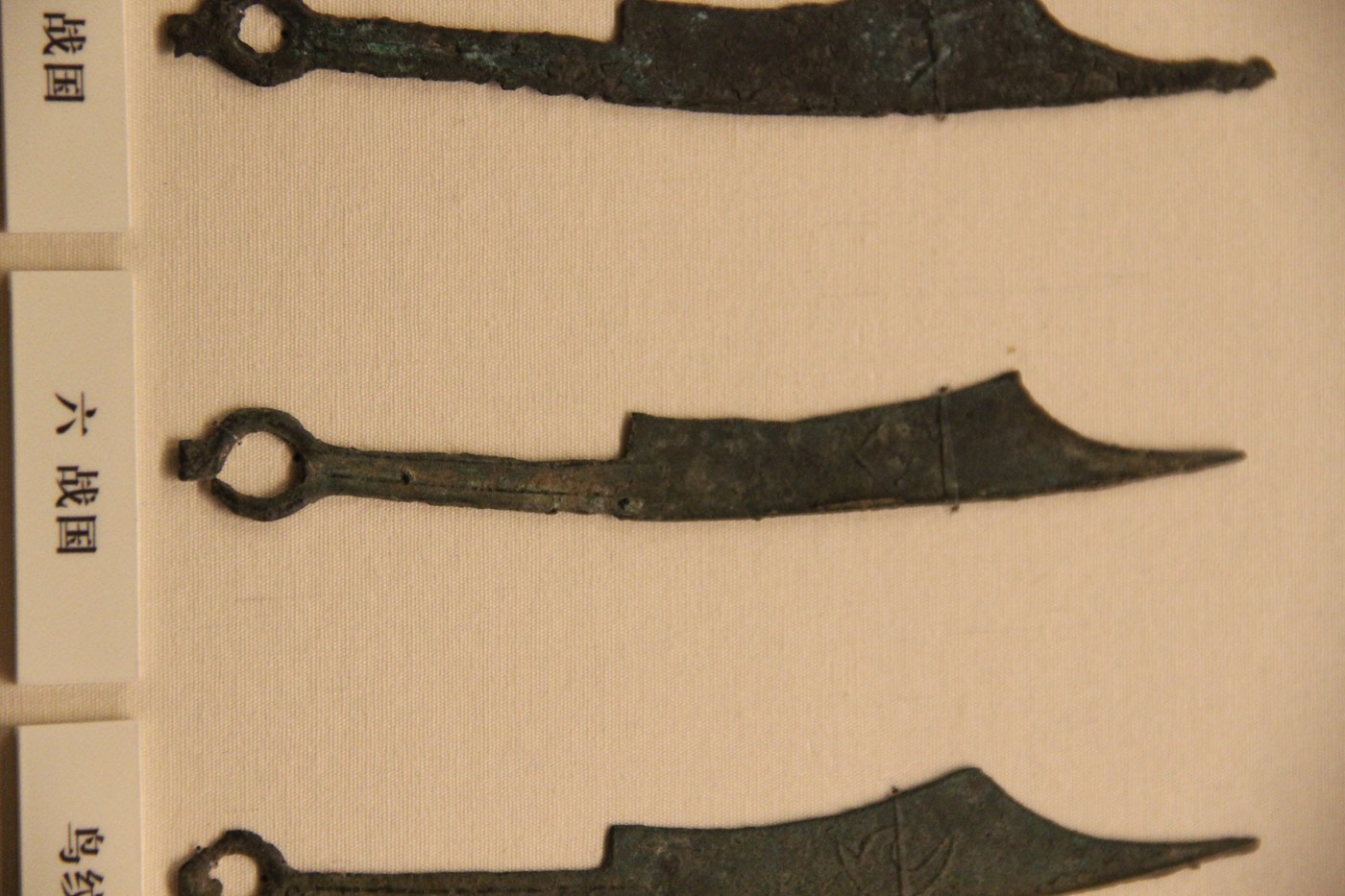
Start with the overall form, because it identifies the category instantly. Knife money is not round: it is a thin, blade-shaped bar of bronze that narrows into a handle and ends in a ring. On the piece observed here, the ring forms a circular head and the handle is a slim rectangular strip bearing inscriptions. If you are holding a bronze object shaped like a stylized knife with a looped end, you are almost certainly looking at Chinese knife money rather than a conventional coin.
Examine how the characters and outlines were made. Genuine knife money is cast, so the raised script and border ridges should have a slightly soft, flowing quality and may show mould texture or a faint casting seam along the edges. Struck-looking, machine-sharp lettering is a warning sign. The inscriptions, wherever they fall on the blade, handle, or near the ring, are the single most important diagnostic for attributing the knife to a specific series, so record and photograph them carefully.
Assess the metal and surface. The piece should be bronze with a hard, adhering patina in earthen and green tones consistent with long burial, not bright or freshly shiny metal. Real patina tends to be uneven, layered, and difficult to remove; a uniform painted-looking green, a greasy modern coating, or metal that looks too clean should raise suspicion. Note the length, curvature, weight, and any breaks, since these vary by type and affect both attribution and value.
Use the profile and inscription together to narrow down the type. Knife money was issued by more than one authority over the period, and different series differ in size, degree of curvature, and the number and content of characters. Rather than assume all knives are the same, match the outline and the reading of the inscription against a specialist catalog of Chinese cast coins to place it within the correct series.
Finally, be cautious about authenticity. Knife money is heavily reproduced, both as tourist copies and as deceptive fakes with artificial patina. Watch for casting bubbles, grainy or sandy surfaces, seams that do not match genuine mould work, characters that are crude or wrongly formed, and patina that flakes or sits only on the surface. Because condition and authenticity dominate value, have any promising or higher-value piece reviewed by a specialist in ancient Chinese coinage or submitted for third-party authentication before relying on an attribution.
Frequently asked questions
What is the fastest way to recognize knife money?
Look at the shape. Knife money is a thin, blade-like bar of bronze with a narrow handle ending in a ring, not a round disc. That form, combined with raised cast characters and an ancient bronze patina, identifies the category before you even read the inscription.
How can I tell a cast original from a modern reproduction?
Genuine pieces are mould-cast, with soft, flowing characters, casting texture, and a hard, uneven earthen-green patina. Be wary of sharp machine-like lettering, casting bubbles or sandy surfaces, crude or malformed characters, and painted or greasy patina that flakes off or looks uniform.
Why does the inscription matter so much?
The cast characters name a place, value, or authority and are the primary means of attributing a knife to a specific series. Two knives of similar shape can belong to different types, so reading and matching the inscription against a specialist reference is essential for accurate identification.
Should I clean the patina to see it better?
No. The patina is part of a knife coin's authenticity and value, and cleaning can strip it, damage the cast detail, and make the piece harder to authenticate. Leave the surface intact and, if needed, let a specialist assess it as found.