Maundy Three Pence
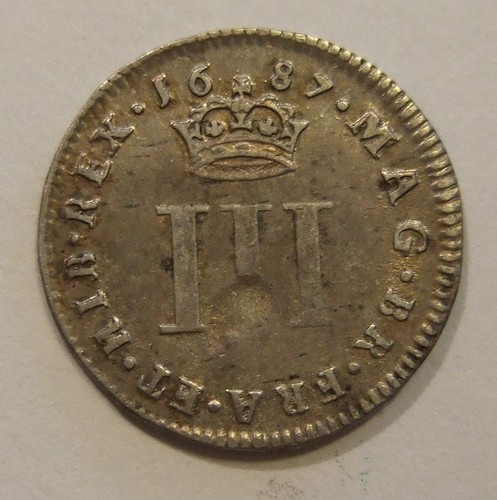
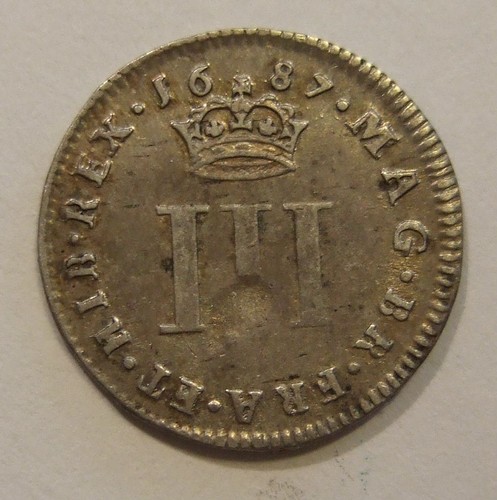
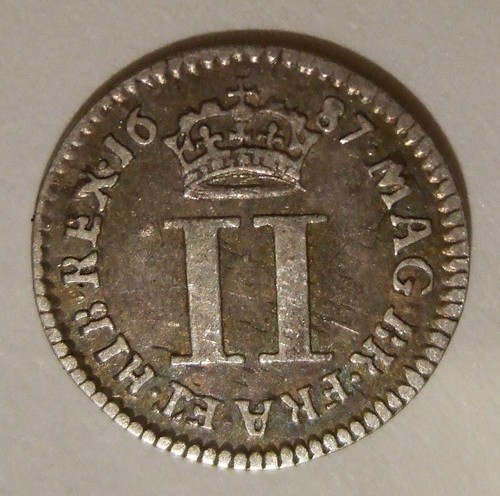
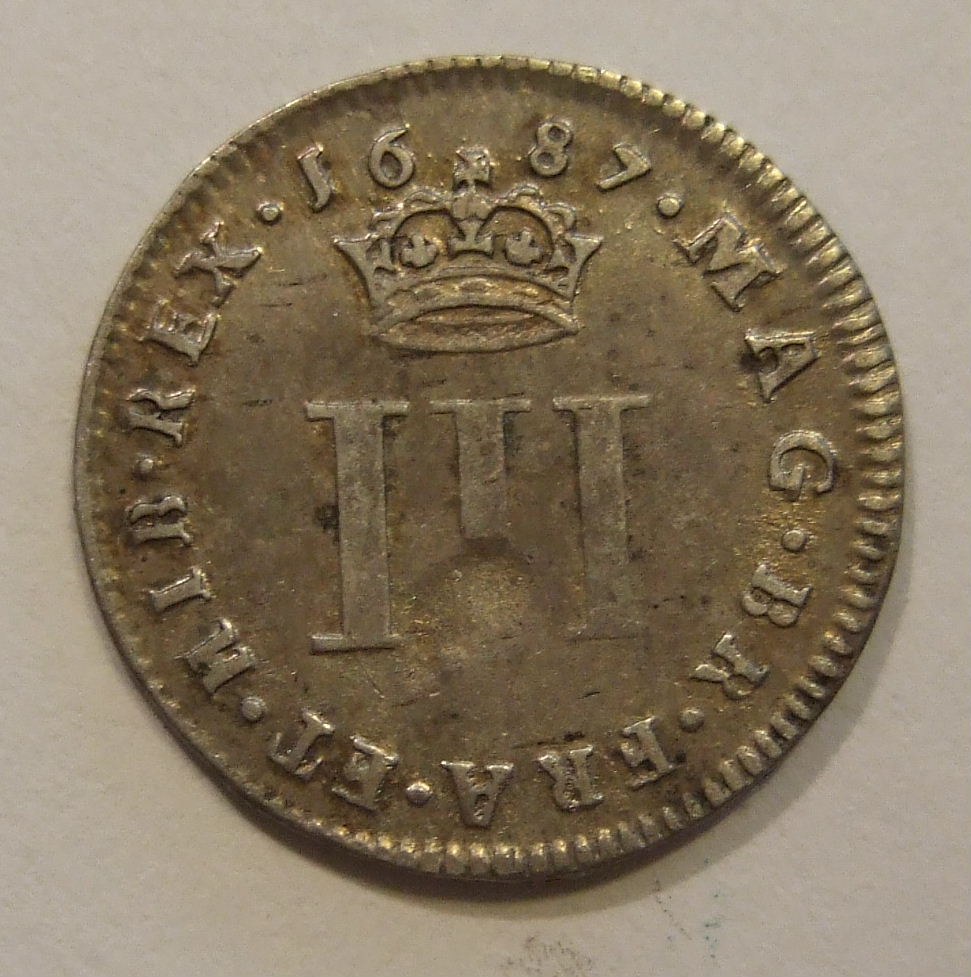
A tiny sterling-silver threepence tied to Britain's Royal Maundy tradition; the photographed 1687 coin shows James II's bust and a crowned Roman numeral III.
- Country
- United Kingdom
- Denomination
- 3 Pence
- Metal
- Silver
Got a coin like this?
Identify any coin from a photo, free.
Overview
The Maundy Three Pence is one of the small silver denominations distributed by the British monarch as part of the Royal Maundy ceremony. Alongside the penny, twopence, and fourpence, the threepence makes up the traditional four-coin group of tiny hand-sized silver pieces associated with the observance. The photographed example dates to 1687 and carries the bust of James II on the obverse and a crowned Roman numeral III on the reverse.
Because of their very small size and silver content, these coins have long been prized by collectors, both as pieces of royal ceremonial history and as compact examples of British milled silver. Early issues such as this James II threepence are considerably scarcer than the more familiar 19th- and 20th-century Maundy threepences.
The denomination sits at the intersection of everyday small change and formal ceremony, which is part of what makes it appealing to specialists in British coinage.
History & Background
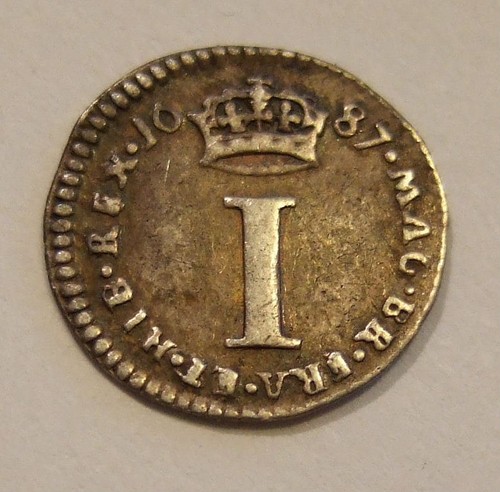
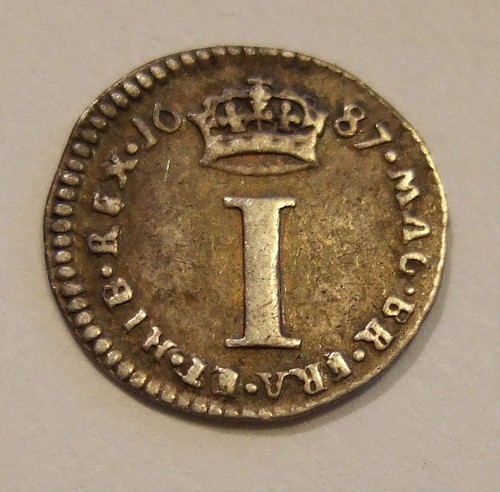
The distribution of alms in silver on Maundy Thursday, the Thursday before Easter, is a royal custom with medieval roots. By the later 17th century the small silver coins used for this purpose – penny through fourpence – were being struck on the screw press as part of the reformed milled coinage introduced under Charles II. The 1687 threepence shown here belongs to the reign of James II (1685–1688), whose short reign produced these small silver denominations bearing his portrait.
Throughout the 18th and 19th centuries the threepence continued to be issued in silver both for general small change and for ceremonial Maundy use, with the two roles gradually separating over time. The crowned numeral reverse that identifies the denomination remained a consistent feature across successive monarchs.
Today the Royal Maundy ceremony endures, and sets containing a silver threepence are still struck for it, giving the denomination an unusually long and continuous history stretching from the Stuart era to the present.
How to Identify
The Maundy Three Pence is a very small, thin silver coin, typically around 16–17 mm in diameter and weighing roughly 1.4–1.5 grams. The defining reverse feature is the crowned Roman numeral – III for the threepence – which immediately separates it from the penny (I), twopence (II), and fourpence (IIII) of the same group. On the 1687 example the obverse shows the left-facing bust of James II with a surrounding Latin legend naming him as king.
The legends read in abbreviated Latin: the obverse gives the monarch's name and titles, while the reverse carries the crowned numeral, the date, and the continuation of the royal style. Early pieces like this one have plain edges and the slightly irregular strike typical of hand-fed screw-press coinage.
Key diagnostics are the tiny module, the silver fabric, the crowned III reverse, and the identifiable royal portrait and date. Together these confirm both the denomination and the reign at a glance.
Value & Collectibility
Value depends heavily on the reign, date, and condition. Common later Maundy threepences from the 19th and 20th centuries are relatively affordable and often trade in the modest tens of dollars, while early issues such as a 1687 James II threepence command a clear premium because of their age, scarcity, and Stuart-era portrait.
Condition is critical on such a small coin: sharp, unworn detail on the portrait and crown, clean fields, and attractive toning all raise desirability. Pieces with provenance to an intact Maundy set, or in high grade, can be worth substantially more than circulated examples.
As with all early milled silver, precise prices vary with the market and the specific grade, so ranges should be treated as guidance rather than fixed figures. A specialist dealer or auction record for the exact date and reign gives the most reliable valuation.
Frequently asked questions
What is a Maundy Three Pence?
It is a small silver threepence linked to Britain's Royal Maundy ceremony, in which the monarch distributes silver coins as alms. It is identified by a crowned Roman numeral III on the reverse.
Why does the reverse show the numeral III?
The small Maundy silver denominations use crowned Roman numerals to state their value: I for the penny, II for twopence, III for threepence, and IIII for fourpence.
Who is on the 1687 example?
The 1687 threepence carries the portrait of King James II, who reigned from 1685 to 1688, with his name and titles in abbreviated Latin around the bust.
Is it made of real silver?
Yes. Historic Maundy threepences of this era were struck in sterling silver. The coin is very small and thin, weighing only around a gram and a half.
Are early Maundy threepences rare?
Early issues such as this James II piece are far scarcer than the common 19th- and 20th-century threepences, and they carry a premium among collectors of British milled silver.
Maundy Three Pence guides
In-depth guides for identifying, valuing, and collecting Maundy Three Pence.