
How to Identify the Maundy Three Pence
A collector's guide to spotting a silver Maundy threepence: the crowned III reverse, the tiny silver module, the royal portrait, and common look-alikes.
Read the full Maundy Three Pence encyclopedia entry →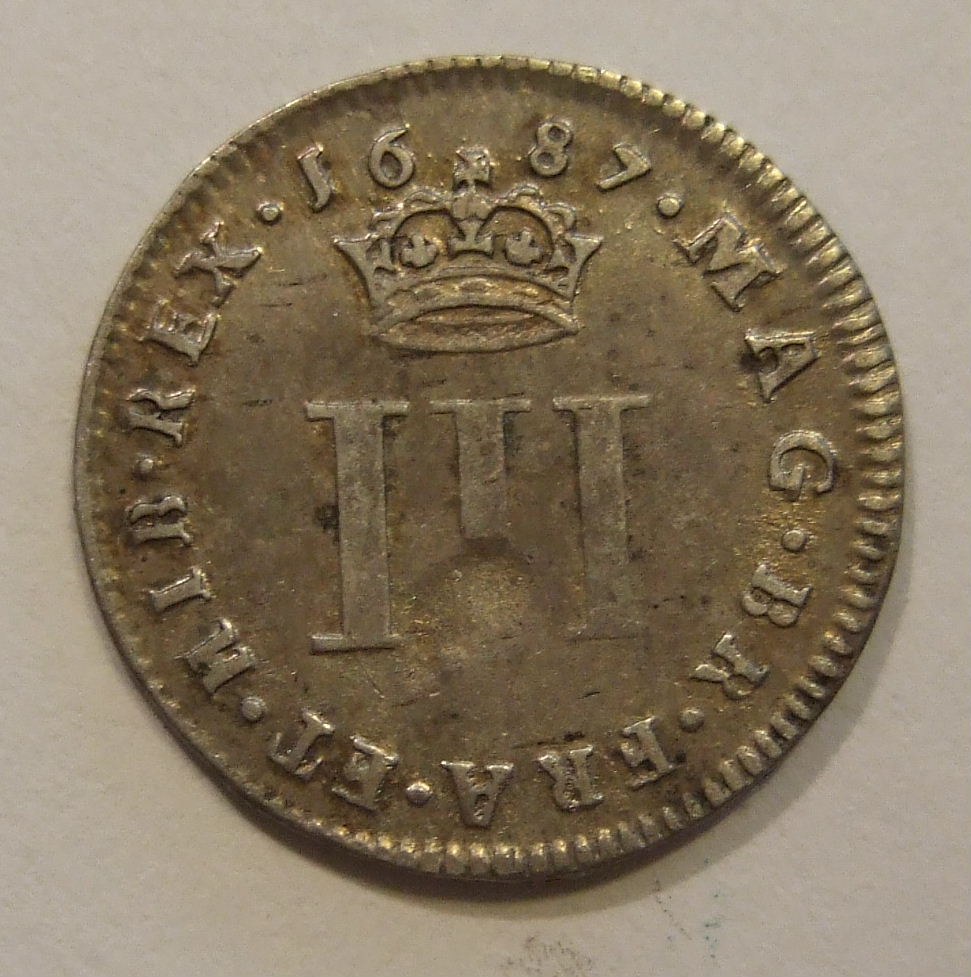
Start with the reverse, because it is the fastest confirmation of denomination. A genuine Maundy Three Pence shows a crowned Roman numeral III at the center, surrounded by the date and the continuation of the royal Latin titles. If you instead see I, II, or IIII, you are holding the penny, twopence, or fourpence of the same small-silver group rather than the threepence.
Next, check the size and metal. This is a very small, thin coin – roughly 16–17 mm across and only about 1.4–1.5 grams of silver. Genuine pieces have a bright, hard silver ring and fabric, not the dull, slightly greasy feel of base-metal or plated fakes. The edge on early examples such as the 1687 issue is plain, without milling or lettering.
Read the obverse portrait and legend to pin down the reign. The 1687 example shows the left-facing bust of James II with his name and titles abbreviated in Latin around the rim. Matching the portrait style, the direction the bust faces, and the date to a known reign is the surest way to attribute the coin, since the same crowned-III reverse was used across many monarchs.
Watch for look-alikes. The most common confusion is with the circulating silver threepence of later centuries, which shares the small size and, in some periods, a similar design – Maundy and currency strikings can be nearly identical and are often separated by finish, date, and provenance rather than by an obvious visual difference. The other three Maundy denominations are also easily mistaken at a glance, so always confirm the numeral.
Finally, be cautious about authentication. Because these coins are tiny and valuable in early reigns, cast copies and altered dates exist. Weigh the coin, examine the sharpness of the crown and portrait under magnification, and be wary of soft, mushy detail or seams around the edge. For a high-value early piece like a James II threepence, confirmation from a specialist dealer or grading service is worthwhile before you rely on any valuation.
Frequently asked questions
How do I tell the threepence from the other Maundy coins?
Look at the crowned numeral on the reverse. The threepence shows III; the penny shows I, the twopence II, and the fourpence IIII. The numeral is the definitive marker.
How can I confirm it is silver and not a fake?
Check the weight and feel: it should be around 1.4–1.5 grams with a bright silver fabric and a clean plain edge. Soft detail, casting seams, or an off weight are warning signs of a copy.
How do I identify the reign?
Read the portrait and the Latin legend and date. The photographed coin shows James II's left-facing bust with his titles, dated 1687, which places it firmly in his 1685–1688 reign.
Is a Maundy threepence the same as a circulating threepence?
They can look almost identical in some periods. Maundy strikings were made for the ceremony and are often distinguished by finish, date, and provenance rather than by design alone, so context matters.