Maundy Money Threepence
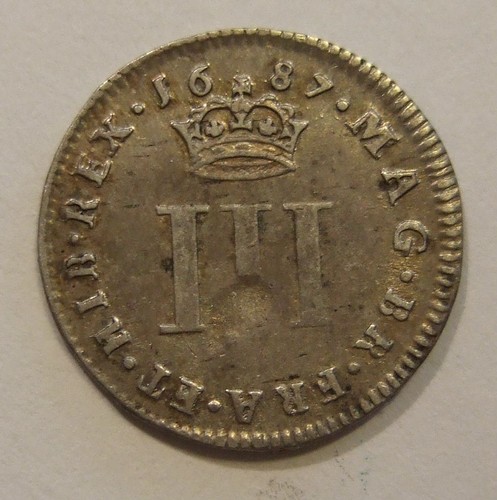
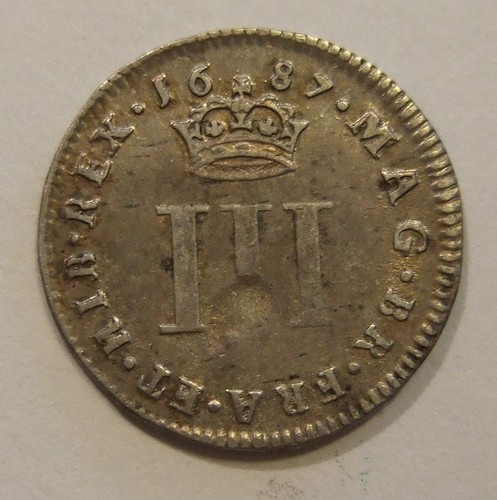
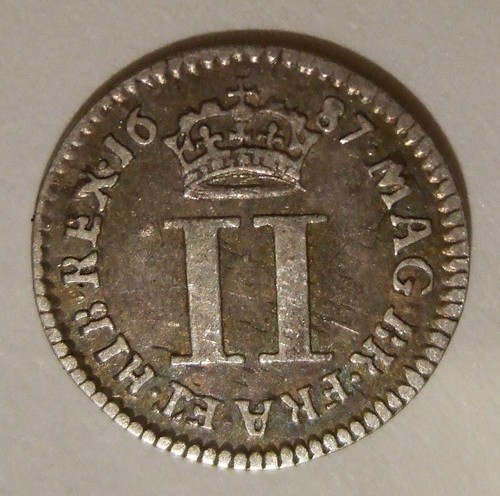
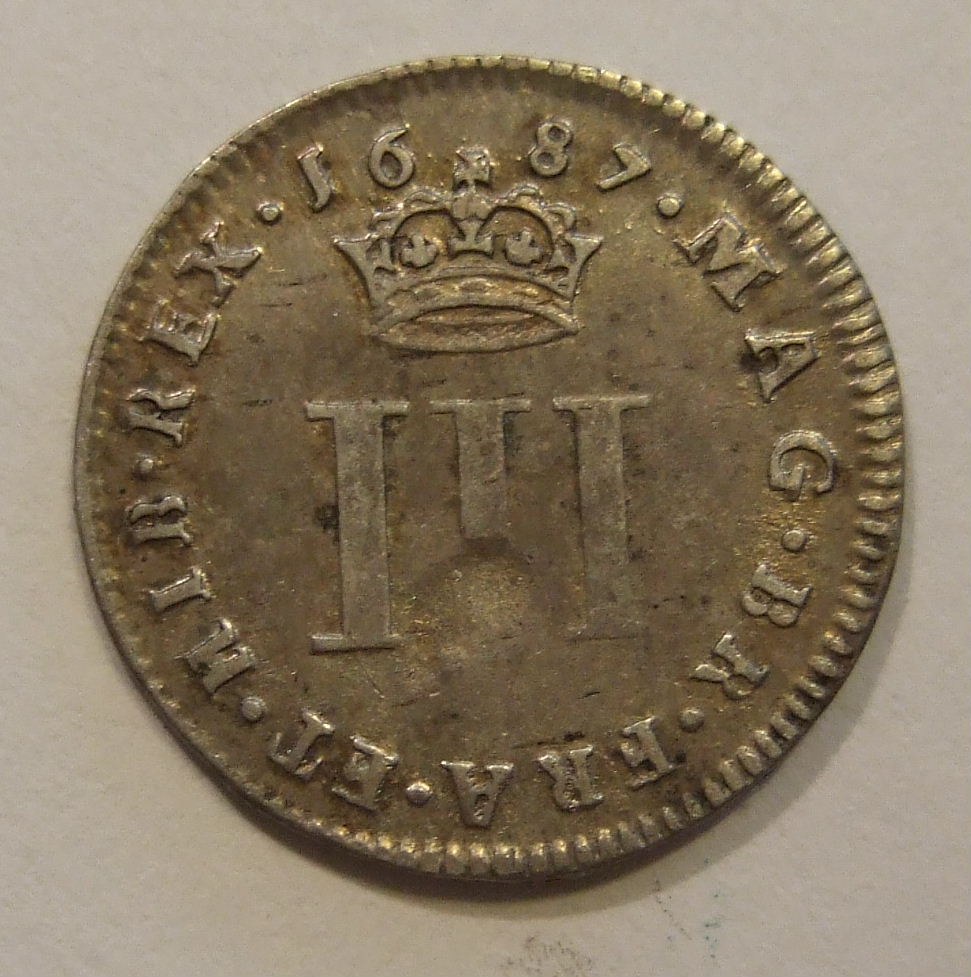
A tiny sterling-silver British threepence; the 1687 James II example shows a crowned bust and a crowned Roman numeral III on the reverse.
- Country
- United Kingdom
- Denomination
- 3 Pence
- Metal
- Silver
Got a coin like this?
Identify any coin from a photo, free.
Overview
The Maundy Money Threepence is one of the four small silver denominations — penny, twopence, threepence and fourpence — associated with the British Royal Maundy tradition. The example photographed here is a 1687 threepence of James II, with the king's crowned profile on the obverse and a large crowned Roman numeral III on the reverse.
These coins are struck in sterling silver and are very small, making the threepence easy to confuse with the twopence and fourpence of the same series unless the numeral is read carefully. In the late 17th century the same small silver pieces served both as ordinary circulating change and as gifts distributed at the sovereign's Maundy Thursday almsgiving, so a James II threepence of this date is best described as small silver of the type later formalised as "Maundy money."
History & Background
The custom of the British sovereign distributing alms and small silver coins on Maundy Thursday dates back centuries, and by the reign of Charles II dedicated milled sets of the four small silver denominations were being produced. James II reigned only briefly (1685–1688), so his small silver, including the 1687 threepence, was struck in modest quantity compared with longer reigns.
Over the following centuries the four small silver coins became increasingly reserved for the Royal Maundy ceremony rather than everyday commerce, and today they are struck specifically as Maundy money in very limited numbers. The photographed 1687 piece belongs to the early, transitional part of that story, when the same coin design could be both pocket change and ceremonial gift.
How to Identify
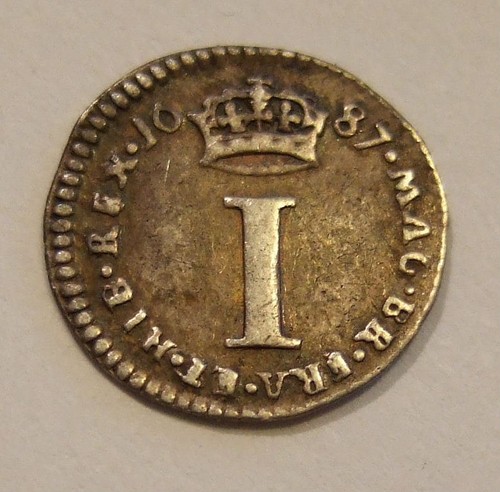
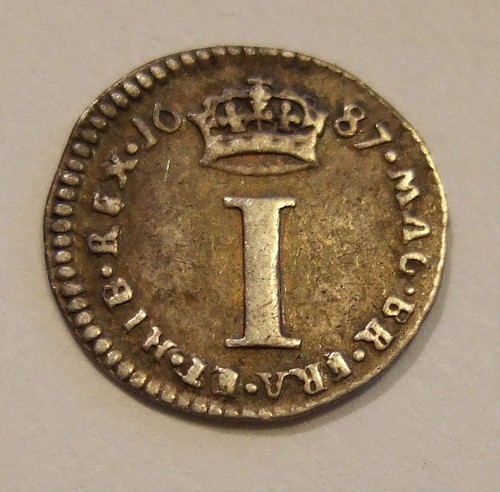
Obverse: a right- or left-facing crowned/laureate profile portrait of James II, surrounded by a Latin legend giving his name and titles. Reverse: a large Roman numeral III beneath a crown, with the date 1687 in the surrounding legend. The numeral is the key diagnostic — I marks a penny, II a twopence, III a threepence and IIII/IV a fourpence.
The coin is sterling silver, small in diameter, and light in weight (well under 2 grams). Genuine early milled examples show hand-engraved detail, even edges from the mill, and honest wear consistent with age. Because the four denominations share the same portrait and layout, always confirm the numeral before attributing a piece as a threepence.
Value & Collectibility
Value depends heavily on the reign, date, grade and whether a coin survives as part of a complete Maundy set. As a single early piece, a genuine 1687 James II threepence is a scarcer, several-centuries-old silver coin and typically carries a modest-to-moderate collector premium over its silver content, rising sharply for sharp, problem-free examples.
Worn, cleaned, holed or damaged examples sell for much less, while original complete Maundy sets and high-grade single coins command the strongest prices. Because condition and originality drive the market, treat any single figure with caution and compare recent auction results for the exact reign and grade rather than relying on a fixed catalogue number.
Frequently asked questions
Is the Maundy threepence real silver?
Yes. British Maundy small silver, including the James II threepence shown, is struck in sterling silver. It is a genuine precious-metal coin, though its very small size means the silver content is modest.
How do I tell a threepence from the other Maundy coins?
Read the Roman numeral on the reverse: I is a penny, II a twopence, III a threepence and IIII/IV a fourpence. All four share the same portrait and crowned layout, so the numeral is the reliable way to identify the value.
What does the 1687 date mean?
1687 is the year the coin was struck, during the short reign of James II (1685–1688). Because his reign was brief, coins dated within it are relatively scarce compared with those of longer-reigning monarchs.
Was this coin only used for the Maundy ceremony?
Not strictly in the 17th century. At that time the same small silver pieces could circulate as ordinary change and also be given as Maundy gifts. The four denominations only became reserved almost exclusively for the Royal Maundy ceremony in later centuries.
Maundy Money Threepence guides
In-depth guides for identifying, valuing, and collecting Maundy Money Threepence.