Liberty Head Nickel
U.S. five-cent piece struck 1883–1912, showing a left-facing Liberty head ringed by stars, with a Roman-numeral "V" reverse; the 1913 issue is a legendary rarity.
- Country
- United States
- Denomination
- 5 Cents
- Metal
- Copper-Nickel
Got a coin like this?
Identify any coin from a photo, free.
Overview
The Liberty Head Nickel is a United States five-cent coin produced by the U.S. Mint from 1883 through 1912, with a tiny, unauthorized number of coins famously dated 1913. Its obverse shows a left-facing head of Liberty crowned with a coronet reading "LIBERTY," encircled by thirteen stars and the date below. Because the reverse denomination is expressed as the Roman numeral "V," collectors commonly call it the "V Nickel."
Like other U.S. nickels, it is struck in a copper-nickel alloy (about 75% copper and 25% nickel), measures roughly 21.2 mm across, and weighs about 5 grams with a plain edge. The example shown here is dated 1913 — the year associated with the series' most storied rarity.
History & Background
The Liberty Head Nickel was designed by U.S. Mint Chief Engraver Charles E. Barber and introduced in 1883 to replace the Shield nickel. The first 1883 coins showed only the large "V" on the reverse with no word "CENTS." Because the size and Liberty-head design resembled the five-dollar gold piece, some were gold-plated and passed as five dollars. The Mint responded the same year by adding the word "CENTS" beneath the wreath, creating the two well-known 1883 varieties: "No CENTS" and "With CENTS."
The design ran through 1912, when the Denver and San Francisco mints struck five-cent pieces for the first time, adding the small "D" or "S" mint mark. In 1913 the series was replaced by the Buffalo (Indian Head) nickel. Only five 1913 Liberty Head Nickels are known to exist; they were produced outside official channels and were never an authorized issue, which is why a genuine 1913 is one of the most celebrated rarities in American numismatics.
How to Identify
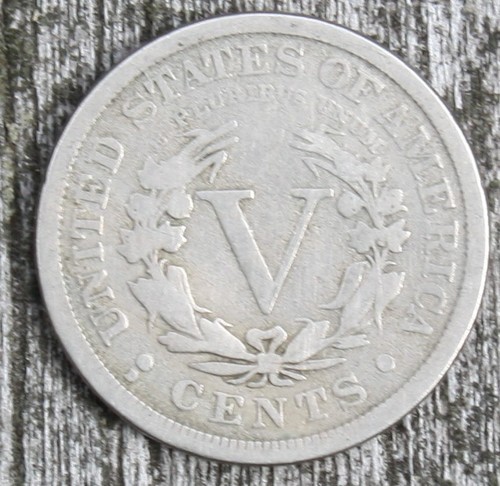
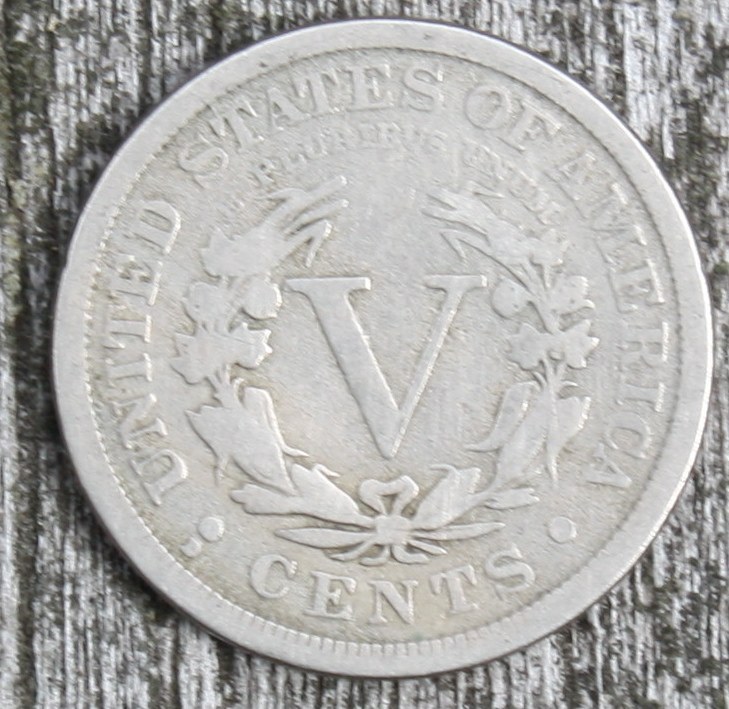
The obverse shows a left-facing head of Liberty wearing a coronet lettered "LIBERTY," surrounded by thirteen stars with the date at the bottom — the coin here reads 1913. The reverse (not pictured on this example) displays a large Roman numeral "V" within a wreath of corn, wheat, and cotton, with "UNITED STATES OF AMERICA" and "E PLURIBUS UNUM" around it, and the word "CENTS" below on all issues from late 1883 onward.
The coin is about 21.2 mm in diameter with a plain (smooth) edge and weighs roughly 5 grams in copper-nickel, giving it a pale silvery-gray look. Mint marks, when present, appear on the reverse to the left of the word "CENTS"; only 1912 coins carry a "D" or "S," while every other date, including all Philadelphia strikes, has no mint mark.
Value & Collectibility
Common-date Liberty Head Nickels in worn condition are inexpensive and widely available, with prices climbing steadily for coins that retain full "LIBERTY" lettering and sharp detail, and much higher for uncirculated pieces. Condition, strike quality, and eye appeal drive most of the value for ordinary dates.
Certain issues command strong premiums: the 1883 "No CENTS" variety is a popular first-year type, and the 1885, 1886, and 1912-S are recognized scarcities. The 1913 Liberty Head Nickel is in a class entirely its own — with only five known examples, genuine specimens have sold for well into the millions of dollars, making authentication essential. Because of that fame, most 1913-dated Liberty Head Nickels encountered in everyday circulation are replicas, novelty pieces, or altered coins rather than one of the five originals.
Frequently asked questions
Why is it called a "V Nickel"?
The reverse shows the denomination as the Roman numeral "V" (five) inside a wreath, so collectors nicknamed it the "V Nickel." The obverse portrait of Liberty gives it the formal name Liberty Head Nickel.
What is a Liberty Head Nickel made of?
It is struck in a copper-nickel alloy, about 75% copper and 25% nickel, weighing roughly 5 grams and measuring about 21.2 mm across with a plain edge.
Is a 1913 Liberty Head Nickel really worth millions?
Only five genuine 1913 examples are known, and they are among the most valuable U.S. coins, selling for millions. However, most 1913-dated pieces people find are replicas or altered coins, not one of the five originals.
Where is the mint mark on a Liberty Head Nickel?
Mint marks appear only on 1912 coins, as a small "D" or "S" on the reverse to the left of the word "CENTS." All other dates were struck at Philadelphia and have no mint mark.
What are the two 1883 varieties?
The first 1883 coins have no word "CENTS" below the "V"; the Mint then added "CENTS" to prevent the coins being gold-plated and passed as five dollars, creating the "No CENTS" and "With CENTS" types.
Liberty Head Nickel guides
In-depth guides for identifying, valuing, and collecting Liberty Head Nickel.