
How to Identify the Liberty Head Nickel
How to spot the coronet Liberty head, ringed stars, Roman-numeral "V" reverse, copper-nickel look, the 1912-only mint marks, and 1913 fakes to watch for.
Read the full Liberty Head Nickel encyclopedia entry →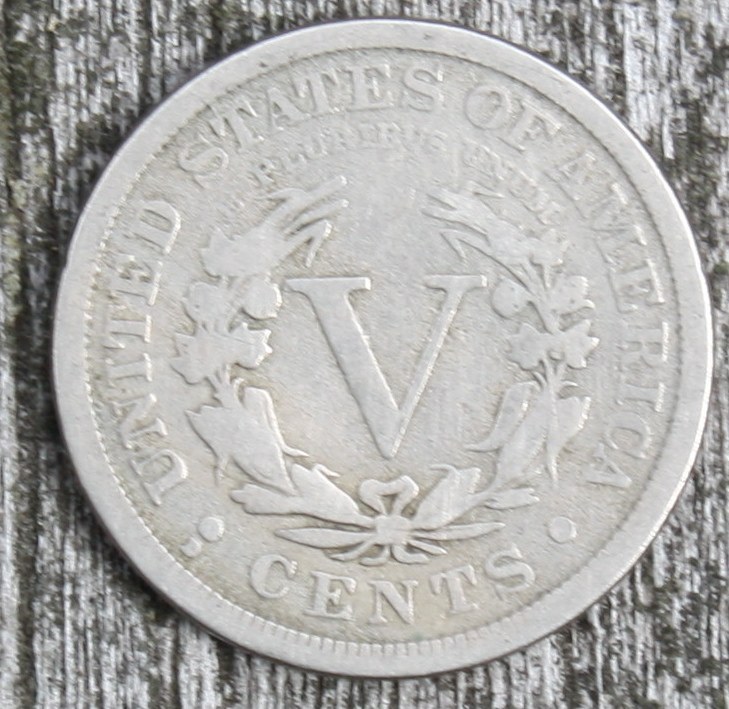
Start With the Obverse
Look for a left-facing head of Liberty wearing a coronet with the word "LIBERTY" across it, encircled by thirteen stars, with the four-digit date at the bottom — the example here reads 1913. The legibility of "LIBERTY" on the coronet is a standard wear indicator: sharp, fully readable lettering points to a higher grade, while heavily worn coins lose those letters. This coronet portrait separates the coin from the earlier Shield nickel, which has no head at all.
Check the Reverse "V"
The reverse carries a large Roman numeral "V" inside a wreath of corn, cotton, and wheat, with "UNITED STATES OF AMERICA" and "E PLURIBUS UNUM" around the rim. Confirm whether the word "CENTS" appears below the wreath: its absence marks the scarce first-type 1883 "No CENTS" coin, while all later dates add "CENTS." On the pictured coin the reverse is not shown, so the date and obverse are the primary diagnostics here.
Confirm Size, Metal, and Edge
The Liberty Head Nickel is about 21.2 mm in diameter, weighs roughly 5 grams, and has a plain, smooth edge. It is struck in copper-nickel (about 75% copper, 25% nickel), giving a pale silvery-gray color rather than the yellow of brass or the bright white of silver. These figures match every U.S. five-cent nickel of the era, so use them to rule out foreign look-alikes and plated novelty pieces.
Find the Mint Mark
Mint marks are limited: only 1912 coins bear a small "D" (Denver) or "S" (San Francisco) on the reverse, to the left of the word "CENTS." Every other date — including the entire run from 1883 to 1911 — was struck in Philadelphia with no mint mark. The 1912-S is a recognized key, so an "S" on a genuine coin deserves a careful second look.
Beware the 1913 and Altered Coins
A date of 1913 is the biggest caution flag in the series. Only five authentic 1913 Liberty Head Nickels exist, all accounted for, so any 1913 found loose is almost certainly a replica, a novelty strike, or a coin with an altered date (often a genuine 1910 or 1912 re-cut). The same caution applies to added mint marks on 1912 coins. For any piece that appears valuable, compare it against trusted reference images and submit it to a reputable third-party grading service rather than relying on the date alone.
Frequently asked questions
How do I tell a Liberty Head Nickel from a Buffalo nickel?
The Liberty Head Nickel shows a coronet head of Liberty with stars and a Roman-numeral "V" reverse. The Buffalo nickel that replaced it in 1913 shows a Native American profile and a bison, so the designs are entirely different despite the same size and metal.
My coin is dated 1913 — is it one of the famous rarities?
Almost certainly not. Only five genuine 1913 Liberty Head Nickels are known and all are documented. A 1913 found in change or a collection is far more likely a replica or an altered date, so have it authenticated before assuming any value.
How can I check for the 1883 "No CENTS" variety?
Look at the reverse below the "V": if there is no word "CENTS," it is the early 1883 type. If "CENTS" appears beneath the wreath, it is the later 1883 issue or a subsequent date.
Should I clean a Liberty Head Nickel?
No. Cleaning scratches and dulls the surface and reduces collector value. Examine the coin under good light and magnification, and leave any conservation to professionals.