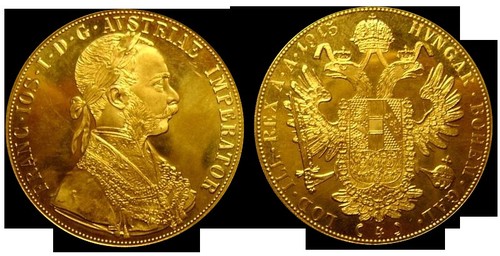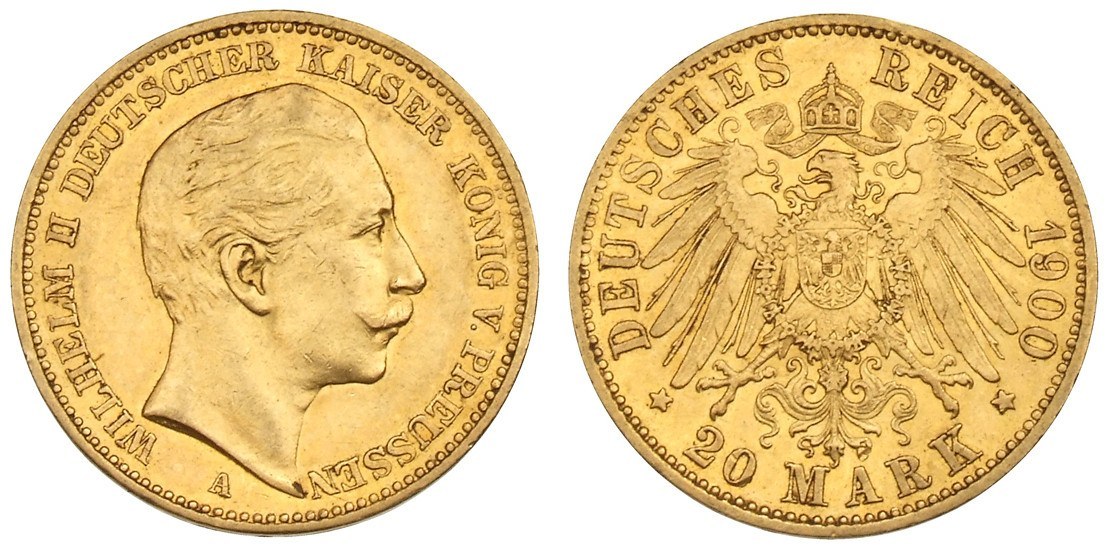
German 20 Mark Gold
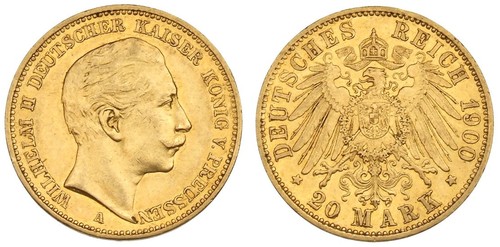
German Empire gold 20 mark of Prussia, with Kaiser Wilhelm I's bust and the imperial eagle; a small .900 gold coin from the pre-WWI Goldmark era.
- Country
- Germany (Prussia)
- Denomination
- 20 Mark
- Metal
- Gold
Got a coin like this?
Identify any coin from a photo, free.
Overview
The German 20 Mark is a small gold coin of the German Empire (Kaiserreich), struck in the standard .900 fine gold used across the empire's gold denominations. The example shown is a Prussian issue dated 1900, carrying the right-facing bust of Kaiser Wilhelm I on the obverse and the German imperial eagle with a shield and the value on the reverse.
Though the empire shared a single Goldmark currency, its member states each struck coins bearing their own ruler. This piece is therefore a Prussian 20 mark within the wider imperial coinage — a widely collected and traded type prized both for its historical interest and its gold content. It weighs roughly 7.96 grams with about 0.2305 troy ounces of pure gold, making it a compact fractional gold coin.
Because many millions were struck across the empire's states between 1871 and 1915, the 20 mark is one of the most familiar pre-WWI German gold coins and trades today largely as a semi-numismatic bullion piece.
History & Background
After German unification in 1871, the new empire replaced the varied currencies of its states with a single gold-standard mark. Gold 5, 10 and 20 mark coins were introduced, with the 20 mark as the largest circulating gold denomination for general commerce. Each constituent state — Prussia, Bavaria, Saxony, the Hanseatic cities and others — struck coins to a common weight and fineness but with its own portrait and legend.
This Prussian coin depicts Wilhelm I, King of Prussia and first German Emperor (reigned as emperor 1871–1888). Prussian issues bearing his bust were struck in the 1870s and 1880s; portrait coins dated after his 1888 death, or a 1900 Prussian 20 mark, would carry his successor Wilhelm II, so the year and portrait should always be read together to confirm which Kaiser is shown. Whichever ruler appears, the reverse eagle marks it as imperial German gold.
Production of gold mark coins effectively ended with the outbreak of the First World War in 1914–1915, when Germany suspended the gold standard. Large numbers survived in bank and private holdings, which is why the type remains common in the market today.
How to Identify
Obverse: a profile bust of the Kaiser facing right — here identified as Wilhelm I — surrounded by a legend giving the ruler's name and titles (typically DEUTSCHER KAISER KOENIG V. PREUSSEN for Prussian issues), with the date below.
Reverse: the German imperial eagle bearing a crowned shield on its breast, encircled by the legend DEUTSCHES REICH and the denomination 20 MARK. A small mint mark letter (for Prussia usually A for Berlin) appears in the legend and identifies the striking mint.
Physical clues: the coin is small — about 22.5 mm across and roughly 7.96 g — struck in .900 gold with a reeded edge, giving a rich yellow-gold color. Confirm the type by the pairing of a right-facing imperial bust with the DEUTSCHES REICH eagle and the 20 MARK value.
Value & Collectibility
The German 20 mark trades mainly on its gold content — about 0.2305 troy ounces of pure gold — so its base value tracks the gold spot price, with common dates and rulers selling at a modest premium over melt. As a heavily minted type, most ordinary examples are valued as semi-numismatic bullion rather than rarities.
Premiums rise for better-preserved (uncirculated) coins, for scarcer states, dates and mint marks, and for early Wilhelm I Prussian issues, which can command more than common Wilhelm II coins. Rare state issues or top-grade certified examples can be worth multiples of their gold value to collectors.
Because prices move with the gold market and with the specific state, date, mint mark and grade, treat any single figure as approximate. Check the current gold price and recent sales of comparable German 20 mark coins before buying or selling.
Frequently asked questions
What metal is the German 20 mark made of?
It is struck in .900 fine gold. A 20 mark weighs about 7.96 grams and contains roughly 0.2305 troy ounces of pure gold, with the balance copper for durability.
Who is on the coin?
This Prussian issue shows a right-facing imperial bust — here Kaiser Wilhelm I. Prussian 20 marks may instead depict Wilhelm II depending on the date, so read the portrait and year together.
Why does it say Prussia if it is a German coin?
The German Empire used one Goldmark currency, but each member state struck its own coins with its ruler's portrait. This is a Prussian 20 mark within the shared imperial coinage.
Is the German 20 mark gold valuable?
Yes, chiefly for its gold content. Common dates trade near melt plus a small premium, while scarce states, dates, mint marks and high grades can bring significant collector premiums.
How big is the coin?
It is small, about 22.5 mm in diameter and roughly 7.96 grams, with a reeded edge — a compact fractional gold coin rather than a large medal-sized piece.
German 20 Mark Gold guides
In-depth guides for identifying, valuing, and collecting German 20 Mark Gold.