
How to Identify the German 20 Mark Gold
A collector's guide to recognizing the German Empire 20 mark by its imperial bust, DEUTSCHES REICH eagle, gold color, size and mint mark.
Read the full German 20 Mark Gold encyclopedia entry →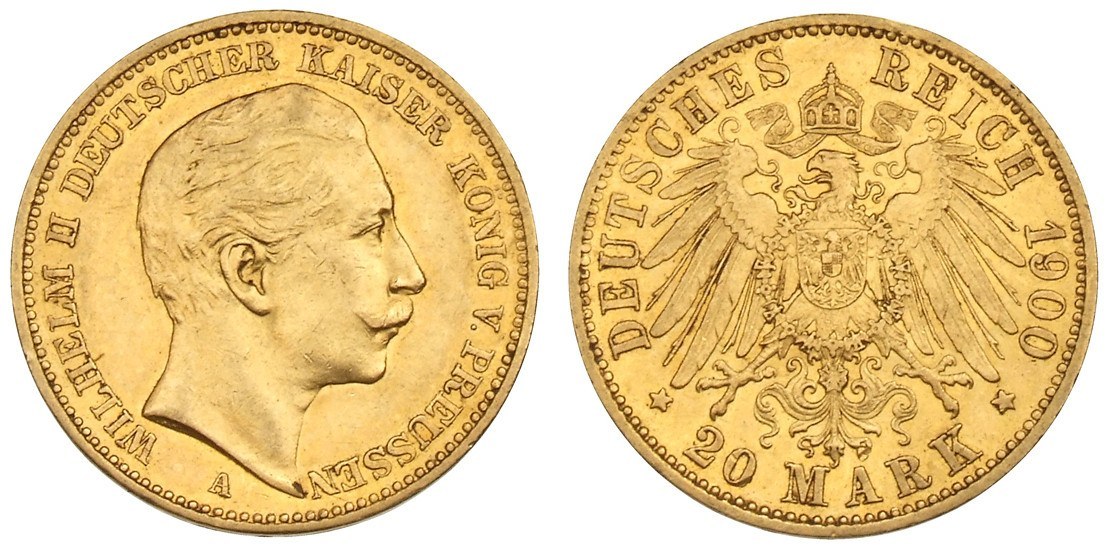
Confirm the denomination and empire first. The reverse should read DEUTSCHES REICH around the imperial eagle and clearly state the value 20 MARK. That legend, not the ruler's portrait, is what marks the coin as German Empire gold, since every member state used the same reverse and currency. If you see 5 or 10 MARK instead, it is a smaller gold denomination of the same family.
Read the obverse portrait and the state legend together. A right-facing bust with a Prussian legend (DEUTSCHER KAISER KOENIG V. PREUSSEN) identifies a Prussian issue. Match the portrait to the date: Wilhelm I appears on Prussian coins of the 1870s–1880s, while coins dated around 1888 onward — including 1900 — normally show Wilhelm II. Other states (Bavaria, Saxony, Baden, the Hanseatic cities) show different rulers or arms, so the obverse tells you which state struck it.
Find the mint mark. A single letter in the reverse legend names the mint — A is Berlin (Prussia's mint), with other letters such as D, E, F, G and J used by other cities. On a Prussian coin you should generally expect A. The mint letter, combined with the state and date, pins down the exact issue and matters for cataloguing and value.
Check size, weight and metal. A genuine 20 mark is small — about 22.5 mm and 7.96 g in .900 gold with a reeded edge — and has a warm yellow-gold tone. Weighing and measuring is one of the best quick authenticity checks: gold-plated base-metal fakes or wrong-size copies will miss the correct mass or diameter. The 20 mark is roughly twice the size and weight of the 10 mark, which helps separate the two.
Watch for look-alikes and fakes. Because the type is popular, counterfeits and modern replicas exist, including cast copies and coins with altered dates or mint marks to fake a rarity. Compare lettering sharpness, eagle detail and edge reeding against reference images of the same state and date, and for any coin bought as a rarity or for its gold value, prefer examples verified by weight, dimensions or third-party certification.
Frequently asked questions
What is the fastest way to confirm this is a German 20 mark?
Look for DEUTSCHES REICH around the imperial eagle with the value 20 MARK on the reverse, paired with a right-facing imperial bust on the obverse. That combination defines the type.
How do I tell which Kaiser is on a Prussian coin?
Read the portrait with the date. Wilhelm I appears on Prussian issues of the 1870s–1880s; coins dated from about 1888 on, such as 1900, normally show Wilhelm II.
Where is the mint mark and what does it mean?
It is a single letter in the reverse legend. A is Berlin (Prussia); other letters mark other imperial mints. It identifies where the coin was struck and helps confirm the issue.
How can I check it is real gold and not a fake?
Verify size and weight — about 22.5 mm and 7.96 g in .900 gold with a reeded edge. Wrong mass or diameter, mushy detail or altered dates are warning signs; certify valuable pieces.