French 40 Francs Gold (Napoleon I)
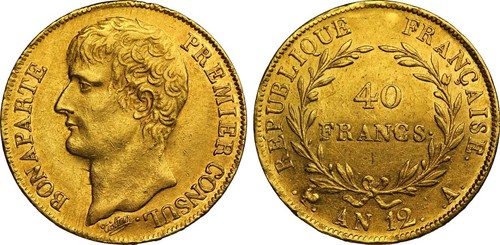
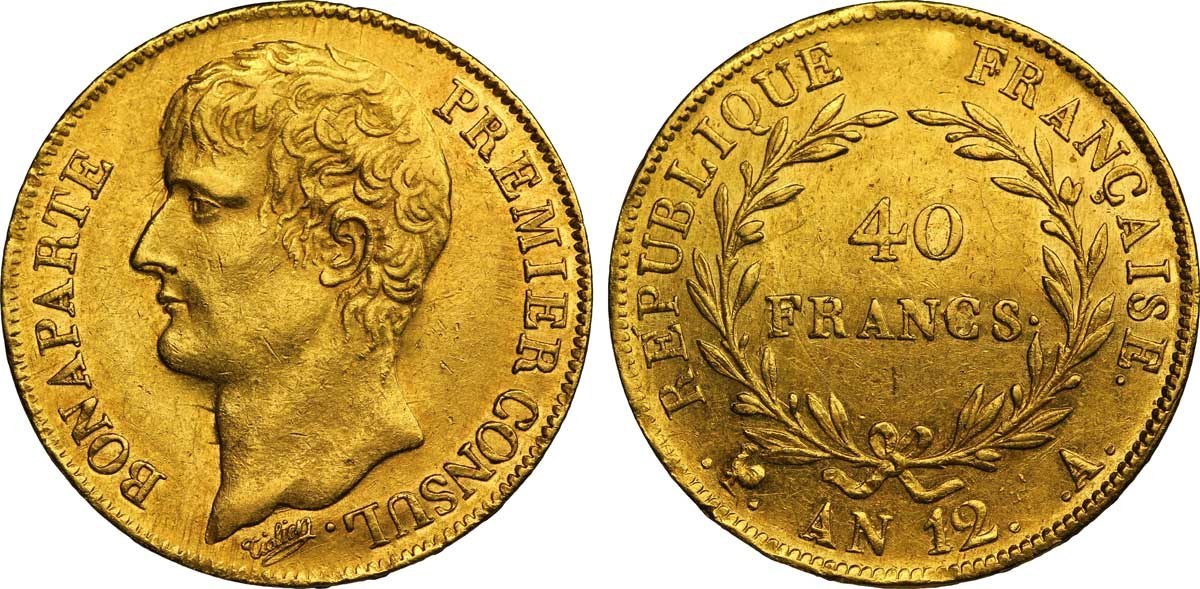
A large early French gold coin showing Napoleon Bonaparte's left-facing profile and a wreathed reverse, struck in the opening years of his rule.
- Country
- France
- Denomination
- 40 Francs
- Metal
- Gold
Got a coin like this?
Identify any coin from a photo, free.
Overview
The French 40 Francs Gold of Napoleon I is a substantial gold coin from the early years of the modern French franc system. The example shown carries the left profile of Napoleon Bonaparte on the obverse and a laurel wreath enclosing the 40 FRANCS value on the reverse, dated 1804.
The 40 francs was the largest of the everyday gold denominations of its day, worth twice the more common 20 francs. Struck in gold of roughly 90% fineness, it was a serious store of value and a coin of commerce for the wealthy rather than pocket change. Its size, weight and portrait make it a centerpiece of any collection of Napoleonic or early-19th-century French coinage.
As a period gold piece it is valued both for the bullion it contains and for its historical association with Napoleon, whose changing titles across these years are reflected in the coin's legends.
History & Background
France reformed its money in 1803 (An 11), establishing the franc germinal on a fixed gold-and-silver standard. The 40 francs and 20 francs gold coins were created under this reform, giving the new franc a high-value gold expression. Coins of this earliest phase carry Napoleon's portrait as First Consul or as the newly proclaimed Emperor.
The year 1804 was the pivot point: Napoleon was proclaimed Emperor in that year, and coins of the period show his bare-headed profile with legends that shift from BONAPARTE PREMIER CONSUL to NAPOLEON EMPEREUR, while the reverse still named the RÉPUBLIQUE FRANÇAISE before it later changed to EMPIRE FRANÇAIS. Dates of this era often appear in the revolutionary calendar (An 12, An 13) as well as, or instead of, the Gregorian year.
The 40 francs denomination continued under later French regimes, but the Napoleon I portrait types of the Consulate and First Empire are the original issues that established it. They were struck at several French mints, each identified by a small mint mark, and production of the largest gold denomination was always smaller than that of the workhorse 20 francs.
How to Identify
Obverse: the bare, left-facing profile of Napoleon Bonaparte, surrounded by a legend naming him — as First Consul (BONAPARTE PREMIER CONSUL) or as Emperor (NAPOLEON EMPEREUR) depending on the exact issue — with the engraver's name below the neck.
Reverse: the value 40 FRANCS within a laurel wreath, with the state legend (RÉPUBLIQUE FRANÇAISE or EMPIRE FRANÇAIS) around the rim and the date, which may be given as a calendar year such as 1804 and/or a revolutionary An year. A small mint mark letter and privy marks sit at the base of the reverse, identifying the striking mint.
Size and metal: a large gold coin, appreciably bigger and heavier than the 20 francs, struck in gold of about 90% fineness with the characteristic warm yellow tone. The eagle motif and wreath belong to the reverse composition; the coin's key identifiers are the Napoleon portrait, the 40 FRANCS value in the wreath, and the early date.
Value & Collectibility
The French 40 Francs Gold of Napoleon I is a genuine gold coin, so it always carries at least the value of its gold content, which is significant given the coin's size. Beyond bullion, the early Napoleon I portrait types command a numismatic premium as historically important and comparatively scarce issues.
Value varies widely with the exact type, mint, date and grade. Common later 40-franc types trade nearer their gold value, while the earliest Consulate and First Empire portraits — especially in higher grades or from scarcer mints — can be worth many multiples of melt. Wear, damage and any signs of cleaning or mounting reduce a coin's grade and price.
Because both gold prices and collector demand move over time, treat any single figure as indicative only. For a coin of this value, confirm the precise type and authenticity and compare recent auction results for the same date, mint and grade before buying or selling.
Frequently asked questions
Who is shown on the French 40 francs gold coin?
The obverse shows the left-facing profile of Napoleon Bonaparte, with a legend naming him either as First Consul or as Emperor depending on the exact year of issue.
How much gold does it contain?
It is struck in gold of roughly 90% fineness. As the largest common gold denomination of its era, it holds about twice the gold of the 20 francs, giving it a substantial bullion value.
Why do some dates look like 'An 12' instead of a normal year?
France used the revolutionary calendar in this period, so dates may appear as An 12 or An 13 alongside or instead of the Gregorian year such as 1804.
Is the 40 francs rarer than the 20 francs Napoleon?
Generally yes. The 40 francs was struck in smaller numbers than the workhorse 20 francs, and the early Napoleon I portrait types in particular are scarcer and more sought after.
Is this coin valuable?
Yes. It always holds its gold value, and the early Napoleon I types carry a collector premium on top, so many examples are worth well above melt depending on type, mint and grade.
French 40 Francs Gold (Napoleon I) guides
In-depth guides for identifying, valuing, and collecting French 40 Francs Gold (Napoleon I).