Austrian 4-fold Ducat
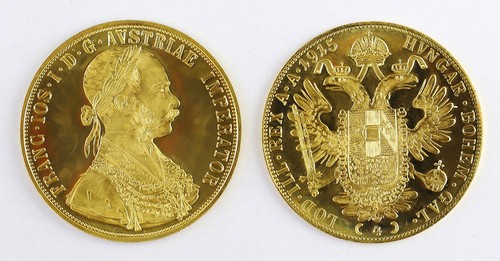
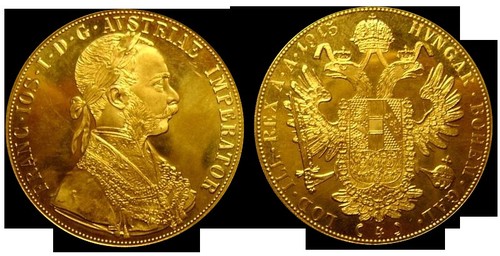
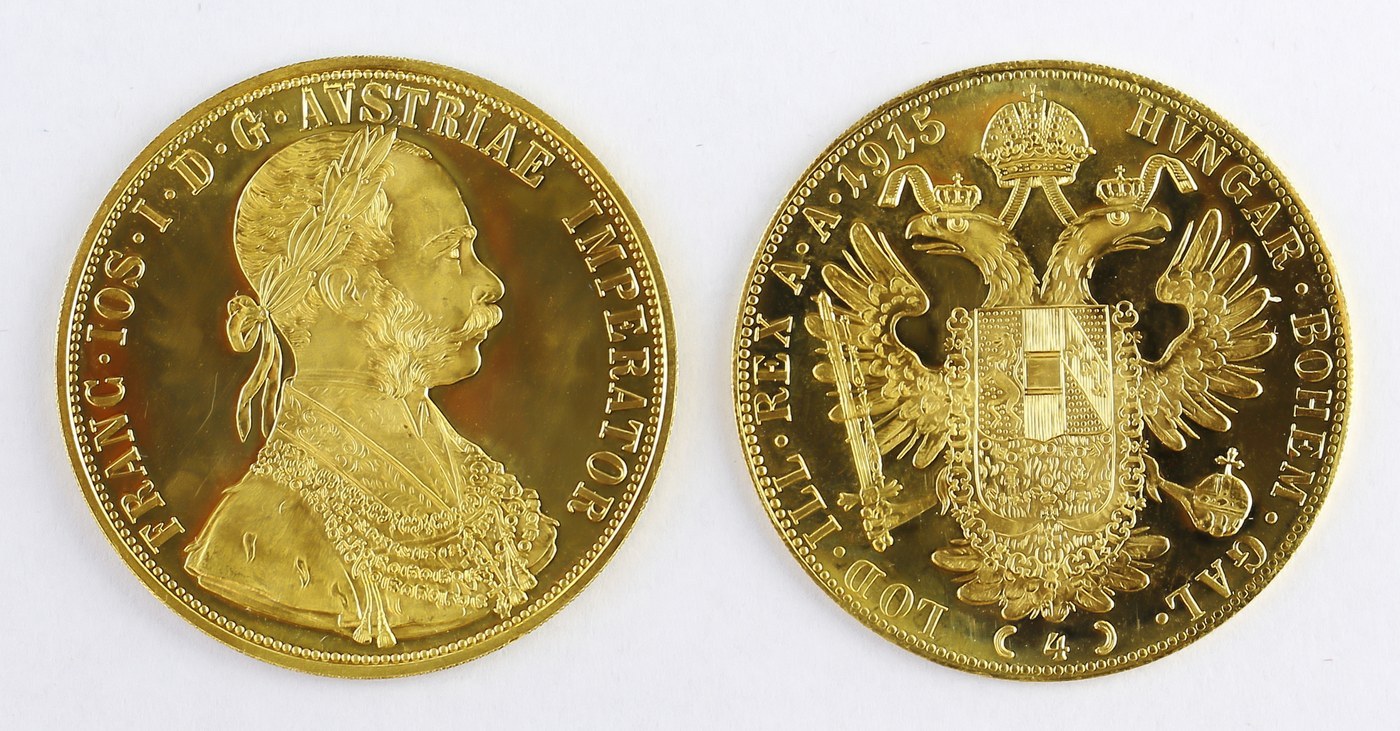
A large Austrian gold 4 Ducat dated 1915, showing Emperor Franz Joseph I in uniform and the crowned double-headed imperial eagle.
- Country
- Austria
- Denomination
- 4 Ducats
- Metal
- Gold
Got a coin like this?
Identify any coin from a photo, free.
Overview
The Austrian 4-fold Ducat is a large gold trade and bullion coin of the Austro-Hungarian monarchy, valued at 4 Ducats — four times the standard single ducat. The example shown is gold and dated 1915, bearing the likeness of Emperor Franz Joseph I.
The obverse presents a laureate bust of Franz Joseph I in military uniform with medals, encircled by a Latin titular legend. The reverse is dominated by the crowned double-headed imperial eagle bearing a detailed heraldic shield on its breast, with the value and date arranged around it. Because of its high purity and generous gold content, the 4 Ducat was prized as a bullion and gift piece rather than an everyday circulating coin.
History & Background
Franz Joseph I of the House of Habsburg reigned as Emperor of Austria from 1848 until his death in 1916, one of the longest reigns in European history. The ducat had been a staple of Central European trade coinage for centuries, struck to a high, internationally recognized gold fineness, and the Austrian mint issued both single and multiple-ducat pieces bearing his portrait.
The year 1915 is significant: after this date the Austrian mint continued to strike ducats — both single and 4 Ducat pieces — as official restrikes bearing the frozen 1915 date, long after the coins ceased to circulate. These restrikes were produced to meet ongoing demand for a trusted, high-purity gold bullion coin, in the same way Austria restruck the 1915-dated gold Corona pieces.
As a result the 1915 date does not by itself indicate the year of striking. The type stands as a memorial of the Habsburg empire's gold coinage tradition and remains one of the classic large gold pieces associated with Franz Joseph I.
How to Identify
Obverse: a bust of Emperor Franz Joseph I facing right, in military uniform with medals and a laurel wreath, framed by an abbreviated Latin legend giving his name and titles. The uniformed, decorated portrait is the key identifier for this ruler's later coinage.
Reverse: the crowned double-headed imperial eagle of Austria, wings spread, carrying a detailed heraldic coat of arms on its breast and clutching a sword, orb and sceptre. The denomination and the date 1915 appear around the design.
Physical clues: the 4 Ducat is a large, thin gold coin of high fineness (the ducat standard is roughly .986 fine), noticeably broader than the common single ducat but struck on a thin flan. Confirm the uniformed Franz Joseph portrait, the double-headed eagle, and the 4 Ducat value together — the combination, not any single element, secures the attribution.
Value & Collectibility
As a high-purity gold piece containing roughly four ducats' worth of gold (about half a troy ounce of fine gold), the 4 Ducat carries substantial intrinsic bullion value, and its price tracks the gold market closely. Official 1915-dated restrikes are relatively available, so most trade at a modest premium over their gold content.
Genuine period-struck (pre-restrike) examples, pieces in exceptional condition, or those with proof-like surfaces can command higher premiums among collectors. Because the same 1915 date covers both original and restruck coins, and because large gold coins are frequently counterfeited, compare recent dealer and auction prices for matching examples and rely on weight, dimensions, and specialist authentication rather than the date alone.
Frequently asked questions
What is an Austrian 4-fold Ducat?
It is a large Austrian gold coin valued at 4 Ducats, four times the standard single ducat. The example shown is dated 1915 and bears Emperor Franz Joseph I on the obverse and the imperial eagle on the reverse.
Who is shown on the coin?
The obverse portrait is Emperor Franz Joseph I of Austria, depicted in military uniform with medals and a laurel wreath, surrounded by his name and titles in an abbreviated Latin legend.
Does the 1915 date mean it was made in 1915?
Not necessarily. The Austrian mint restruck 4 Ducat coins with the frozen 1915 date for many years afterward as bullion pieces, so the date reflects the type rather than the exact year of striking.
How much gold does it contain?
The 4 Ducat is struck in high-fineness gold (about .986) and contains roughly four ducats of gold, close to half a troy ounce, which sets its baseline bullion value.
Is it valuable?
Its gold content gives it a solid intrinsic value, and original strikes or high-grade examples can bring collector premiums. Because large gold coins are often faked, have valuable examples authenticated.
Austrian 4-fold Ducat guides
In-depth guides for identifying, valuing, and collecting Austrian 4-fold Ducat.