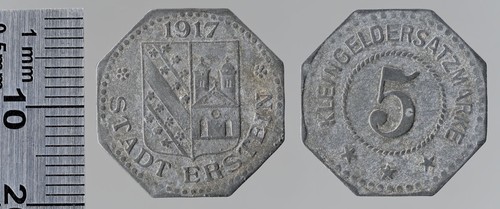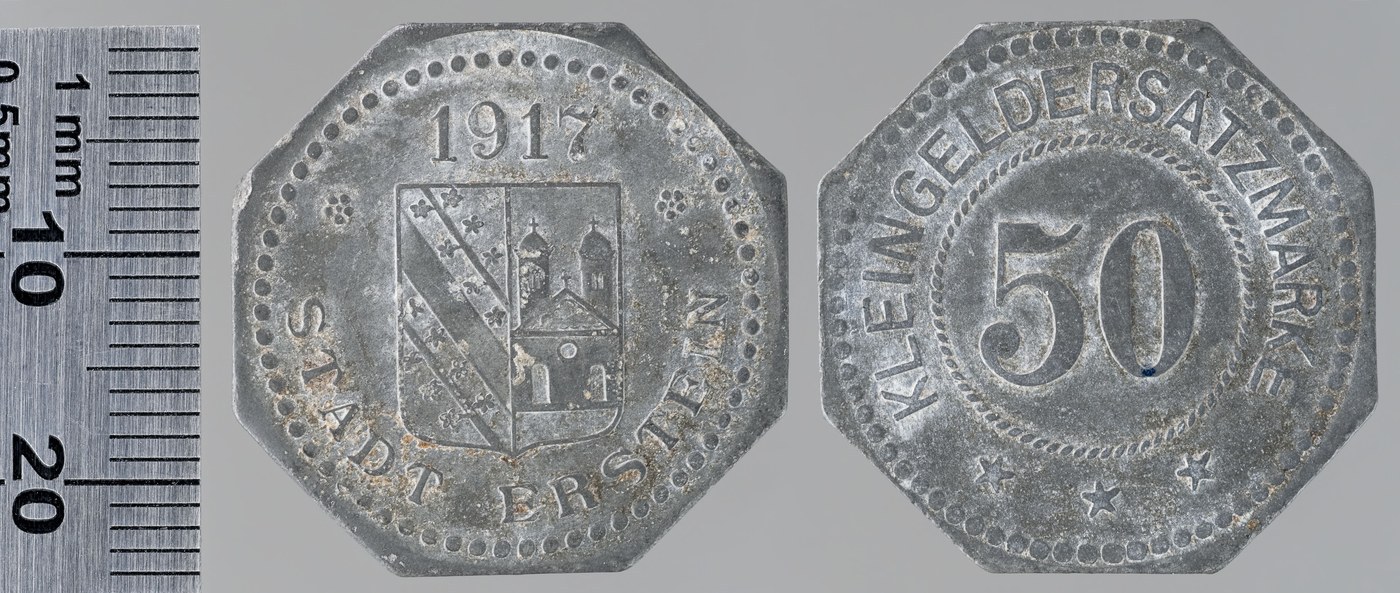
Erstein Notgeld 50 Pfennigs
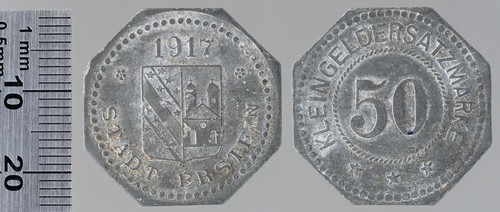
A 1917 German emergency-money token for 50 Pfennigs from Erstein in Alsace, with the town coat of arms on the obverse and a large 50 on the reverse.
- Country
- Germany
- Denomination
- 50 Pfennigs
- Metal
- Zinc-iron
Got a coin like this?
Identify any coin from a photo, free.
Overview
The Erstein Notgeld 50 Pfennigs is a local emergency-money token issued in 1917 by the town of Erstein, then part of the German imperial territory of Alsace-Lorraine (Elsass-Lothringen). Notgeld — literally "emergency money" — was small change produced by towns, districts, and companies to replace official coins that had vanished from circulation during the First World War.
The piece shown carries the Erstein town coat of arms and lettering on the obverse and a large denomination numeral 50 on the reverse. It is a base-metal token, described here as zinc-iron, made to serve as everyday small change within the local area rather than as a national coin of the German Empire.
History & Background
During the First World War, Germany's official small-denomination coins — struck in copper, nickel, and silver — disappeared from circulation as metal was diverted to the war effort and as people hoarded coins for their intrinsic value. To keep local commerce functioning, hundreds of towns, cities, districts, and businesses issued their own emergency small change, collectively known as Kriegsnotgeld (wartime emergency money).
Erstein, a town in Lower Alsace south of Strasbourg, was part of the German Empire from 1871 until the end of the war in 1918, when Alsace-Lorraine returned to France. Its 1917-dated 50 Pfennig token belongs to this wartime wave of municipal issues. Such pieces were typically struck in whatever inexpensive metal was available — zinc, iron, aluminum, or alloys of them — because precious and strategic metals were reserved for military use.
Metal Notgeld like this was intended to circulate locally and, in principle, to be redeemed by the issuing authority. After the war and the transfer of Alsace back to France, these German-era tokens ceased to be current money and passed into the hands of collectors, for whom Alsatian Notgeld is a distinct and popular specialty.
How to Identify
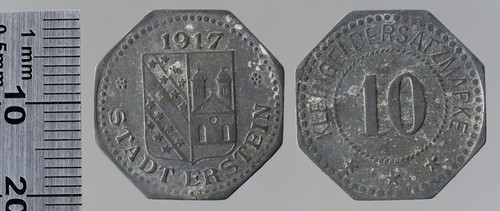
Obverse: the coat of arms of the town of Erstein together with lettering identifying the issuing town. Municipal Notgeld normally names the town and may include wording such as Stadt (town) or the value.
Reverse: a large numeral 50 as the central design, denoting the 50-Pfennig value, usually accompanied by the word Pfennig and the date 1917.
Physical clues: a small base-metal token of zinc-iron appearance — grayish, relatively light, and often magnetic if iron is present. Wartime emergency tokens are frequently a little crude compared with regular imperial coinage, with simple lettering and heraldry. The combination of a local coat of arms, a plain large value numeral, the date 1917, and a non-precious metal is characteristic of municipal Notgeld rather than a national coin of the German Empire.
Value & Collectibility
Erstein's 1917 50 Pfennig token is a collector item within the broad and well-catalogued field of German metal Notgeld. Values are generally modest, driven by condition, eye appeal, and demand for Alsatian (Elsass) issues, which some collectors seek specifically. Common base-metal Notgeld typically trades for small sums, while scarcer varieties, error strikes, or pieces in exceptional preservation can bring more.
Because many towns issued Notgeld in several metals, denominations, and minor die varieties, precise attribution matters to value. Consult a specialized German Notgeld catalogue (such as the standard references by Funck for metal war money) and compare recent sales of the same town and denomination in similar grade before assigning a price. Corrosion is common on zinc and iron tokens, so well-preserved, uncorroded examples command a premium.
Frequently asked questions
What is the Erstein Notgeld 50 Pfennigs?
It is a 1917 local emergency-money token for 50 Pfennigs issued by the town of Erstein in German-ruled Alsace, made to replace official coins that had disappeared during the First World War.
Is it an official German coin?
No. It is municipal Notgeld — emergency money issued locally by the town rather than the national mint. It was meant to circulate as small change within the area and to be redeemed by the issuer.
What is shown on it?
The obverse bears the Erstein town coat of arms and lettering, and the reverse shows a large numeral 50 for the 50-Pfennig value, with the date 1917.
What metal is it made of?
It is a base-metal token of zinc-iron character. Wartime Notgeld used inexpensive metals like zinc and iron because copper, nickel, and silver were reserved for the war effort.
Is it valuable?
Most base-metal Notgeld is inexpensive, but value depends on condition, variety, and collector demand for Alsatian issues. Well-preserved, uncorroded examples and scarcer varieties are worth more; check a Notgeld catalogue and recent sales.
Erstein Notgeld 50 Pfennigs guides
In-depth guides for identifying, valuing, and collecting Erstein Notgeld 50 Pfennigs.