
How to Identify the Erstein Notgeld 50 Pfennigs
Identify the 1917 Erstein 50 Pfennig token by its town coat of arms, large 50 reverse, zinc-iron base metal, and municipal Notgeld character.
Read the full Erstein Notgeld 50 Pfennigs encyclopedia entry →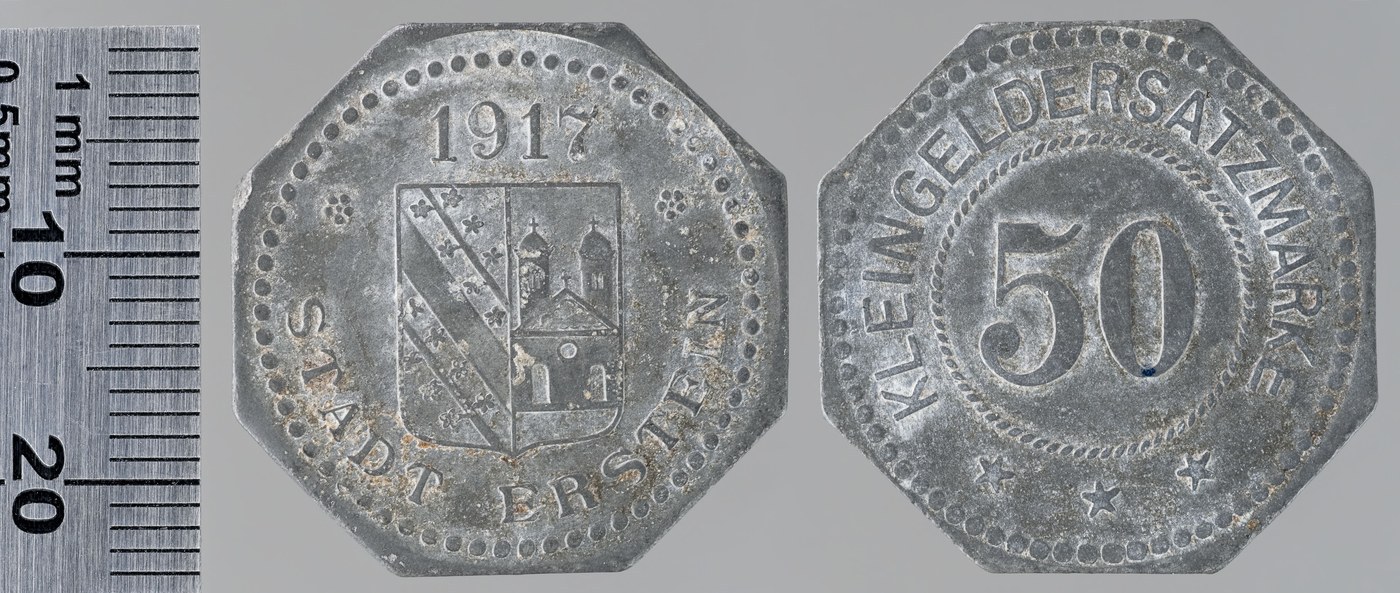
Start with the two faces. This type pairs a town coat of arms and lettering on the obverse with a large denomination numeral 50 on the reverse. That layout — civic heraldry on one side, a bold plain value figure on the other — is the classic look of municipal Notgeld and immediately separates it from a regular German Empire coin, which would show the imperial eagle and a denomination in a standardized national design.
Confirm the town and date. Read the obverse legend for the name Erstein and any word such as Stadt (town), and look for the reverse word Pfennig alongside the value and the date 1917. Because hundreds of towns issued near-identical large-numeral tokens, the town name is the key diagnostic — the coat of arms and legend together tie the piece specifically to Erstein rather than to another Alsatian or German town.
Check the metal and size. Expect a small base-metal token of zinc-iron appearance: grayish, comparatively light, and often magnetic if iron is present. A magnet test and a look for the dull gray tone or gray-to-white corrosion typical of zinc help confirm the composition. Genuine wartime tokens can look slightly crude, with simple lettering and heraldry, which is normal for emergency issues and not by itself a sign of a fake.
Watch for look-alikes. Many towns and companies produced 50 Pfennig metal Notgeld in 1917 with a comparable big-numeral reverse, so do not identify the piece by the value and date alone — always match the coat of arms and town name. Do not confuse it with paper Notgeld (issued in vast quantities and collected separately) or with official 50 Pfennig imperial coins, which carry national, not municipal, designs.
Authenticate with references. Attribute the exact issue using a specialized metal-Notgeld catalogue (for example the standard Funck listings), which record each town's denominations, metals, and die varieties. Confirm the metal, weight, and diameter against the catalogue entry; discrepancies can indicate a different variety or a modern reproduction. For anything offered as scarce, a second opinion and a check of recent sales of the same Erstein issue are worthwhile.
Frequently asked questions
How do I tell this from an official German 50 Pfennig coin?
Official imperial coinage shows national designs like the German eagle and standardized lettering. This token instead shows the Erstein town coat of arms and a large plain 50, marking it as local municipal Notgeld, not a national coin.
What single feature confirms it is from Erstein?
The town name in the obverse legend, together with the Erstein coat of arms. Many towns used a similar large-numeral reverse, so the town name and arms are what pin the piece to Erstein specifically.
How can I check the metal?
Look for a grayish, relatively light base-metal token. A magnet may attract it if iron is present, and zinc surfaces often show dull gray or white powdery corrosion. Match the weight and diameter to a Notgeld catalogue to confirm the composition.
Are reproductions a concern?
Common base-metal Notgeld is inexpensive, so casual fakes are less of an issue than with rare coins, but restrikes and copies exist. Verify the metal, weight, and diameter against a specialized catalogue, and get a second opinion on anything sold as scarce.