Bonn Notgeld 50 Pfennig
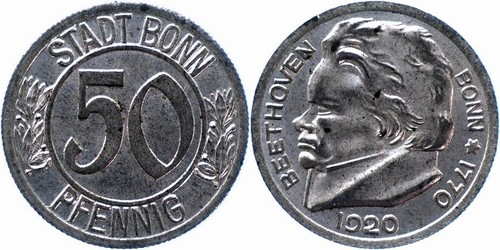
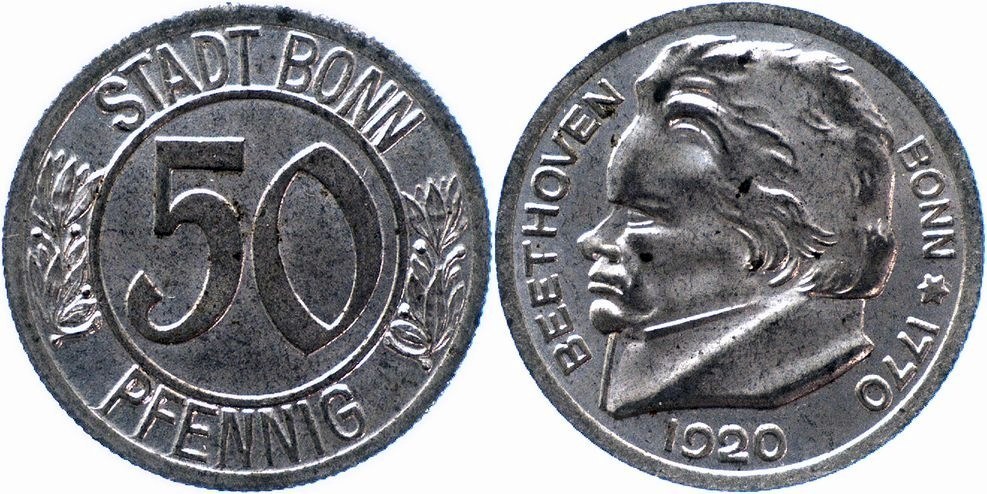
A German emergency-money (Notgeld) 50 Pfennig of the city of Bonn, dated 1920, with the civic arms on the obverse and a Beethoven profile on the reverse.
- Country
- Germany
- Denomination
- 50 Pfennig
- Metal
- Zinc-iron
Got a coin like this?
Identify any coin from a photo, free.
Overview
The Bonn Notgeld 50 Pfennig is a piece of German municipal emergency money (Notgeld) issued by the city of Bonn and dated 1920. It is a small base-metal token, here struck in zinc-iron, made to serve as small change during the coin shortages that followed the First World War.
The obverse carries the city coat of arms of Bonn framed by an ornamental border, marking the issuing authority. The reverse honors the city's most famous son with a profile portrait of the composer Ludwig van Beethoven, who was born in Bonn in 1770. The pairing of civic arms and local celebrity is typical of the way German towns personalized their Notgeld.
History & Background
Notgeld — literally "emergency money" — was issued across Germany during and after the First World War, when official small coinage disappeared from circulation as metal was hoarded or diverted. Towns, cities, districts, and even private firms produced their own tokens and paper notes to keep everyday commerce moving.
By 1920 the practice was widespread, and municipal metal Notgeld was commonly struck in cheap base metals such as zinc, iron, and aluminum because precious and even standard coinage metals were scarce and expensive. The city of Bonn issued such small-denomination pieces, including this 50 Pfennig, for local use.
Bonn's choice of a Beethoven portrait tied the coin directly to civic pride: Ludwig van Beethoven was born in Bonn in 1770, and the city has long celebrated the connection. Many German towns similarly featured local landmarks, coats of arms, legends, or famous figures on their Notgeld, which is a large part of why these pieces are so avidly collected today.
How to Identify
Obverse: the coat of arms of the city of Bonn set within an ornamental border. An inscription naming the city and the value (50 Pfennig) typically accompanies the arms.
Reverse: a profile portrait of Ludwig van Beethoven, the Bonn-born composer, usually with his name and the date 1920 in the surrounding design.
Physical clues: this is a small base-metal token struck in zinc-iron, not a precious-metal coin. Such pieces are lightweight, often gray in tone, and iron-content examples may respond to a magnet. Confirm the identification by matching all of the key features together — the Bonn arms, the Beethoven reverse, the 50 Pfennig value, and the 1920 date — rather than relying on any single element, since many German towns issued visually similar Notgeld.
Value & Collectibility
German metal Notgeld of this era is generally affordable and widely collected. Values depend on the specific town and type, the metal, die varieties, and above all condition, with sharp, well-preserved examples and scarcer varieties commanding a premium over common, worn pieces.
Because Notgeld was produced in great variety by thousands of issuers, catalog references (such as Funck for German metal Notgeld) are the best guide to a given piece's relative scarcity. Exact prices vary with grade and demand, so compare recent sales of the same Bonn Beethoven type rather than relying on a single quoted figure. Zinc and iron tokens can suffer corrosion, so eye appeal strongly influences value.
Frequently asked questions
What is Notgeld?
Notgeld is German "emergency money" — tokens and notes issued by towns, cities, and firms during and after the First World War to replace official small change that had vanished from circulation. This Bonn 50 Pfennig is a metal example dated 1920.
Why is Beethoven on the coin?
The composer Ludwig van Beethoven was born in Bonn in 1770, and the city celebrates him as its most famous son. Featuring his profile on the reverse was an expression of local civic pride, common practice on German Notgeld.
What is the coin made of?
This example is a base-metal token struck in zinc-iron. Municipal Notgeld of 1920 was commonly made from cheap metals such as zinc, iron, and aluminum because standard coinage metals were scarce.
Is it a real coin?
It is emergency money issued locally by the city of Bonn rather than a national coin of the German state, but it circulated as small change in and around the city. Collectors treat it as a token or Notgeld piece.
Is it valuable?
Most German metal Notgeld is affordable and widely collected. Value depends on the town, variety, metal, and condition, with crisp, well-preserved examples worth more. Compare recent sales of the same Bonn Beethoven type for a realistic figure.
Bonn Notgeld 50 Pfennig guides
In-depth guides for identifying, valuing, and collecting Bonn Notgeld 50 Pfennig.