
How to Identify the Bonn Notgeld 50 Pfennig
Identify Bonn's 1920 emergency 50 Pfennig by the civic arms in an ornamental border, the Beethoven profile reverse, and its small zinc-iron token module.
Read the full Bonn Notgeld 50 Pfennig encyclopedia entry →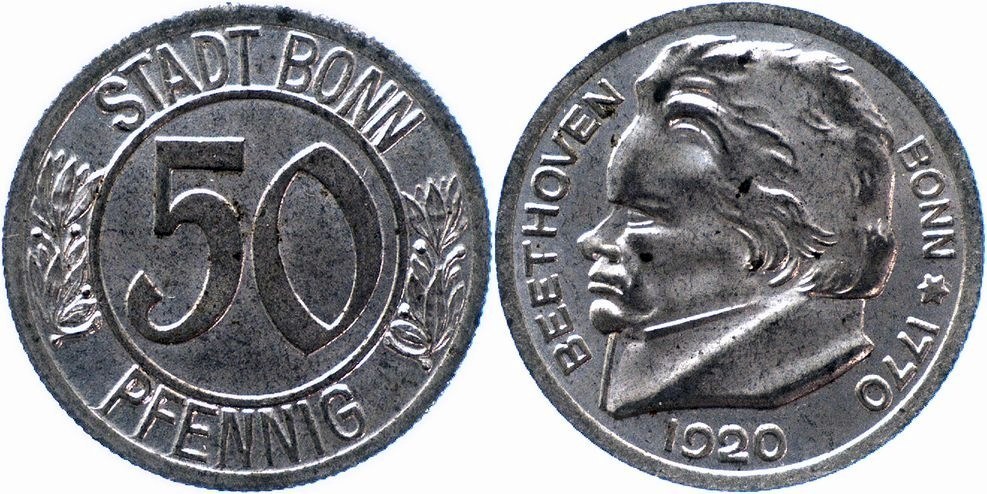
Read both sides together. The defining combination is the coat of arms of Bonn inside an ornamental border on the obverse and a profile portrait of Ludwig van Beethoven on the reverse. Look also for the value 50 Pfennig, the city name, and the 1920 date worked into the legends. Matching all of these confirms the type; any one alone is not enough, because many German towns issued similar arms-and-portrait Notgeld.
Check the metal and feel. This is a small base-metal token in zinc-iron, not silver or gold. Genuine pieces are lightweight and typically gray-toned; iron-bearing examples may be attracted to a magnet. Corrosion, pitting, or a whitish crust is common on zinc and iron and helps distinguish these tokens from modern shiny reproductions.
Confirm the denomination and issuer. The obverse should name Bonn and state 50 Pfennig. Notgeld denominations were often small change values — 5, 10, 25, 50 Pfennig — so read the number carefully and make sure the issuing city matches the arms shown.
Watch for look-alikes. Countless towns produced 1920-era metal Notgeld with local arms and portraits, so a piece with similar styling may belong to a different city entirely; always verify the Bonn arms and the Beethoven reverse specifically. Beethoven also appears on later commemorative medals and modern tokens, which are not this Notgeld — check for the 50 Pfennig value, the 1920 date, and the Bonn civic arms to rule those out.
Authenticate with catalogs. German metal Notgeld is documented in specialist references (for example the Funck catalog), which list issuers, metals, and varieties. Compare your piece's arms, portrait, legends, metal, and date against a catalog entry or recent sales images of the same Bonn type. Because values are modest, elaborate forgery is uncommon, but confirming the exact variety still helps with attribution and grading.
Frequently asked questions
How do I confirm this is a Bonn piece and not another town's Notgeld?
Check that the obverse shows the coat of arms of Bonn and names the city, and that the reverse carries the Beethoven profile. Many towns used arms-and-portrait designs, so verify the Bonn arms and the Beethoven reverse together with the 50 Pfennig value and 1920 date.
What metal is it and how can I test it?
It is a zinc-iron base-metal token. Such pieces are light and gray-toned, and iron content may respond to a magnet. Surface corrosion or pitting is common on zinc and iron and is normal for genuine Notgeld of this age.
How is this different from a Beethoven commemorative medal?
Commemorative medals usually carry no small-change denomination and often no issuing city arms. This is emergency money marked 50 Pfennig, dated 1920, and issued by the city of Bonn, which its face value and civic arms make clear.
Where can I look up the exact variety?
Specialist German Notgeld catalogs such as Funck list metal issues by town, metal, and variety. Match your coin's design, metal, and date to a catalog entry or to recent sales images of the same Bonn Beethoven type.