Erstein Notgeld 10 Pfennigs
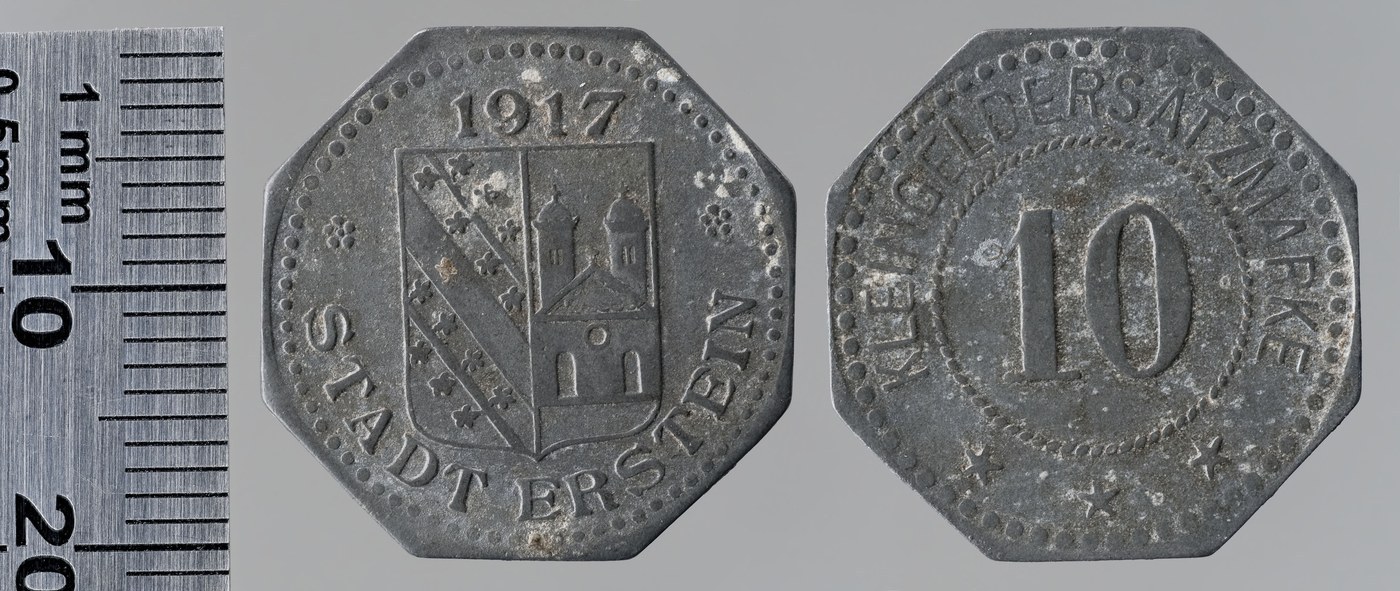
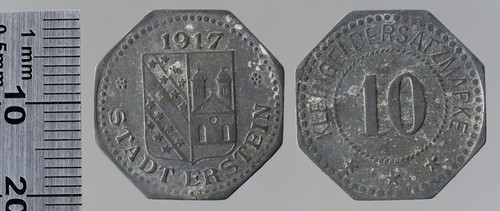
A 1917 German emergency coin (Notgeld) for 10 Pfennigs from the town of Erstein, with the city coat of arms on one side and a large 10 on the other.
- Country
- Germany
- Denomination
- 10 Pfennigs
- Metal
- Zinc-iron
Got a coin like this?
Identify any coin from a photo, free.
Overview
The Erstein Notgeld 10 Pfennigs is a piece of local emergency money (Notgeld) issued by the town of Erstein and dated 1917, during the First World War. It is struck in a zinc-iron base metal typical of wartime substitute coinage, when precious and even standard coinage metals were scarce.
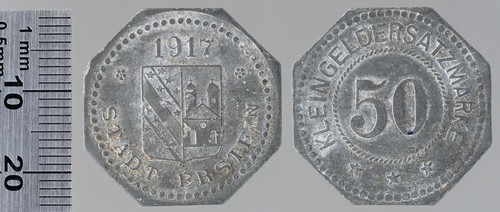
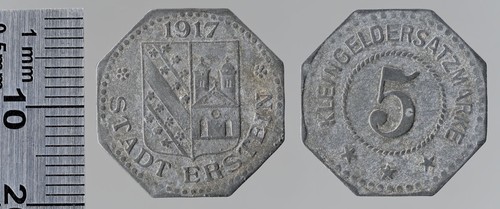
The obverse bears the coat of arms of the city of Erstein together with lettering naming the issuing town. The reverse is dominated by a large numeral 10, marking the value of ten Pfennigs. Pieces like this circulated locally as small change when official imperial coin was hoarded or withdrawn.
History & Background
During the First World War, metal shortages and the hoarding of official coinage led hundreds of German towns, cities and firms to issue their own Notgeld — literally "emergency money." These local tokens filled the gap for everyday small transactions when Reich coinage disappeared from circulation. Low-value pieces were commonly struck in cheap base metals such as iron, zinc and their alloys rather than the copper or nickel of regular coins.
Erstein, a town in Alsace (then part of the German Empire's Reichsland Elsaß-Lothringen), was among the many municipalities that put out such wartime pieces. This 1917 10-Pfennig issue reflects that broad national pattern of locally authorized emergency coinage produced under the pressures of the war economy.
After the war the region returned to France, so Erstein's German-era Notgeld now stands as a small artifact of the period when the town was administered within the German Empire. Collectors study these municipal issues as documents of local history and of Germany's wartime monetary strains.
How to Identify
Obverse: the coat of arms of Erstein with surrounding text identifying the issuing town. Notgeld legends typically spell out the place name and sometimes the word for emergency or war money.
Reverse: a large denomination numeral 10, indicating ten Pfennigs, usually accompanied by the date 1917 and the word Pfennig or Pf.
Physical clues: the piece is a small base-metal coin of zinc-iron alloy, consistent with wartime substitute coinage. Such metal can appear grey and is often lightly magnetic where iron is present, and surfaces are prone to corrosion and spotting. Confirm the type by reading the Erstein name, the 1917 date and the 10 Pfennig value together rather than by any single feature.
Value & Collectibility
Erstein's 1917 emergency 10-Pfennig piece is a modestly valued collector item rather than a precious-metal coin. Values are driven mainly by condition, surface preservation and the specific variety, since base-metal Notgeld corrodes easily and well-preserved examples are scarcer than worn or spotted ones.
Exact prices vary with grade and demand and are best checked against recent sales of the same town's issues; treat any single figure with caution. As inexpensive base-metal tokens these pieces are widely collected by theme — German city Notgeld, Alsace history, or First World War emergency money — where a clean, legible example with the arms and date sharp commands a premium over a corroded one.
Frequently asked questions
What is the Erstein 10 Pfennigs coin?
It is a piece of local emergency money (Notgeld) issued by the town of Erstein in 1917, during the First World War, valued at ten Pfennigs and struck in a zinc-iron base metal.
What does Notgeld mean?
Notgeld is German for 'emergency money.' Many towns, cities and firms issued their own tokens during wartime shortages when official Reich coinage was hoarded or withdrawn from circulation.
What is shown on the coin?
The obverse displays the coat of arms of Erstein with the town's name, and the reverse shows a large numeral 10 for the value of ten Pfennigs, with the date 1917.
Where is Erstein?
Erstein is a town in Alsace. In 1917 it lay within the German Empire's Reichsland Elsaß-Lothringen; the region returned to France after the First World War.
Is it valuable?
It is a modestly valued base-metal collectible rather than a precious-metal coin. Value depends chiefly on condition and how well the surfaces have survived, since zinc-iron Notgeld corrodes easily.
Erstein Notgeld 10 Pfennigs guides
In-depth guides for identifying, valuing, and collecting Erstein Notgeld 10 Pfennigs.
Erstein Notgeld 10 Pfennigs identified by the community
Real coins identified with Coin Identifier.