Erstein Notgeld 5 Pfennigs
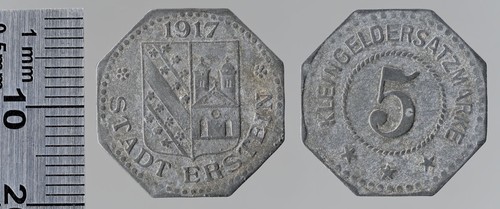
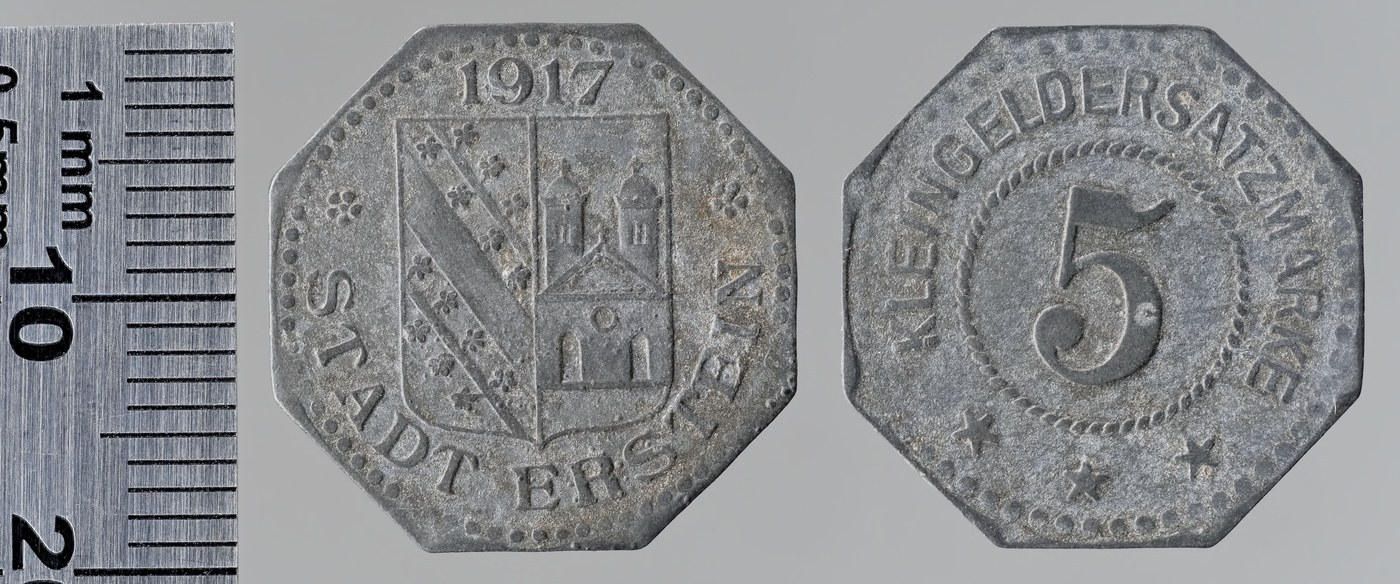
A World War I emergency small-change coin issued by the town of Erstein in 1917, with the civic coat of arms on one side and a large 5 on the other.
- Country
- Germany
- Denomination
- 5 Pfennigs
- Metal
- Zinc-iron
Got a coin like this?
Identify any coin from a photo, free.
Overview
The Erstein Notgeld 5 Pfennigs is a municipal emergency coin (Notgeld) struck for the town of Erstein during the First World War. Made of a zinc-iron alloy, it was intended to replace the imperial small change that had vanished from circulation as base metals were diverted to the war effort and coins were hoarded.
The piece follows the plain, utilitarian format typical of German coin-form Notgeld: the obverse carries the Erstein town coat of arms and lettering identifying the issuer and value, while the reverse is dominated by a large numeral 5 marking the denomination. The date 1917 places it firmly in the middle years of the war, when local emergency issues were at their peak.
History & Background
During World War I, Germany suffered an acute shortage of everyday coinage. Copper, nickel, and silver were needed for war production, and the public hoarded whatever hard coin it could find, leaving shops, factories, and tram lines without the small change needed for daily transactions. In response, hundreds of towns, cities, districts, and companies issued their own Notgeld — emergency money — in low-value metal and, later, paper.
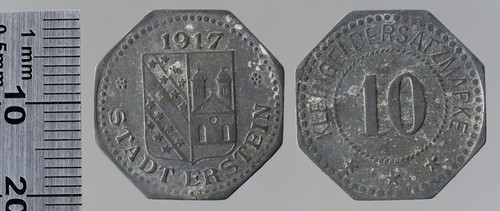
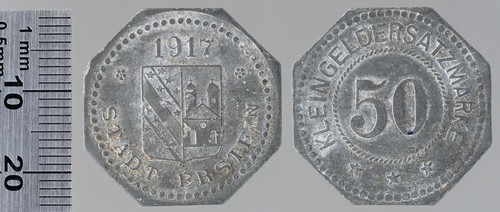
Erstein, a town in Alsace (Bas-Rhin), lay within the German Empire's Reichsland Elsass-Lothringen at this time, and like many communities it produced coin-form emergency pieces in 5 and 10 Pfennig values. These were struck from cheap, readily available substitute metals — here a zinc-iron alloy — rather than the copper or nickel of regular circulating coins.
Such pieces were legal only locally and were meant to circulate within the town and its immediate area. After the war and the return of Alsace to France, these German-era emergency coins fell out of use and passed into the hands of collectors, who study them as artifacts of the wartime economy and of Alsace's period under German administration.
How to Identify
Obverse: the Erstein town coat of arms together with lettering naming the issuing town and, on many such pieces, the denomination. The heraldic shield is the key civic identifier — read the surrounding legend for the town name to confirm the attribution.
Reverse: a large denomination numeral 5, usually accompanied by the word or abbreviation for Pfennig and the date 1917. The bold central figure is the quickest way to recognize the value at a glance.
Physical clues: a small, coin-sized emergency piece in a zinc-iron alloy. Wartime substitute metals like this are typically grayish, lightweight, and prone to corrosion, with zinc surfaces often showing dark spots or white oxidation and iron-bearing pieces sometimes reacting to a magnet. There is no imperial eagle or national inscription — the design is purely local, which distinguishes Notgeld from regular German Empire coinage of the same era.
Value & Collectibility
As a common category of collectible, coin-form Notgeld generally trades in modest amounts, with condition, eye appeal, and local demand driving price. Zinc and iron issues are prone to corrosion, so well-preserved, problem-free examples command a premium over spotted or pitted ones. Scarcer town issues and higher grades sit at the upper end of the range.
Erstein pieces appeal both to Notgeld specialists and to collectors of Alsace-Lorraine material, which can add regional interest. Because exact rarity varies by town, denomination, and variety, check recent sales of the same Erstein type and grade rather than relying on a single figure, and factor in that impaired zinc-iron surfaces reduce value.
Frequently asked questions
What is the Erstein Notgeld 5 Pfennigs?
It is an emergency small-change coin (Notgeld) issued by the town of Erstein in 1917, during World War I, to replace the imperial coinage that had disappeared from circulation.
Why was it made of zinc-iron instead of copper or nickel?
Wartime demand diverted copper, nickel, and silver to military use, so towns struck emergency coins from cheap substitute metals like zinc and iron alloys.
Where is Erstein?
Erstein is a town in Alsace (Bas-Rhin). In 1917 it was part of the German Empire's Reichsland Elsass-Lothringen; the region returned to France after the war.
How can I recognize it?
Look for the Erstein town coat of arms and lettering on one side, a large numeral 5 with the date 1917 on the other, and a small, grayish zinc-iron coin body.
Is it valuable?
Coin-form Notgeld is generally modest in value, driven mainly by condition. Clean, uncorroded examples and scarcer town issues bring more; check recent sales of the same type and grade.
Erstein Notgeld 5 Pfennigs guides
In-depth guides for identifying, valuing, and collecting Erstein Notgeld 5 Pfennigs.