
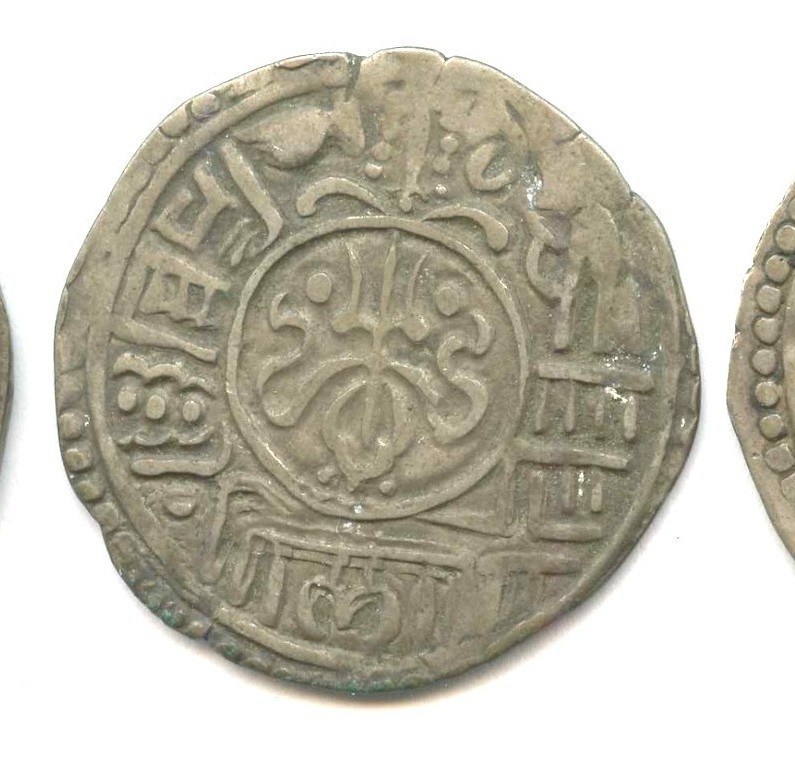
Tibetan Tangka
A silver tangka, the standard coin of old Tibet, its faces filled with Tibetan script and Buddhist ornamental motifs, struck from the late 18th into the 19th century.
- Country
- Tibet
- Denomination
- Tangka
- Metal
- Silver
Got a coin like this?
Identify any coin from a photo, free.
Overview
The Tibetan Tangka was the principal silver coin of Tibet, serving as the everyday unit of account across the Himalayan plateau from the late eighteenth century well into the twentieth. The example shown here follows the classic pattern of the type: both faces are covered with Tibetan (Uchen) script arranged in radiating panels and surrounded by ornamental and auspicious Buddhist designs, with no portrait or ruler's bust of the kind found on Western or Indian coins.
A tangka is a thin, broadly struck silver piece, typically a few grams in weight and roughly 25 to 30 mm across, often on a coarse or debased alloy that ranges from bright silver to grey. Many were struck by hand on somewhat irregular flans, so the design is frequently off-center and the two sides seldom line up perfectly. Circulating examples show heavy wear and toning from generations of use in a cash-poor economy where the coin passed constantly from hand to hand.
Rather than one single design, "tangka" covers a family of related silver coins, of which the two most familiar early types are the Sino-Tibetan Kong-par tangka and the long-lived Ganden (dga'-ldan) tangka bearing the eight auspicious symbols. All share the same denomination, script-and-symbol layout and Buddhist iconography seen on this coin.
History & Background
Before Tibet struck its own silver, much of its coined money came from Nepal, whose Malla and early Shah mints supplied silver mohars in exchange for Tibetan bullion. That arrangement broke down in the later eighteenth century amid disputes over debased Nepalese coin, contributing to conflict on the frontier. In the wake of the Sino-Nepalese war, Tibet — under Qing oversight — began issuing its own silver, and the tangka became the standard indigenous coin.
The earliest widely recognized indigenous silver is the Kong-par tangka, first struck in the Qianlong era of the late eighteenth century and named for the Kongpo region; it carries Tibetan legends and a central floral or lotus motif and was produced in several later issues. From roughly the middle of the nineteenth century the Ganden tangka, named after the Ganden Phodrang government of the Dalai Lamas, became the dominant type, its designs built around the ashtamangala, the eight auspicious symbols of Tibetan Buddhism.
Tangkas remained in daily use for well over a century, circulating alongside later machine-struck Tibetan coinage before the currency system was overtaken by twentieth-century change. Because they were made over many decades by successive mintings, surviving tangkas vary widely in style, silver content and quality of strike, and cataloguing them precisely can be a specialist undertaking.
How to Identify
Identify a tangka first by its overall character: a thin, hand-struck silver disc, roughly 25 to 30 mm across and only a few grams in weight, with Tibetan Uchen script and Buddhist ornament covering both faces and no human portrait anywhere on the coin. The lettering is typically laid out in wedge-shaped panels radiating from the center, and the fields are filled with lotus petals, scrollwork or auspicious emblems.
On the reverse and obverse look for the recurring Buddhist devices, above all the eight auspicious symbols (the endless knot, lotus, victory banner, wheel, parasol, conch, treasure vase and golden fish) that characterize the Ganden tangka, or a central floral/lotus rosette ringed by inscription on the Kong-par type. The strike is often uneven, the flan slightly irregular, and the two dies rarely in perfect register, so expect some off-center design and weak areas — these are normal for hand-hammered Himalayan coinage, not signs of damage.
Metal and surface help confirm the piece. Genuine tangkas are silver or debased silver (billon) and tone to grey or dark patina with wear; the alloy can be quite base on later strikings. Most are undated or carry only a Tibetan cyclical-calendar date rather than a Western year or mint mark, so attribution usually rests on the design type and script rather than on a legible date.
Value & Collectibility
Tangkas were produced in large numbers over many decades and saw hard everyday use, so common circulated examples are modestly priced and are among the more affordable antique Himalayan silver coins. Value is driven mainly by the specific type, the quality of the strike and the amount of remaining detail rather than by bullion content, since the silver is often debased.
Early and scarcer varieties — certain Kong-par issues, particular die types, and coins with unusually full, well-centered strikes — command higher premiums than the ubiquitous worn Ganden tangkas. Sharp, well-preserved examples with clear script and crisp auspicious symbols are considerably more desirable than the flat, heavily circulated pieces that turn up most often.
Because the series is complex and many varieties look superficially alike, prices vary widely with attribution, condition and demand among collectors of Tibetan and Himalayan coinage. Any figures should be treated as general context, and a precise valuation depends on identifying the exact type and grade with a specialist reference.
Frequently asked questions
What is a Tibetan tangka?
It is the standard silver coin of old Tibet, used as everyday money from the late 18th century into the 20th. The name (also spelled tanka, trangka or tam) refers to the denomination as well as to this family of script-and-symbol coins.
Why is there no face or portrait on the coin?
Tibetan coinage followed a Buddhist rather than a European tradition, so instead of a ruler's bust the tangka carries religious inscriptions in Tibetan script and auspicious symbols such as the lotus and the endless knot.
Is it real silver?
Yes, though usually debased. Tangkas were struck in silver or billon (a low-grade silver alloy), and the fineness varies a great deal between issues, with many later strikings quite base.
What are the symbols on the coin?
Many tangkas, especially the Ganden type, display the eight auspicious symbols of Tibetan Buddhism — including the endless knot, lotus, wheel, conch, victory banner, parasol, treasure vase and golden fish — arranged around Tibetan inscriptions.
Why does my coin look uneven or off-center?
Tangkas were struck by hand on irregular flans, so off-center designs, uneven strikes and mismatched sides are normal and expected rather than defects.
Tibetan Tangka guides
In-depth guides for identifying, valuing, and collecting Tibetan Tangka.
Other coins you may enjoy
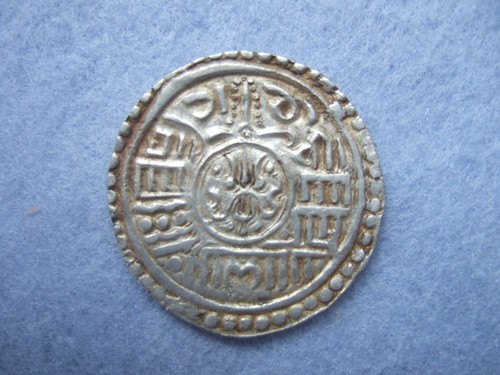
Nepalese Mohar
19th century, struck under the Shah dynasty; dates given in the Saka era rather than the Western calendar
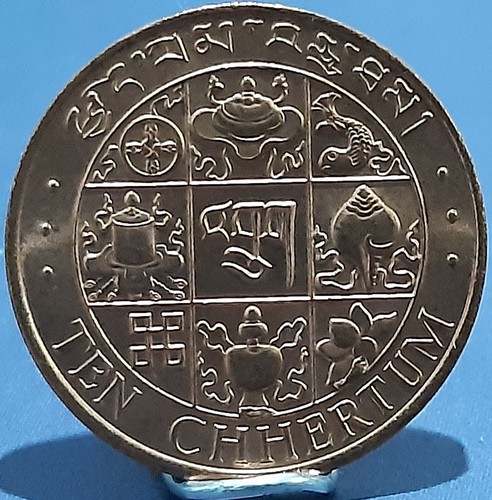
Bhutan 10 Sengtrum
1979
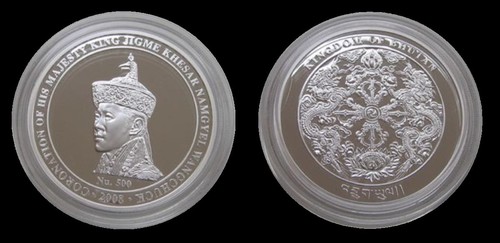
Bhutan 500 Ngultrum Commemorative
Dated 2008, issued under King Jigme Khesar Namgyel Wangchuck
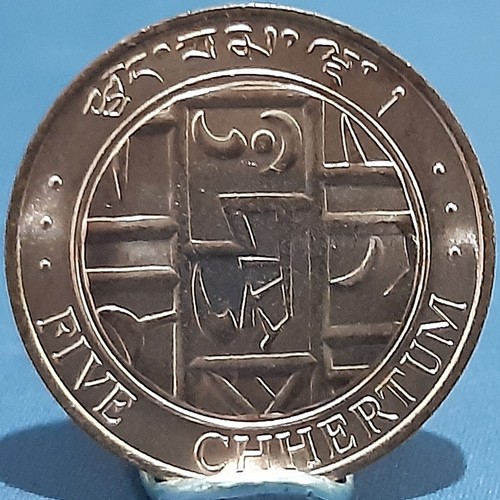
Bhutan 5 Sengtrum
Dated 1979, part of Bhutan's decimal Ngultrum coinage