
How to Identify the Tibetan Tangka
A collector's guide to attributing a Tibetan silver tangka: script layout, Buddhist symbols, size and metal, dating, look-alike Nepalese coins and fakes.
Read the full Tibetan Tangka encyclopedia entry →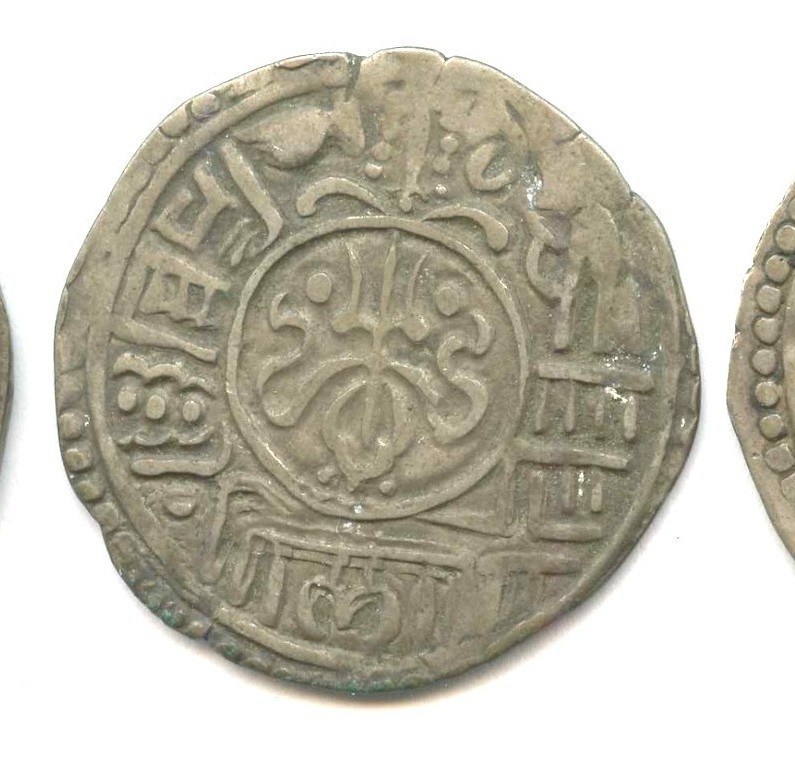
Start with the general impression, because it separates a tangka from almost anything else at a glance: a thin, hand-struck silver disc roughly 25 to 30 mm across, weighing only a few grams, with Tibetan Uchen script and Buddhist ornament covering both faces and no portrait anywhere. If a coin of about this size shows radiating panels of Tibetan lettering rather than a bust or a Western legend, you are almost certainly holding a tangka.
Read the design type next. The two faces are usually organized as wedge-shaped script panels around a central motif. On the widespread Ganden (dga'-ldan) tangka, look for the eight auspicious symbols of Tibetan Buddhism — endless knot, lotus, wheel, conch, victory banner, parasol, treasure vase and golden fish — distributed around the inscriptions. On the earlier Sino-Tibetan Kong-par tangka, expect a central floral or lotus rosette ringed by Tibetan legend. Matching the coin to one of these families is the practical first step in attribution.
Check size, metal and strike. Tangkas are silver or debased billon, toning grey to dark with age; the alloy can be quite base on later issues, so do not expect bright, high-purity silver. Because they were hammered by hand on irregular flans, the strike is often off-center, the flan slightly out of round, and the two dies rarely in register — normal traits, not damage. Weigh and measure the coin: a few grams and roughly a couple of centimeters across is right; anything markedly heavier or in gold does not belong to this type.
Be careful about dating and look-alikes. Most tangkas are undated or bear only a Tibetan cyclical-calendar date, not a Western year, so attribution rests on design and script rather than a legible date. The most important look-alikes are Nepalese silver mohars, which circulated in Tibet and share a similar size and script-filled, portrait-free layout; distinguish them by their Nagari/Nepalese legends and Hindu (rather than Tibetan Buddhist) motifs. Later machine-struck Tibetan coins are more regular and sharply centered than the hand-struck tangka.
Apply the usual authentication cautions. Genuine tangkas are struck, so lettering and symbols, though sometimes weak from wear, should have the crisp edges of a hammered coin rather than the soft, rounded detail, seams or trapped bubbles of a cast copy. Because the series is large and varieties look alike, confirm difficult pieces against a specialist catalog of Tibetan and Himalayan coinage, and be wary of unusually heavy, unusually pure, or suspiciously pristine "tangkas" offered as rare types.
Frequently asked questions
How do I tell a Ganden tangka from a Kong-par tangka?
Look at the central design. The Ganden tangka arranges the eight auspicious Buddhist symbols around its inscriptions, while the earlier Kong-par tangka centers on a floral or lotus rosette ringed by Tibetan legend. Both are silver and script-covered, but the motifs differ.
How can I distinguish a tangka from a Nepalese mohar?
Nepalese mohars are a common look-alike of similar size and layout. Tangkas carry Tibetan Uchen script and Buddhist symbols; Nepalese coins use Nagari-style legends and Hindu motifs. Reading the script and iconography is the surest way to separate them.
There is no date on my coin — is that normal?
Yes. Most tangkas are undated or bear only a Tibetan cyclical date rather than a Western year or mint mark, so identification depends on the design type and script rather than on a readable date.
How do I spot a fake tangka?
Genuine tangkas are hand-struck, so details should have crisp struck edges even when worn. Watch for casting seams, bubbles or mushy detail, and be suspicious of pieces that are too heavy, too pure, in gold, or improbably pristine. Confirm doubtful coins against a specialist Himalayan reference.