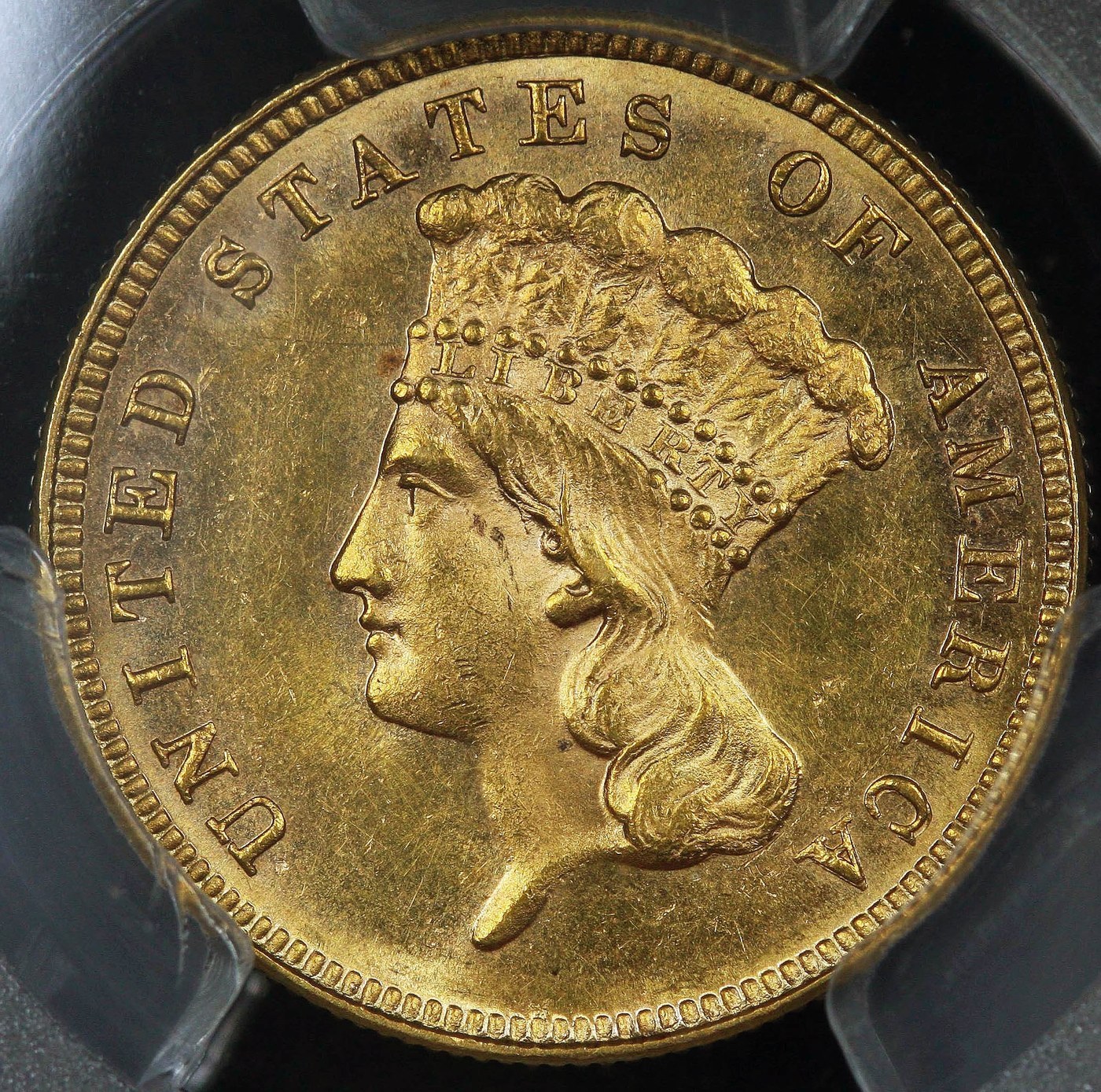
Three-Dollar Gold Piece
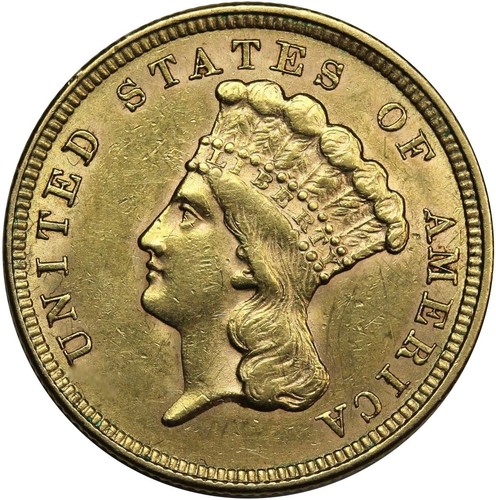
An unusual U.S. gold coin of the $3 denomination struck 1854–1889, showing a Liberty head in a feathered Indian-style headdress. The photo shows the 1854 first year.
- Country
- United States
- Denomination
- $3
- Metal
- Gold
Got a coin like this?
Identify any coin from a photo, free.
Overview
The Three-Dollar Gold Piece is one of the most distinctive denominations in American coinage, produced by the United States Mint from 1854 to 1889. Its obverse, seen in the photograph, features a left-facing head of Liberty wearing an ornate feathered headdress in the style of a Native American war bonnet, encircled by the legend UNITED STATES OF AMERICA. The design is the work of Mint engraver James B. Longacre.
The photographed coin is dated 1854, the very first year the denomination was issued. Struck in gold, the $3 piece is small and thin — slightly larger than a $2.50 quarter eagle but smaller than the more familiar half eagle. The reverse (not shown in this image) carries a wreath of tobacco, wheat, corn, and cotton surrounding the denomination and date.
The odd $3 face value, combined with a relatively short production run and generally low mintages, makes this a coin more collected as a curiosity and type piece than one that ever saw heavy everyday use.
History & Background
Congress authorized the Three-Dollar Gold Piece in the Act of February 21, 1853, and the first coins were struck in 1854. A common explanation ties the denomination to the three-cent postage stamp: a $3 coin could conveniently buy a sheet of one hundred three-cent stamps, and it also related to purchases of three-cent silver pieces. Whatever the exact rationale, the denomination never became genuinely popular in commerce.
James B. Longacre, then Chief Engraver of the Mint, designed both sides. His Liberty head with a feathered headdress is often called an "Indian Princess," though it depicts a classical Liberty rather than an actual Native American portrait. The 1854 first-year coins, like the one pictured, are distinctive for showing the words DOLLARS and the smaller lettering used only in that debut year on the reverse.
The coin was minted mainly at Philadelphia, with small quantities from the branch mints at Dahlonega, New Orleans (both 1854 only), and San Francisco. Mintages were modest throughout, and the denomination was finally discontinued in 1890 after the final 1889-dated coins. An extraordinary rarity, the unique 1870-S, is among the most famous of all American coins.
How to Identify
The quickest identifier is the obverse portrait: a left-facing Liberty wearing a tall feathered headdress, ringed by stars and the legend UNITED STATES OF AMERICA. This headdress design is unique to the $3 gold and the closely related gold dollar of the same era, so it is a strong diagnostic. The date on the pictured coin is 1854.
The reverse, not shown here, carries a wreath of tobacco, wheat, corn, and cotton around the inscription "3 DOLLARS" and the date. On the 1854 issue the word DOLLARS is in noticeably smaller letters than on later years — a useful way to confirm a first-year coin.
Physically the coin is gold, about 20.5 mm in diameter and roughly 5.0 grams, thin for its width. A mint mark, when present, sits on the reverse below the wreath: no mark means Philadelphia, while D, O, or S indicates Dahlonega, New Orleans, or San Francisco. Because most dates and mints are scarce, careful attention to date, mint mark, and genuine gold color is essential.
Value & Collectibility
The Three-Dollar Gold Piece is a scarce coin across every date, so even the most common issues carry a substantial premium over their gold content. The 1854 first-year coin is one of the more available dates and is the one most often used as a type example, but it still trades for far more than melt value in any collectible grade.
Condition drives price sharply. Well-worn examples of common dates are the most affordable entry point, while lightly circulated and Mint State coins climb steeply, and gem-quality or proof pieces can reach very high levels. Scarce branch-mint issues — and especially the legendary unique 1870-S — command dramatically higher prices, with the finest rarities among the most valuable of U.S. coins.
Because values swing widely with date, mint mark, and grade, any specific coin should be checked against recent auction results and, for meaningful purchases, verified by a professional grading service. Ranges here are general context, not fixed prices.
Frequently asked questions
Is the portrait on the Three-Dollar gold piece a Native American?
No. The design shows the goddess Liberty wearing a feathered headdress in a Native American style, an image often nicknamed the "Indian Princess." It is a classical Liberty portrait, not a real person.
Why did the United States make a $3 coin?
It was authorized in 1853, partly for convenience with three-cent postage stamps and three-cent silver coins. The odd denomination never caught on in everyday commerce and was discontinued in 1890.
What makes the 1854 coin special?
1854 is the first year of the denomination. It is also the only year the branch mints at Dahlonega and New Orleans struck the coin, and it uses smaller DOLLARS lettering on the reverse than later dates.
How can I tell it apart from a gold dollar?
Both use Longacre's feathered-headdress Liberty, but the $3 is larger (about 20.5 mm) and thicker in appearance, and its reverse reads "3 DOLLARS." The gold dollar is much smaller and reads "1 DOLLAR."
Is my Three-Dollar gold piece valuable?
Every date is scarce, so all genuine examples carry a strong premium over gold value. Exact worth depends heavily on date, mint mark, and condition, and rare issues can be worth a great deal.
Three-Dollar Gold Piece guides
In-depth guides for identifying, valuing, and collecting Three-Dollar Gold Piece.