
How to Identify the Three-Dollar Gold Piece
A collector's checklist for confirming a genuine U.S. $3 gold coin — the headdress portrait, reverse wreath, size, mint marks, look-alikes, and counterfeit cautions.
Read the full Three-Dollar Gold Piece encyclopedia entry →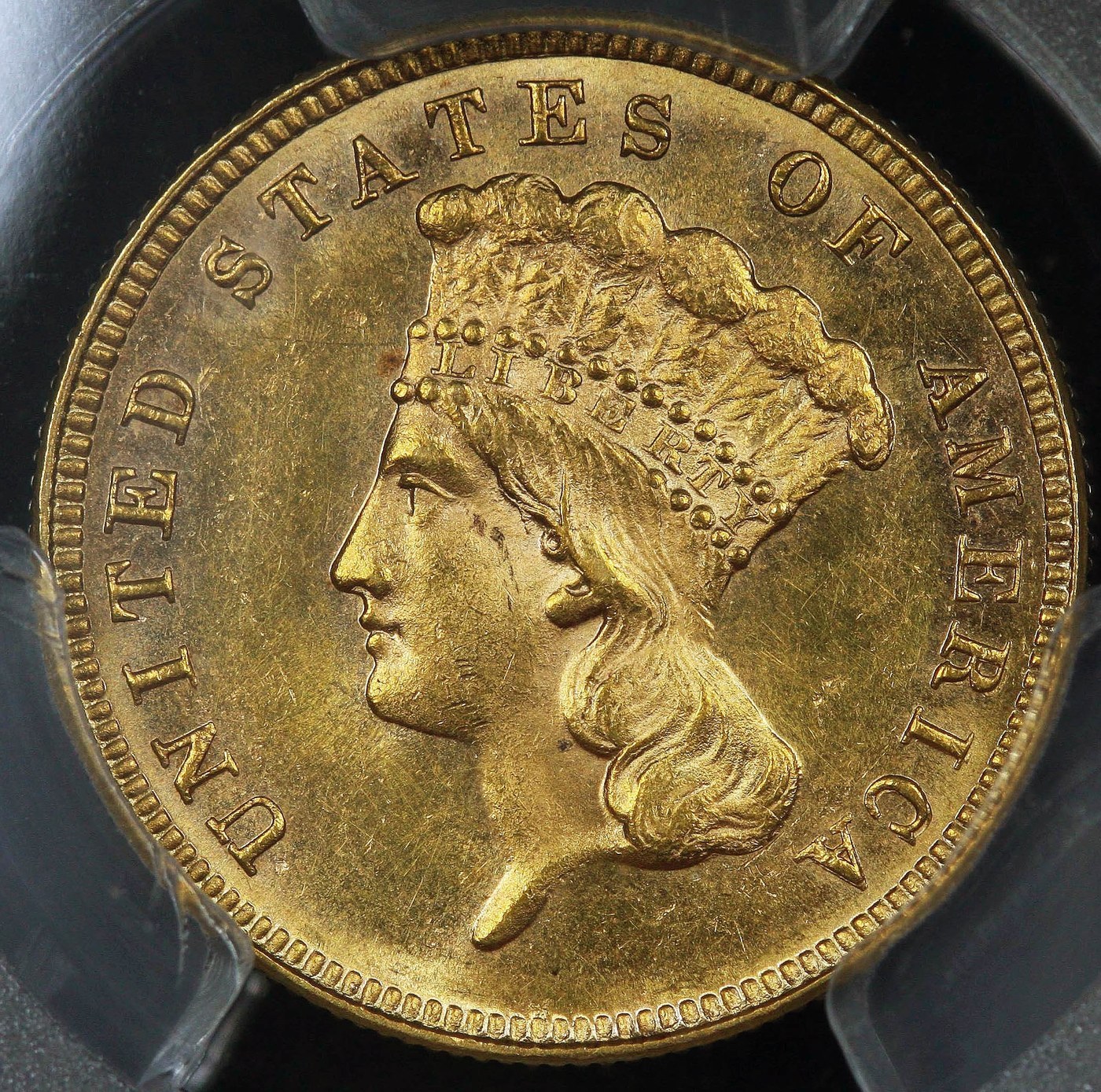
Begin with the obverse, because Longacre's design is highly recognizable. You should see a left-facing head of Liberty wearing a tall feathered headdress, surrounded by the legend UNITED STATES OF AMERICA and a ring of stars, with the date below. On the photographed coin the date is 1854. This feathered-headdress Liberty is shared only with the contemporary gold dollar, so if the portrait matches and the coin is clearly larger than a tiny gold dollar, you are likely holding a $3 piece.
Confirm with the reverse, which is not shown in the photo. A genuine $3 gold shows an agricultural wreath of tobacco, wheat, corn, and cotton enclosing the words "3 DOLLARS" and the date. Reading "3 DOLLARS" (rather than "1 DOLLAR") is the definitive denomination check. On 1854-dated coins specifically, the word DOLLARS appears in smaller letters than on 1855 and later issues — a quick way to authenticate a first-year example.
Check the physical specifications. The coin is gold, roughly 20.5 mm in diameter and about 5.0 grams, and looks thin relative to its width. It should have a reeded edge and the warm yellow color of genuine gold. A piece that is the wrong diameter, wrong weight, magnetic, or oddly pale should be treated with suspicion.
Locate the mint mark on the reverse, below the wreath. No mint mark means Philadelphia; D, O, or S indicates Dahlonega, New Orleans, or San Francisco. Mint marks matter enormously here because branch-mint coins are far scarcer than Philadelphia issues — and the unique 1870-S is a legendary rarity. Because scarce dates and mint marks invite fraud, be alert for added, removed, or altered mint marks and altered dates.
Finally, weigh authentication seriously. This denomination has been counterfeited and altered, and genuine details — crisp headdress feathers, sharp wreath elements, correct lettering style for the year — should be examined closely. For any coin of real value, rely on trusted dealers and third-party certification (PCGS or NGC) rather than eye appeal alone.
Frequently asked questions
How do I know it is a $3 coin and not a $1 gold dollar?
Both share Longacre's feathered-headdress Liberty, but the $3 is larger (about 20.5 mm) and its reverse reads "3 DOLLARS." The gold dollar is much smaller and reads "1 DOLLAR."
Where is the mint mark and why does it matter?
It sits on the reverse below the wreath. No mark is Philadelphia; D, O, or S are branch mints. Branch-mint coins are much scarcer, so the mint mark strongly affects rarity and value — and invites alteration.
How can I confirm an 1854 first-year coin?
Check the reverse: 1854 coins use noticeably smaller DOLLARS lettering than later dates. 1854 is also the only year Dahlonega and New Orleans struck the denomination.
How do I confirm a valuable example is genuine?
Verify diameter (about 20.5 mm), weight (about 5.0 g), non-magnetic gold color, and correct lettering for the year. Watch for altered dates or mint marks, and use PCGS or NGC certification for costly coins.