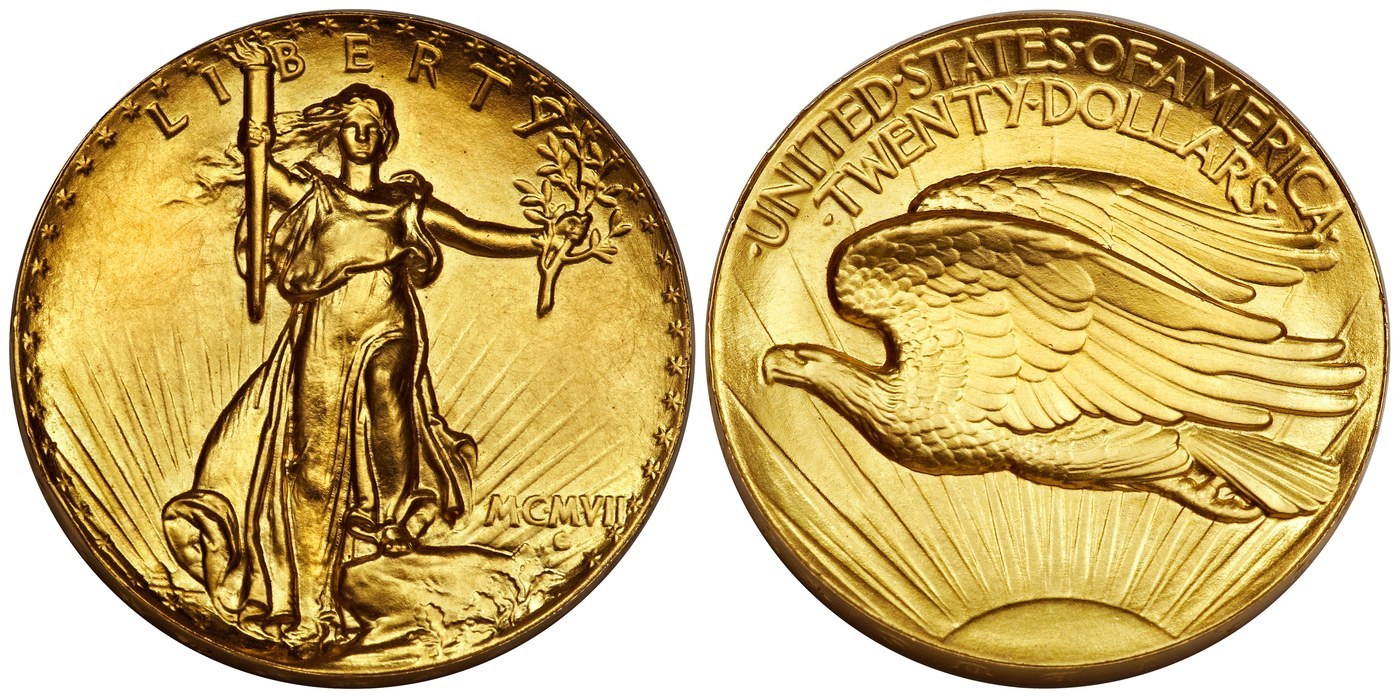
Ultra High Relief Double Eagle
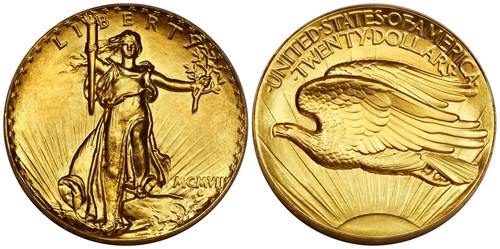
Augustus Saint-Gaudens' 1907 $20 gold pattern struck in sculptural ultra high relief, with striding Liberty and a soaring eagle.
- Country
- United States
- Denomination
- $20
- Metal
- Gold
Got a coin like this?
Identify any coin from a photo, free.
Overview
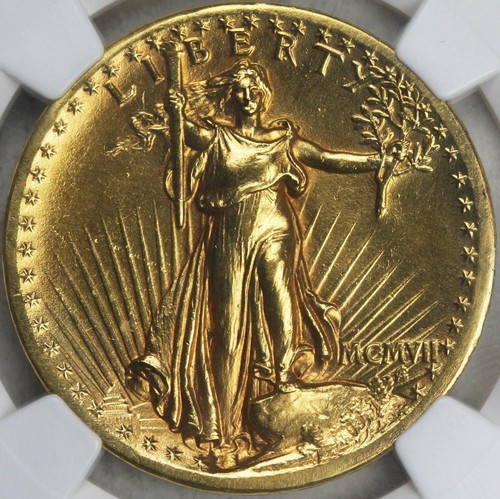
The Ultra High Relief Double Eagle is a 1907 United States $20 gold coin designed by the sculptor Augustus Saint-Gaudens. Its obverse shows a full-length figure of Liberty striding forward, holding a torch aloft in one hand and an olive branch in the other; the reverse depicts an eagle in flight with wings spread wide against a field of rays. It is widely regarded as one of the most beautiful designs ever produced by the U.S. Mint.
What sets this coin apart is its extraordinary depth of relief. The design was struck to be dramatically sculptural rather than flat like ordinary circulating coinage, so the devices rise noticeably from the surface and the coin has a thick, medal-like appearance. These pieces were experimental in nature and were never released for general circulation.
History & Background
President Theodore Roosevelt championed a redesign of American coinage in what he called his "pet crime," recruiting Augustus Saint-Gaudens, the leading American sculptor of the era, to create a $20 gold piece with the artistry of an ancient Greek coin. The resulting ultra high relief pieces of 1907 were the fullest expression of that vision.
Because the relief was so deep, each coin required multiple blows from the press to bring up the full design, making the pieces impractical for mass production. The Mint subsequently reduced the relief to a high-relief version and then to a much lower relief for regular circulation, launching the long-running Saint-Gaudens double eagle series that continued into the 1930s. The 1907 ultra high relief coins survive only in very small numbers and are treated as prized patterns and rarities rather than as ordinary issues.
The same striding Liberty and flying eagle designs, in shallower relief, went on to become one of the most collected U.S. gold series. The original 1907 ultra high relief coin remained the design's artistic high-water mark.
How to Identify
Look first at the relief itself: the genuine 1907 ultra high relief coin is strikingly three-dimensional, with Liberty and the eagle standing well proud of the field and a thick edge profile compared to a normal double eagle. The obverse features Liberty striding forward with a torch raised and an olive branch, the Capitol building small at lower left, rays behind her, and the date 1907. The reverse shows the eagle flying above the sun's rays with the inscriptions for the denomination and country.
The coin is a $20 gold denomination struck in 90% gold, roughly 34 mm in diameter and near an ounce of gold weight in the standard alloy. As a special pattern issue it carries no mint mark. Note that on the earliest 1907 pieces the date appears in Roman numerals (MCMVII), a distinctive feature of the high- and ultra-high-relief coinage.
Because originals are extremely rare and valuable, any piece should be authenticated by a major grading service. The U.S. Mint issued an official 2009 gold reproduction of this design (dated MMIX and struck in modern one-ounce .9999 gold); it is clearly modern and should not be confused with the 1907 original.
Value & Collectibility
Genuine 1907 ultra high relief double eagles are among the most valuable U.S. gold coins in existence. They trade only through specialist auctions and dealers, and quality examples command prices well into the high six figures and beyond, driven by extreme rarity, historical importance, and the coin's celebrated artistry.
Most collectors will never handle a true original. Far more accessible are the regular-relief Saint-Gaudens double eagles (1907-1933), which carry substantial gold bullion value plus a numismatic premium that depends on date, condition, and rarity. The modern 2009 Mint reproduction is valued largely on its one ounce of gold content plus a modest collector premium.
Because values in the top tier are so high and turnover so limited, treat any specific figure as an approximation and rely on recent auction records and professional appraisal rather than a fixed price.
Frequently asked questions
Is the Ultra High Relief Double Eagle real gold?
Yes. The 1907 original is a U.S. $20 gold coin struck in the standard 90% gold alloy, containing close to an ounce of gold. The 2009 Mint reproduction is struck in one ounce of .9999 fine gold.
Why is this coin so famous?
It represents sculptor Augustus Saint-Gaudens' fullest artistic vision for U.S. coinage, commissioned under President Theodore Roosevelt, and its deep sculptural relief is considered among the most beautiful coin designs America ever produced.
How many were made?
The 1907 ultra high relief pieces were experimental and made in only very small numbers, which is why survivors are exceedingly rare. Exact figures are debated and no reliable single mintage should be assumed.
What is the difference between ultra high relief and regular Saint-Gaudens double eagles?
The ultra high relief 1907 coin has dramatically deeper, more three-dimensional relief and required multiple strikes. The Mint later flattened the design for practical mass production, creating the ordinary circulating double eagles.
Could I own a version of this design affordably?
Yes. The 2009 U.S. Mint reproduction and the standard 1907-1933 circulation-relief double eagles let collectors own the design at a fraction of the cost of a genuine 1907 ultra high relief original.
Ultra High Relief Double Eagle guides
In-depth guides for identifying, valuing, and collecting Ultra High Relief Double Eagle.