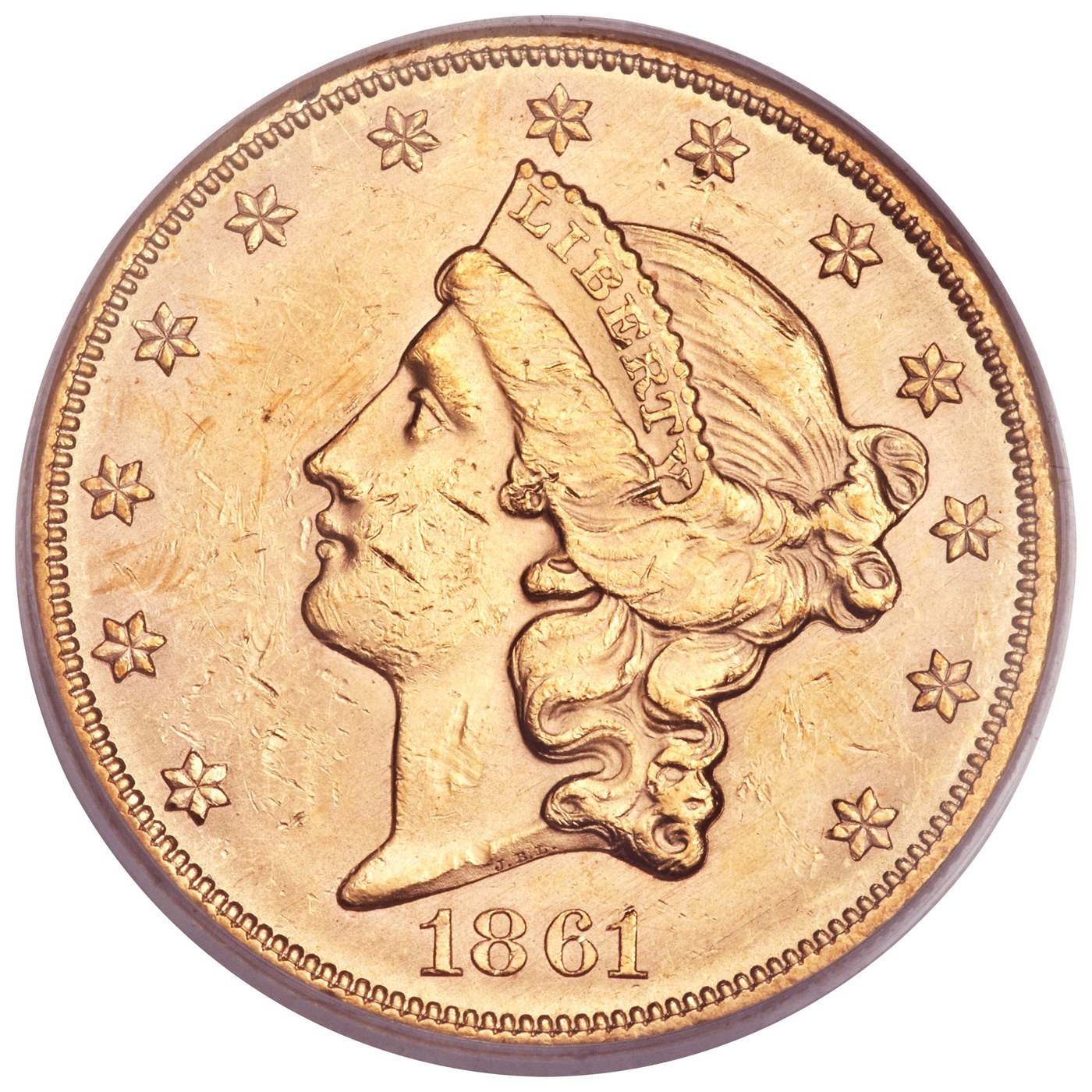
Paquet Double Eagle
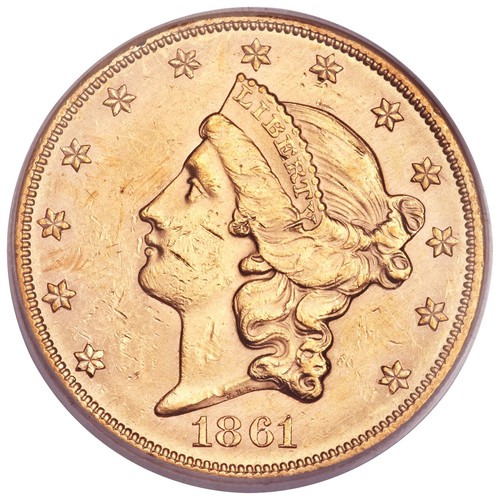
An 1861 U.S. $20 gold piece with the standard Liberty Head obverse paired with Anthony Paquet's rare tall-letter reverse variety.
- Country
- United States
- Denomination
- $20
- Metal
- Gold
Got a coin like this?
Identify any coin from a photo, free.
Overview
The Paquet Double Eagle is a one-year variety of the United States $20 gold piece struck in 1861. It carries the familiar Liberty Head (Coronet) obverse seen on this coin's photo — Lady Liberty facing left, wearing a coronet inscribed LIBERTY, encircled by thirteen stars with the date below — but pairs it with a distinctive reverse redesigned by Mint engraver Anthony C. Paquet.
Because the obverse is identical to the ordinary 1861 double eagle, the Paquet variety is defined entirely by its reverse, which uses noticeably taller, thinner lettering and a narrower rim. The type is prized by collectors as one of the great rarities and stories of 19th-century American gold coinage.
Two mints produced Paquet-reverse double eagles in 1861: Philadelphia (no mint mark) and San Francisco (S). The two issues could hardly differ more in survival — one is among the rarest of all U.S. coins, the other a scarce but collectible circulating issue.
History & Background
In 1860–61 the Mint tested a modified reverse for the double eagle engraved by Anthony C. Paquet, an assistant engraver at the Philadelphia Mint. His reverse kept the heraldic eagle and shield but featured tall, slender letters and a much narrower raised border than James B. Longacre's original design.
After production had begun in early 1861, Mint officials concluded that the narrow rim would leave the coins vulnerable to rapid wear and poor stacking, and Mint Director James Ross Snowden ordered the design withdrawn. Word reached Philadelphia quickly and nearly all of its Paquet-reverse coins were held back and melted, but the recall telegram took much longer to reach San Francisco.
As a result, the San Francisco Mint had already struck and released a substantial run of 1861-S Paquet double eagles into circulation, while Philadelphia's version survives today in only two known examples. The regular Longacre reverse resumed for the rest of the 1861 coinage.
How to Identify
The obverse shown here — Liberty in a coronet lettered LIBERTY, surrounded by thirteen stars over the 1861 date — is the same on both the Paquet variety and the common 1861 double eagle. This is the key point: the obverse alone cannot confirm a Paquet coin. The diagnostic is entirely on the reverse.
On a genuine Paquet reverse, the legends UNITED STATES OF AMERICA and TWENTY D. are struck in distinctly tall, narrow letters, and the beaded/raised rim is thinner than on the standard type. Side-by-side comparison of letter height and rim width against a normal 1861 reverse is the standard test.
Specifications match all Liberty Head double eagles: 90% gold with 10% copper, about 33.4 grams, roughly 34 mm in diameter, containing close to a full ounce of gold. A San Francisco piece shows an S mint mark below the eagle; a Philadelphia piece carries no mint mark.
Value & Collectibility
Value is driven almost entirely by which mint struck the coin. The 1861 Philadelphia Paquet is a legendary rarity with only two examples known, and the finest has sold at auction for figures in the millions of dollars — it is effectively unobtainable for most collectors.
The 1861-S Paquet is far more available because it actually circulated, but it remains scarce and is almost always found well worn. Depending on condition it typically trades from the low tens of thousands of dollars into six figures for the sharpest survivors, well above the coin's roughly one-ounce gold value.
Because a Paquet coin looks identical on the obverse to an ordinary 1861 double eagle and the premium is enormous, any example should be authenticated and graded by a major third-party service before purchase.
Frequently asked questions
What makes a double eagle a "Paquet"?
The reverse. Anthony C. Paquet's 1861 reverse uses taller, thinner lettering and a narrower rim than the standard design. The obverse is unchanged, so the variety is identified only by the reverse.
Why is the Philadelphia Paquet so rare?
Mint officials withdrew the design almost immediately over concerns about the narrow rim, and Philadelphia melted nearly its entire run. Only two 1861 Philadelphia Paquet double eagles are known today.
Why does the 1861-S Paquet exist in more numbers?
The recall order reached San Francisco after coins had already been struck and released, so a run of 1861-S Paquet double eagles entered circulation instead of being melted.
Is it real gold?
Yes. Like all Liberty Head double eagles it is 90% gold and 10% copper, weighs about 33.4 grams, and contains close to a full ounce of gold.
Can I tell if I have a Paquet from the obverse in the photo?
No. The Liberty Head obverse is identical to a common 1861 double eagle. Confirming a Paquet requires examining the reverse lettering and rim, ideally through professional authentication.
Paquet Double Eagle guides
In-depth guides for identifying, valuing, and collecting Paquet Double Eagle.