
How to Identify the Paquet Double Eagle
A collector's guide to spotting the rare 1861 Paquet reverse variety and telling it from a common Liberty Head double eagle.
Read the full Paquet Double Eagle encyclopedia entry →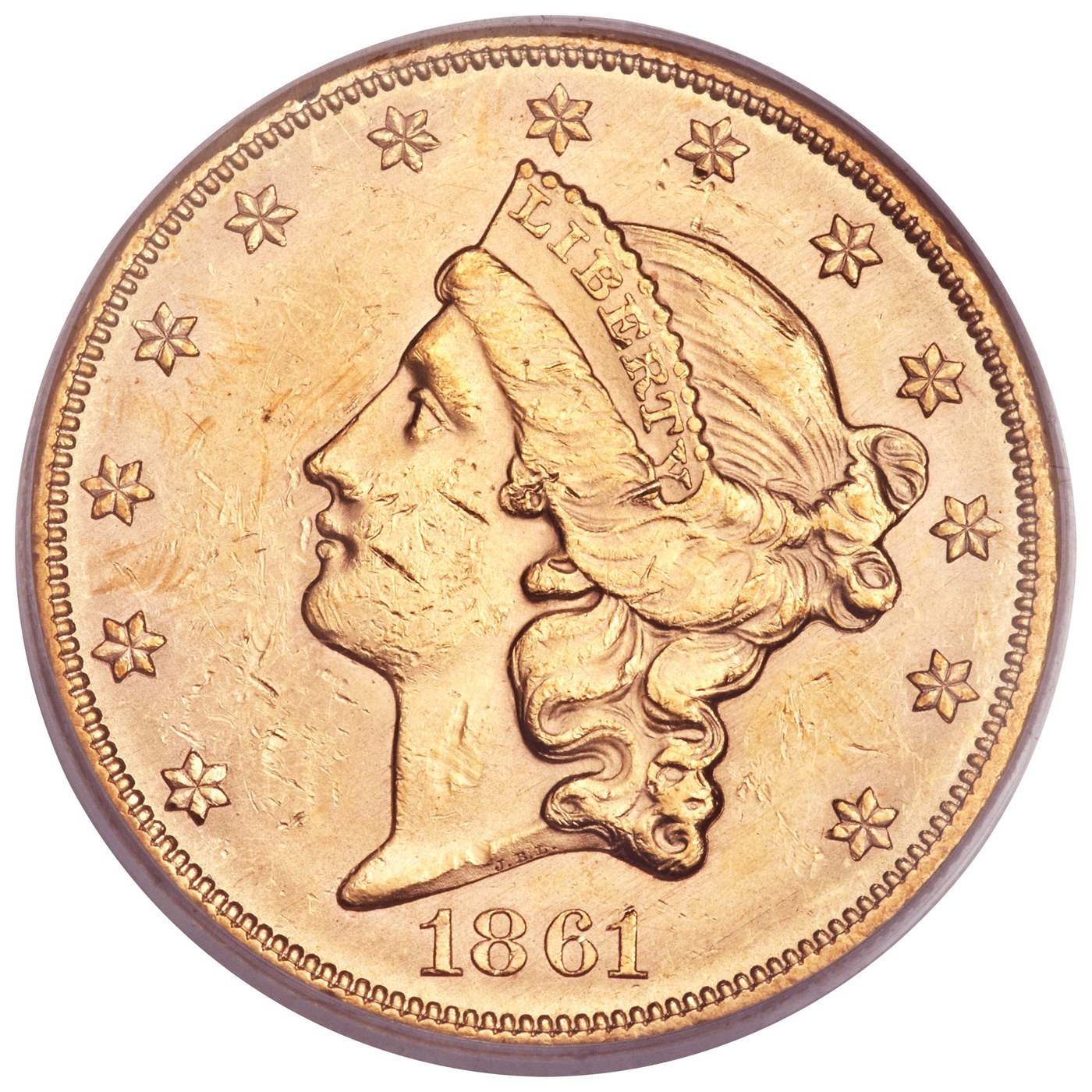
Start by confirming you have an 1861 Liberty Head double eagle at all. The obverse — like the one photographed here — shows Liberty facing left in a coronet reading LIBERTY, ringed by thirteen stars with 1861 below. This obverse is shared by both the ordinary 1861 coin and the Paquet variety, so it is only your starting point, never proof of a Paquet.
The entire diagnosis is on the reverse. On a genuine Paquet reverse, the lettering of UNITED STATES OF AMERICA and TWENTY D. is conspicuously tall and narrow, and the raised rim is thinner than on the standard Longacre reverse. The most reliable check is a direct side-by-side comparison with a normal 1861 reverse: look at letter height, letter spacing, and how much border metal surrounds the design.
Use the physical specifications to rule out fakes and gilded pieces. A real coin is 90% gold, about 33.4 grams, roughly 34 mm across, with the deep yellow color of a circulated gold piece. A Philadelphia example bears no mint mark; a San Francisco example shows a small S beneath the eagle on the reverse.
Be cautious of look-alikes and alterations. Because a Paquet carries a massive premium over a common 1861 double eagle that looks identical from the front, added or re-engraved reverse details and outright counterfeits are a real concern. The Philadelphia Paquet in particular is so rare (two known) that any claimed example demands extreme skepticism.
For anything you believe may be a Paquet, do not rely on the obverse or on a single photo. Submit the coin to a major grading and authentication service, which can verify the reverse die characteristics, weight, and metal and encapsulate it with an attribution.
Frequently asked questions
Can the Paquet variety be identified from the obverse?
No. The obverse is identical to a standard 1861 double eagle. You must examine the reverse lettering and rim to identify a Paquet.
What exactly should I look for on the reverse?
Tall, slender letters in the legends and a noticeably narrower rim than the normal design. Comparing directly against an ordinary 1861 reverse makes the difference clear.
Where is the mint mark?
On the reverse below the eagle. An S indicates San Francisco; no mint mark indicates Philadelphia, the far rarer of the two.
Do I need professional authentication?
Yes. Given the size of the premium and the risk of alterations or fakes, a Paquet should always be verified and graded by a reputable third-party service.