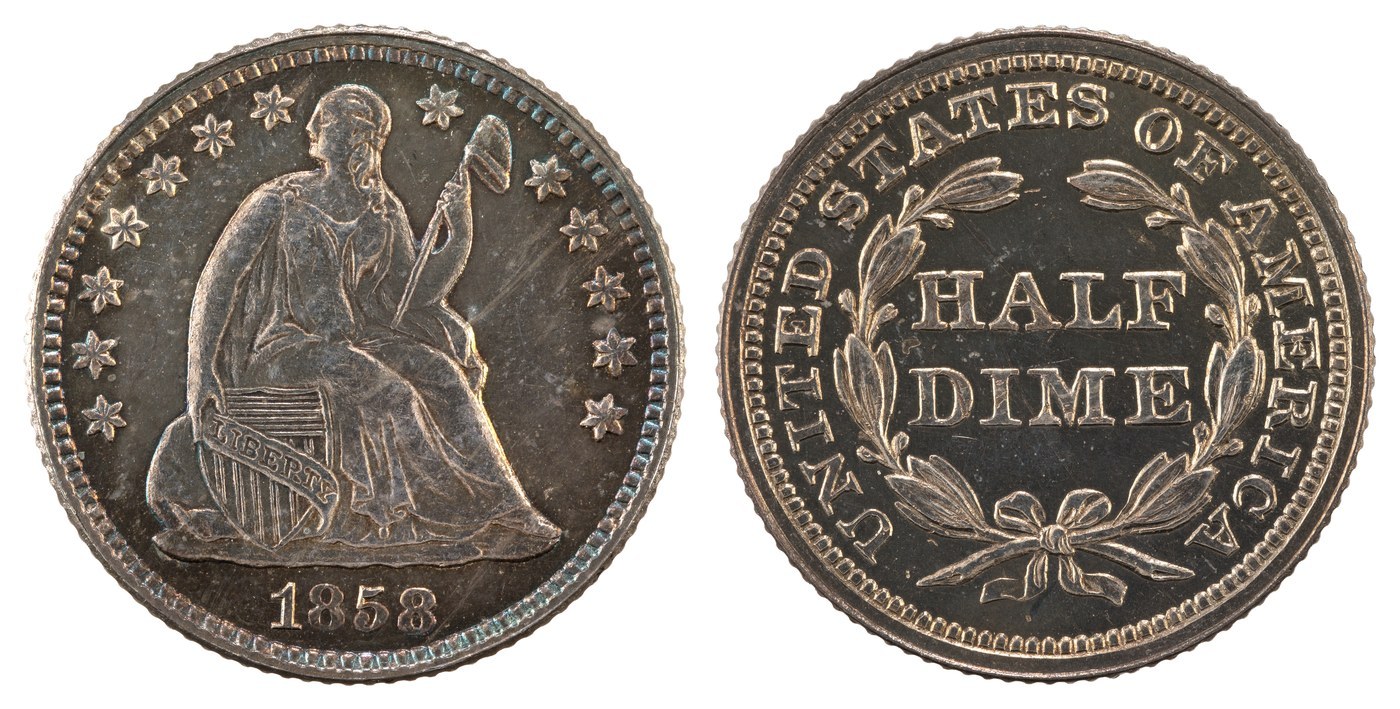
Seated Liberty Half Dime
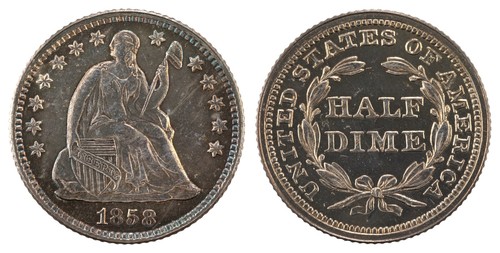
A tiny 90% silver five-cent piece showing Liberty seated with a shield and Liberty pole; the reverse wreath frames HALF DIME. First struck 1837.
- Country
- United States
- Denomination
- 5 Cents
- Metal
- Silver (90% silver, 10% copper)
Got a coin like this?
Identify any coin from a photo, free.
Overview
The Seated Liberty Half Dime is a small silver five-cent coin struck by the United States Mint beginning in 1837. Measuring only about 15.5 mm across, it is one of the smallest regularly circulating U.S. coins and is easily confused in size with the later Seated Liberty dime.
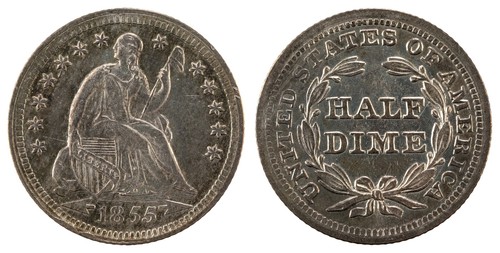
The obverse depicts the figure of Liberty seated on a rock, holding a shield inscribed "LIBERTY" and steadying a pole topped with a liberty cap. The reverse shows an open wreath surrounding the denomination "HALF DIME." Coins of the first year, dated 1837, appear without stars around the obverse, a look prized by type collectors.
Although the denomination sounds unusual today, the half dime filled the same five-cent role later taken over by the copper-nickel Shield and Liberty Head nickels. It circulated widely until the series ended in 1873.
History & Background
The half dime denomination dates to the earliest days of the U.S. Mint, but the Seated Liberty type began in 1837 when Chief Engraver Christian Gobrecht introduced a seated allegorical Liberty modeled on classical Britannia imagery. The same seated figure was rolled out across the silver series, giving the half dime, dime, quarter, half dollar, and dollar a unified national look.
The 1837 coins were struck without obverse stars, a spare early presentation. Beginning in 1838 thirteen stars were added around Liberty, and in the early 1840s extra drapery was added at Liberty's elbow, producing the design subtypes collectors track through the run. New Orleans joined Philadelphia in producing the coins, adding an "O" mint mark on the reverse.
The series continued through 1873, spanning the economic strains of the Civil War era, when silver coins largely vanished from circulation and were hoarded. Congress ended the silver half dime with the Coinage Act of 1873, and its five-cent role passed to the larger copper-nickel nickel.
How to Identify
Look at the obverse for the seated figure of Liberty resting on a rock. She holds a shield marked "LIBERTY" in one hand and steadies a tall pole capped with a liberty cap in the other. What can look like a harp at a glance is this shield-and-pole arrangement. On 1837 coins there are no stars in the field; later dates add thirteen stars around the rim.
The reverse carries an open wreath tied at the bottom, enclosing the words "HALF DIME." Note that the denomination is spelled out rather than shown as "5 CENTS," which helps separate it from the later nickel five-cent pieces.
The coin is silver (90% silver, 10% copper), very small at roughly 15.5 mm, with a reeded edge. Philadelphia coins carry no mint mark; New Orleans issues show a small "O" on the reverse, near the wreath. Its tiny size and bright silver tone are the quickest way to distinguish it from copper cents and later nickels.
Value & Collectibility
Value depends heavily on date, mint, variety, and condition. Common circulated dates are affordable and trade for modest premiums over their small silver content, while first-year 1837 "No Stars" coins, low-mintage dates, and certain New Orleans issues command higher prices. As a 19th-century silver type coin, even worn examples carry collector demand well above face value.
Condition drives price sharply upward. Coins with full, even wear, original surfaces, and no cleaning, holes, or damage are preferred; problem-free uncirculated pieces bring strong premiums. Because the coin is so small, details like a sharp shield and clear wreath matter greatly to grade.
Exact prices move with the silver market and collector demand, so consult a current price guide or recent auction records. Scarce dates and high grades are worth authenticating, since small silver coins can be cleaned, altered, or counterfeited.
Frequently asked questions
Is a half dime the same as a nickel?
It fills the same five-cent role but is not the same coin. The half dime is a tiny 90% silver piece made 1837–1873; the modern nickel is a larger copper-nickel coin that replaced it.
Why does the 1837 half dime have no stars?
The first-year 1837 coins were issued in a plain "No Stars" style. Beginning in 1838 thirteen stars were added around Liberty on the obverse.
What is Liberty holding on the obverse?
She holds a shield inscribed "LIBERTY" and steadies a pole topped with a liberty cap. Seen quickly, the shield and pole can resemble a harp.
Does my half dime have a mint mark?
Philadelphia coins have no mint mark. New Orleans issues show a small "O" on the reverse near the wreath. There is no mint mark on 1837 coins, which were all struck at Philadelphia.
How can I tell a half dime from a Seated Liberty dime?
They share the same design but the half dime is smaller (about 15.5 mm) and its reverse reads "HALF DIME," while the dime is larger and reads "ONE DIME."
Seated Liberty Half Dime guides
In-depth guides for identifying, valuing, and collecting Seated Liberty Half Dime.