
How to Identify the Seated Liberty Half Dime
A collector's guide to recognizing the Seated Liberty Half Dime by its seated figure, HALF DIME wreath, tiny silver size, and mint marks.
Read the full Seated Liberty Half Dime encyclopedia entry →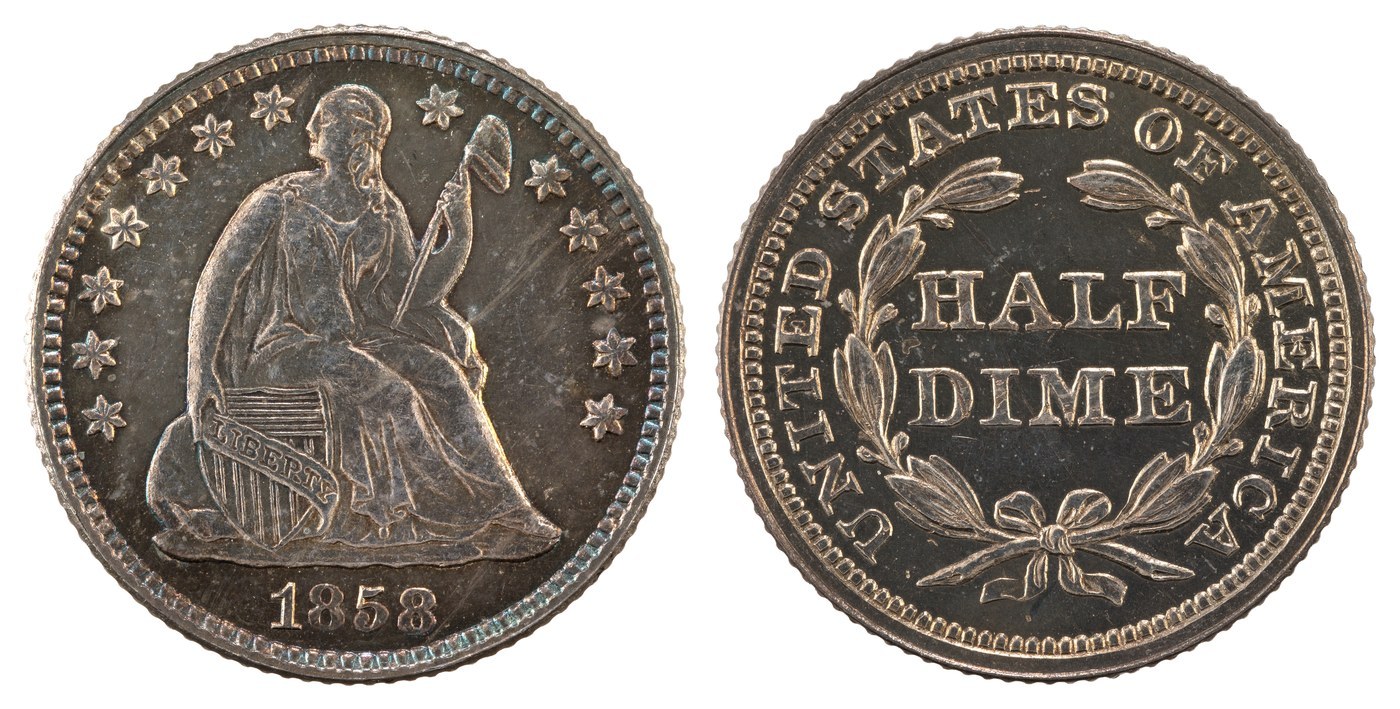
Begin with the obverse figure. A genuine Seated Liberty Half Dime shows Liberty seated on a rock, holding a shield marked "LIBERTY" and a pole topped with a liberty cap. This shield-and-pole grouping is what can look like a harp at first glance. On 1837 coins the field is plain with no stars; from 1838 onward thirteen stars ring Liberty, and early-1840s and later coins add drapery at the elbow. Matching these features to the date helps confirm the subtype.
Read the reverse carefully. The denomination appears as the spelled-out words "HALF DIME" inside an open wreath tied at the bottom. If the coin instead reads "ONE DIME," "5 CENTS," or "5 C," it is a different denomination. The spelled-out wording is a reliable diagnostic for this series.
Check size, metal, and edge. The coin should be very small, about 15.5 mm, struck in 90% silver with a reeded edge, and it should have a bright to gray silver tone rather than a copper or nickel color. Its tiny diameter is one of the fastest ways to separate it from cents and from later five-cent nickels. Weigh or measure it if you are unsure, since the small size is distinctive.
Locate any mint mark. Philadelphia coins carry no mint mark, while New Orleans issues show a small "O" on the reverse near the wreath. There is no "O" on 1837 coins. The mint mark, combined with the date and design subtype, is what determines rarity within the series.
Watch for look-alikes and problem coins. The Seated Liberty dime uses the same design at a larger size, so confirm the "HALF DIME" legend and the diameter before concluding. Cleaned, holed, bent, or corroded pieces are common with such small silver coins and reduce value even when correctly identified. For scarce dates or high grades, have the coin authenticated by a reputable third-party grading service.
Frequently asked questions
How do I tell a Seated Liberty Half Dime from a Seated Liberty dime?
Both share the seated design, but the half dime is smaller (about 15.5 mm) and its reverse reads "HALF DIME," while the dime is larger and reads "ONE DIME."
Where is the mint mark on a Seated Liberty Half Dime?
On New Orleans coins a small "O" appears on the reverse near the wreath. Philadelphia coins, including all 1837 issues, have no mint mark.
Is the design really a harp?
No. Liberty is holding a shield inscribed "LIBERTY" and a pole topped with a liberty cap. Seen quickly the shield-and-pole shape can be mistaken for a harp.
What size and metal should a genuine coin be?
It should be roughly 15.5 mm across, struck in 90% silver with a reeded edge, giving a small, bright silver coin noticeably smaller than a dime.