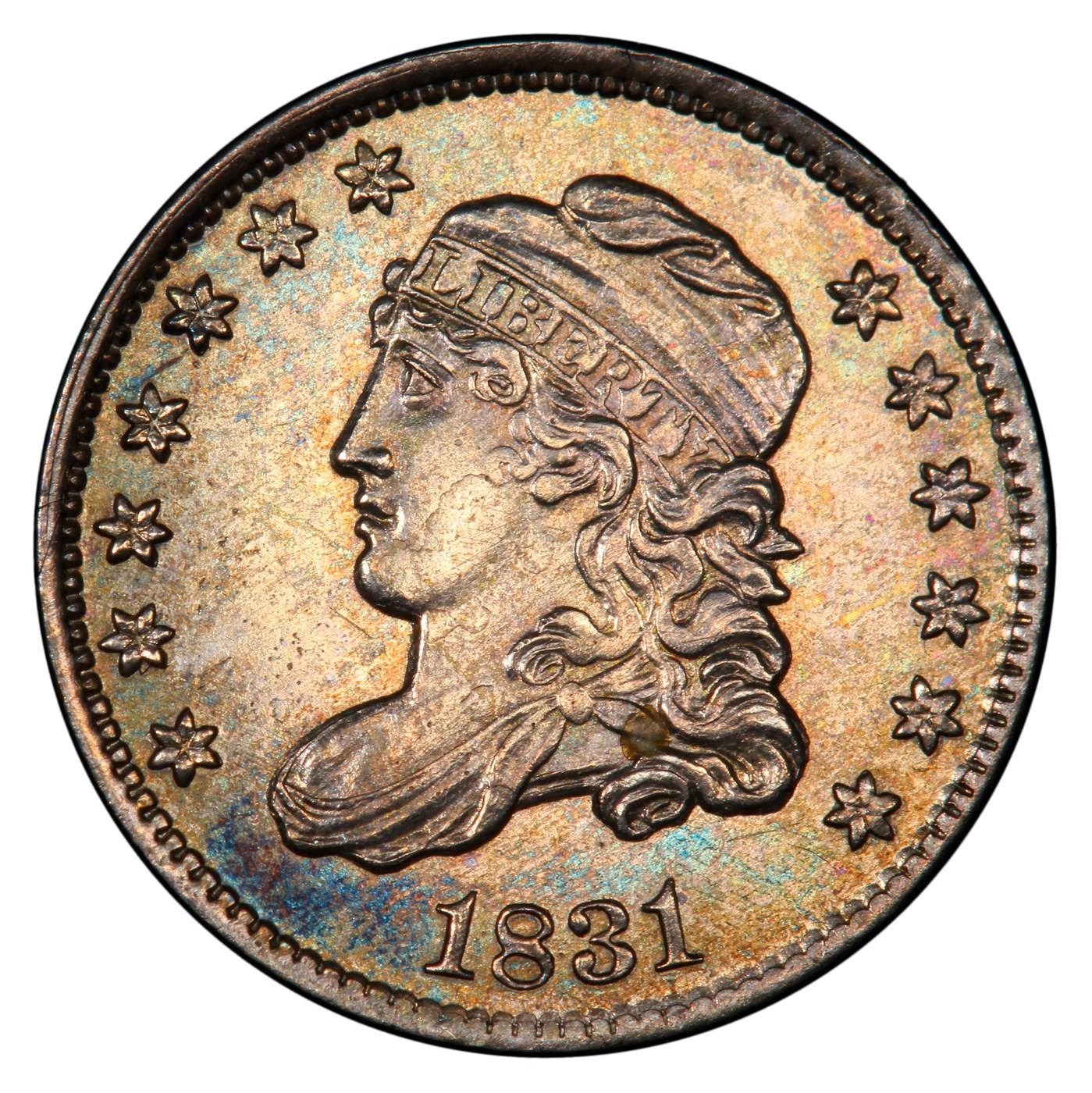
Capped Bust Half Dime
A small early U.S. silver five-cent piece showing Liberty in a Phrygian cap and a shielded eagle reverse, struck at Philadelphia from 1829 to 1837.
- Country
- United States
- Denomination
- 5 Cents
- Metal
- Silver
Got a coin like this?
Identify any coin from a photo, free.
Overview
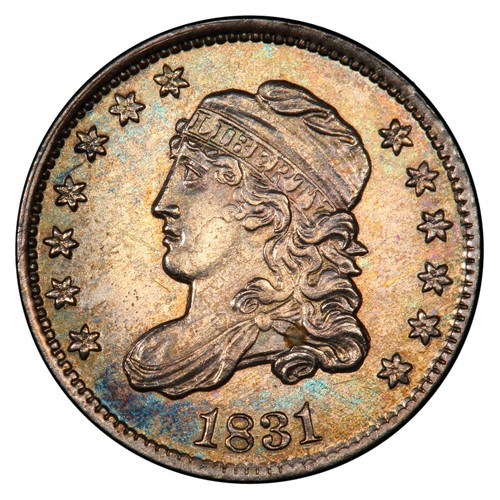
The Capped Bust Half Dime is a tiny silver coin worth five cents, part of the half dime denomination that preceded the modern nickel. Its obverse shows Liberty facing left wearing a soft Phrygian (liberty) cap tied with a band reading LIBERTY, framed by stars, while the reverse carries a heraldic eagle with a shield on its breast, an olive branch and arrows in its talons, and the denomination expressed as "5 C." The photographed example is dated 1831.
Measuring only about 15.5 millimeters across, it is among the smallest coins the United States has ever issued. It was struck entirely at the Philadelphia Mint during a short run in the 1830s, and the whole series was produced for general circulation as everyday small change in a period when silver coins still did the work of daily commerce.
Today the type is collected as an affordable and attractive piece of early American silver. Because it contains genuine silver and dates from the first decades of federal coinage, it appeals both to type collectors seeking one example and to specialists who pursue the die varieties known for the series.
History & Background
The half dime denomination reaches back to the first federal silver coins of 1792, but the Capped Bust design for it appeared only near the end of that early era. Introduced in 1829, the type was the work associated with Chief Engraver William Kneass, who adapted the Capped Bust motif already in use on the larger silver denominations to this smallest silver coin.
Production ran from 1829 through 1837 at the Philadelphia Mint, the only mint striking coins at the time. The design was made using improved close-collar technology, which gave the coins a consistent diameter and a uniform, upright reeded edge compared with earlier hand-adjusted pieces.
In 1837 the Capped Bust half dime gave way to the Liberty Seated design, part of a broader redesign of American silver coinage under Christian Gobrecht. The half dime denomination itself continued until 1873, when it was discontinued; the five-cent role later passed to the larger copper-nickel piece we call the nickel.
How to Identify
Confirm the obverse first: Liberty faces left wearing a rounded Phrygian cap, with the word LIBERTY on the band across the cap. Stars run around the border with the date below the bust; the pictured coin reads 1831. The portrait is a bust cut off at the shoulder, not a full standing or seated figure.
On the reverse, look for a spread-winged eagle holding a shield on its chest, grasping an olive branch and a bundle of arrows. UNITED STATES OF AMERICA arches around the top and the denomination is abbreviated as "5 C." at the bottom. This heraldic-eagle reverse distinguishes the type from the wreath reverses used on later half dimes.
The coin is small silver: roughly 15.5 mm in diameter, about 1.3 grams, with a reeded edge and no mint mark, since all were struck at Philadelphia. The soft, rich gray toning typical of old circulated silver, along with the small size, helps separate a genuine piece from later or larger look-alikes.
Value & Collectibility
Value depends mainly on the coin's grade and eye appeal rather than the date, because the common Philadelphia issues of the 1830s survive in reasonable numbers. Well-worn but problem-free examples are among the more affordable pieces of early U.S. silver, while sharp, lightly worn coins and lustrous uncirculated survivors carry strong premiums. The tiny silver content adds only a small floor to the price.
Original surfaces matter a great deal. Attractive natural gray toning, full LIBERTY on the cap band, and crisp eagle detail all raise desirability, whereas cleaning, scratches, bent flans, or holes sharply reduce value on such a small, thin coin.
The series is also known for collectible die varieties, and certain scarcer varieties or high grades can command far more than a typical example. For any coin you believe to be scarce or high grade, third-party grading is worthwhile given the type's small size and the prevalence of cleaned pieces.
Frequently asked questions
Is the Capped Bust Half Dime made of silver?
Yes. It is a small silver coin of about 15.5 mm. The silver content is modest given its tiny size, so most of its value comes from age, condition, and collector demand rather than bullion.
What does the "5 C." on the reverse mean?
It is the denomination: five cents, or one half dime. The half dime was the silver five-cent coin used before the copper-nickel nickel took over that role.
Does it have a mint mark?
No. Every Capped Bust half dime was struck at the Philadelphia Mint, which used no mint mark, so a blank spot for one is normal and correct.
How is it different from a nickel?
It is much smaller, made of silver, and denominated as a half dime reading "5 C." The modern nickel is a larger copper-nickel coin introduced decades later; the two are unrelated in size and metal.
Are 1831 half dimes rare?
The 1831 date is one of the more available issues of the series in circulated grades. It is collectible and historic, but common dates like this are not rare unless in high grade or a scarce die variety.
Capped Bust Half Dime guides
In-depth guides for identifying, valuing, and collecting Capped Bust Half Dime.