
How to Identify the Capped Bust Half Dime
A collector's checklist for confirming a Capped Bust Half Dime: reading the cap-and-eagle design, checking its tiny silver size, and ruling out look-alikes.
Read the full Capped Bust Half Dime encyclopedia entry →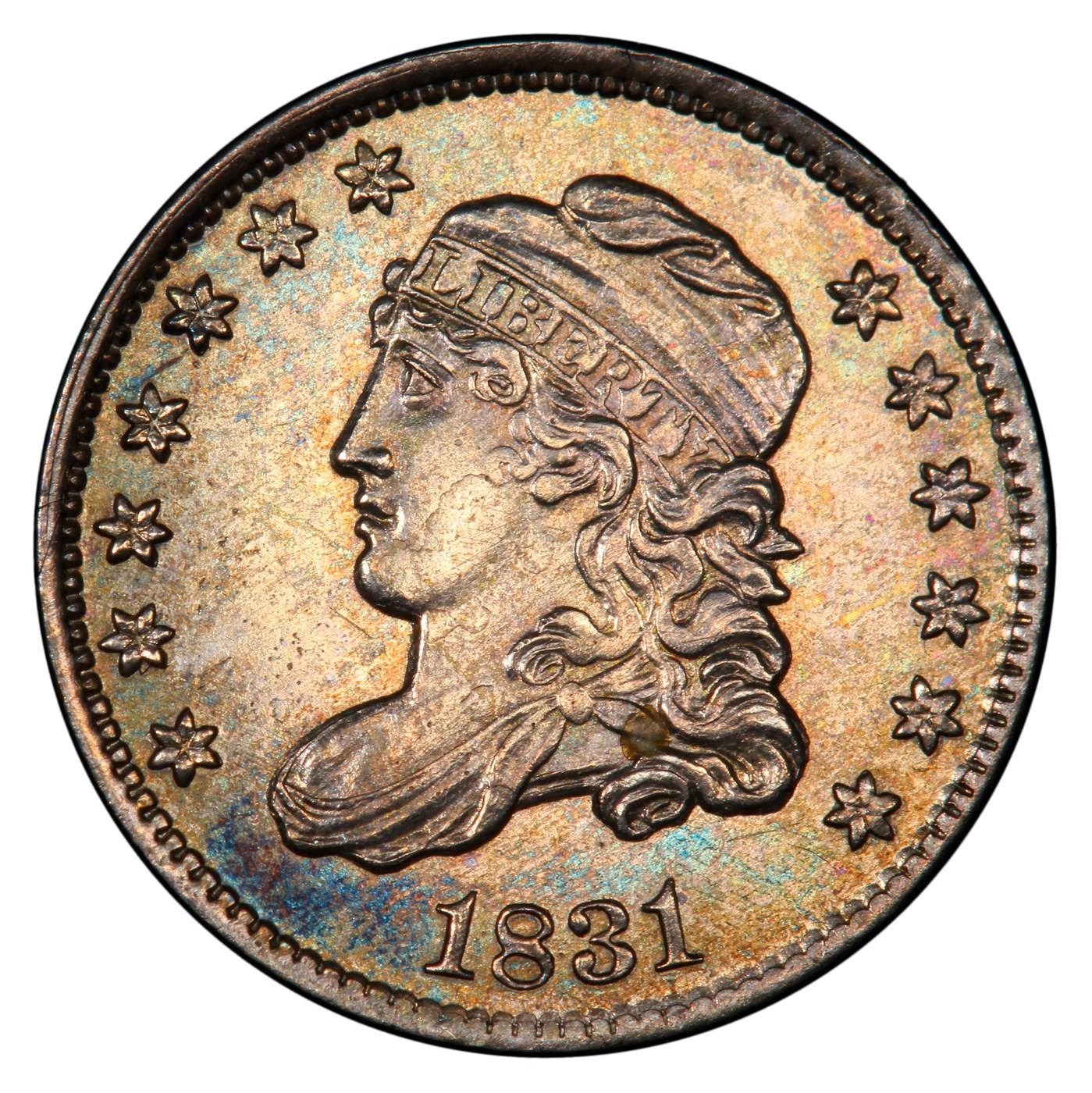
Begin with the obverse portrait. A genuine Capped Bust half dime shows Liberty facing left in a soft, rounded Phrygian cap with LIBERTY lettered on the band across it, surrounded by stars, with the date beneath the bust. On the pictured coin the date reads 1831. If the figure is seated, standing, or bare-headed, you are looking at a different half dime type.
Turn to the reverse and confirm the heraldic eagle: wings spread, a striped shield on its breast, an olive branch and a bundle of arrows in its talons, UNITED STATES OF AMERICA around the top, and the denomination abbreviated "5 C." below. This eagle reverse is the key diagnostic separating the Capped Bust type from the later Liberty Seated half dimes, which use a wreath around the words HALF DIME.
Check the physical coin. It should be silver, only about 15.5 mm across (smaller than a modern dime), weigh roughly 1.3 grams, and have a reeded edge. There is no mint mark, because all were struck at Philadelphia; do not treat the absence of one as a problem. Natural, even gray toning is normal for circulated silver of this age.
Watch for look-alikes and alterations. The tiny size makes these coins easy to bend, hole for jewelry, or clean, all of which hurt value. Because the series has collectible die varieties and the type is old and small, cast or altered fakes exist. Compare the diameter and weight against known figures, examine the reeded edge for casting seams, and be wary of unnaturally bright or glossy surfaces that suggest harsh cleaning.
For any coin that appears scarce, high grade, or unusually valuable, have it authenticated and graded by a recognized third-party service. On a coin this small, precise measurement and expert verification give far more certainty than a naked-eye guess.
Frequently asked questions
How do I tell a Capped Bust half dime from a Liberty Seated half dime?
Look at both sides. The Capped Bust type shows a capped Liberty bust and a shielded eagle reading "5 C."; the Liberty Seated type shows a full seated Liberty and a wreath reverse reading HALF DIME.
What size and weight should it be?
A genuine Capped Bust half dime is silver, about 15.5 mm in diameter, weighs roughly 1.3 grams, and has a reeded edge. It is noticeably smaller than a modern dime.
Where is the mint mark located?
There is none. Every Capped Bust half dime was struck at the Philadelphia Mint, which used no mint mark, so you should not expect to find one on the coin.
What are the biggest authentication risks?
Cleaning, bending, and holing are common on such a small thin coin, and altered or cast fakes exist. Verify diameter, weight, and the reeded edge, and use a reputable grading service for any piece that seems scarce or high grade.