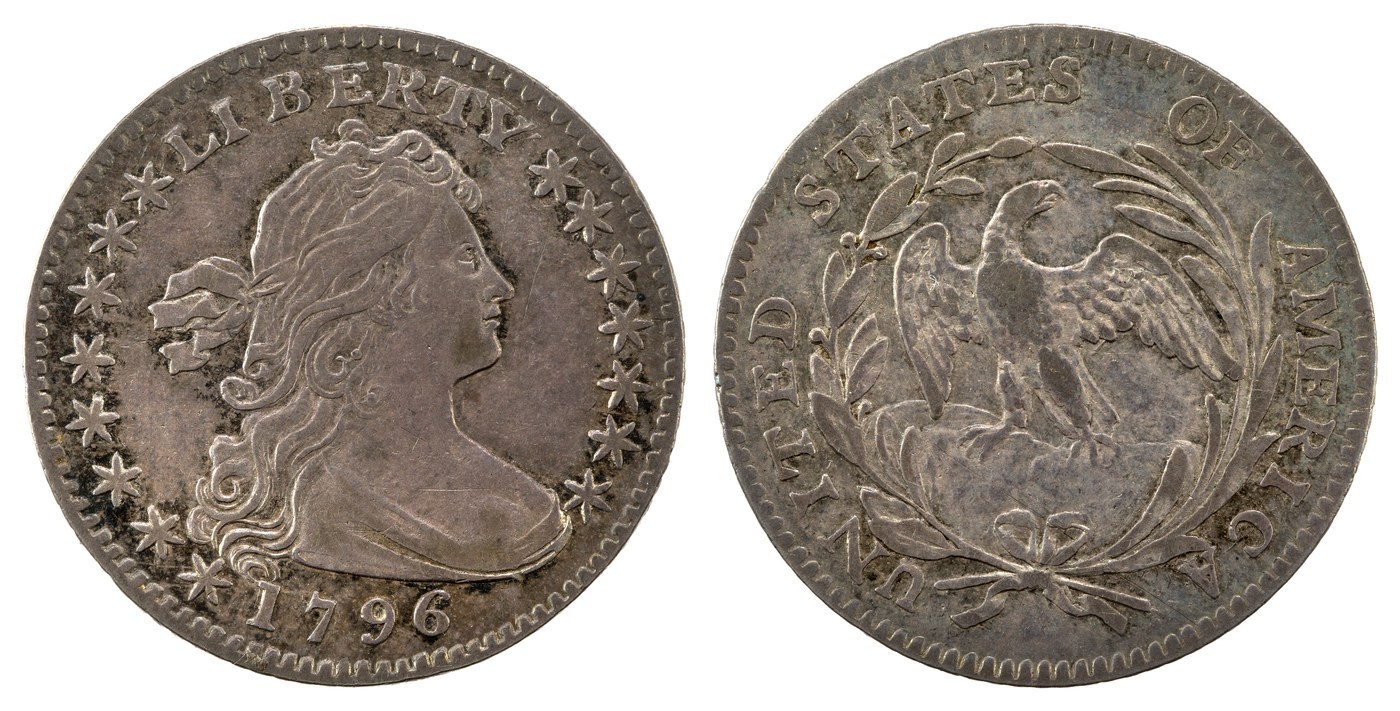
Draped Bust Half Dime
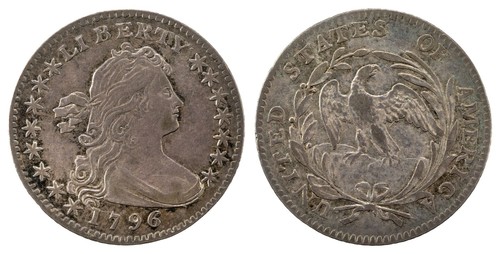
An early U.S. silver five-cent piece showing a draped bust of Liberty ringed by stars; the tiny half dime was struck 1796–1805.
- Country
- United States
- Denomination
- 5 Cents
- Metal
- Silver
Got a coin like this?
Identify any coin from a photo, free.
Overview
The Draped Bust half dime is an early United States silver coin worth five cents — literally half a dime. It is a very small piece, only about 16.5 mm across, struck on a thin silver planchet at the first Philadelphia Mint. The obverse shows a draped bust of Liberty with flowing curls, LIBERTY curved above, the date below, and a ring of stars around the field; the 1796 example seen here is a first-year coin of the type.
Because these coins were hand-struck early in the Mint's history in small quantities, survivors are scarce and highly prized. Like other silver of the era the half dime carries no mark of value on the coin itself — it is identified as a five-cent piece by its size and design rather than by a stamped denomination.
History & Background
The half dime denomination followed the 1794–1795 Flowing Hair type, and in 1796 the Mint adopted Robert Scot's Draped Bust portrait of Liberty, the same general style then appearing across U.S. silver and copper coinage and traditionally linked to a Gilbert Stuart drawing. Draped Bust half dimes were made 1796–1797 with a small-eagle reverse and 1800–1805 with a heraldic-eagle reverse; none were struck in 1798, 1799, or 1804, and mintages throughout were tiny.
Every Draped Bust half dime was produced at the Philadelphia Mint and therefore bears no mint mark. The 1796 date is notable for a range of star counts — reflecting states joining the Union — and for well-known die oddities such as the 1796/5 overdate and a misspelled LIKERTY variety. The Draped Bust type was replaced by the Capped Bust half dime beginning in 1829 after a long pause in the denomination.
How to Identify
Look for a very small silver coin, roughly 16.5 mm in diameter — smaller and thinner than a modern dime — showing Liberty with a draped bust and loose, curling hair. LIBERTY arcs above the portrait, the four-digit date sits below (1796 on the coin shown here), and a circle of stars surrounds the bust. On 1796 pieces the number of stars varies, so counting them is part of attribution.
The reverse, not visible on this example, determines the sub-type: 1796–1797 coins carry a small, delicate eagle perched within an open wreath, while 1800–1805 coins show a larger heraldic eagle with a shield. UNITED STATES OF AMERICA runs around the reverse rim, and there is no stated denomination anywhere on the coin. Because these were struck by hand, expect some off-center detail, adjustment marks, and slightly uneven rims; genuine surfaces tone naturally to gray or russet silver.
Value & Collectibility
Draped Bust half dimes are scarce across the board, and the 1796 first-year date is one of the more sought-after issues in the series. Even heavily worn, honest examples typically trade in the low- to mid-thousands of dollars, while problem-free coins with clear detail bring substantially more, and high grades or famous varieties reach well into five figures.
Condition, originality, and eye appeal drive value sharply: cleaning, scratches, bends, holes, and porous or artificially toned surfaces reduce a coin dramatically, while original gray or lightly toned silver is favored. Given the money involved and the number of contemporary and modern counterfeits, it is best to have the exact date, star count, and variety attributed and authenticated before assigning a firm figure.
Frequently asked questions
Is a half dime the same as a nickel?
No. The half dime is an early five-cent coin struck in silver, while the later nickel five-cent piece (from 1866) is made of copper-nickel. They share a face value of five cents but are different coins entirely.
Why doesn't my 1796 half dime say five cents anywhere?
Early U.S. silver coins carried no mark of value on the coin. The half dime is recognized as a five-cent piece by its small size and design rather than by a stamped denomination.
Why is there no mint mark?
All Draped Bust half dimes were struck at the Philadelphia Mint, which did not use a mint mark at the time. The absence of one is normal and expected for the series.
What is the coin made of?
It is struck in silver alloyed with a small amount of copper. The piece is tiny and light, so its value comes from rarity, age, and condition far more than from its modest silver content.
Draped Bust Half Dime guides
In-depth guides for identifying, valuing, and collecting Draped Bust Half Dime.