
How to Identify the Draped Bust Half Dime
A collector's walkthrough for confirming a 1796–1805 Draped Bust half dime by size, portrait, star count, reverse eagle, and authenticity.
Read the full Draped Bust Half Dime encyclopedia entry →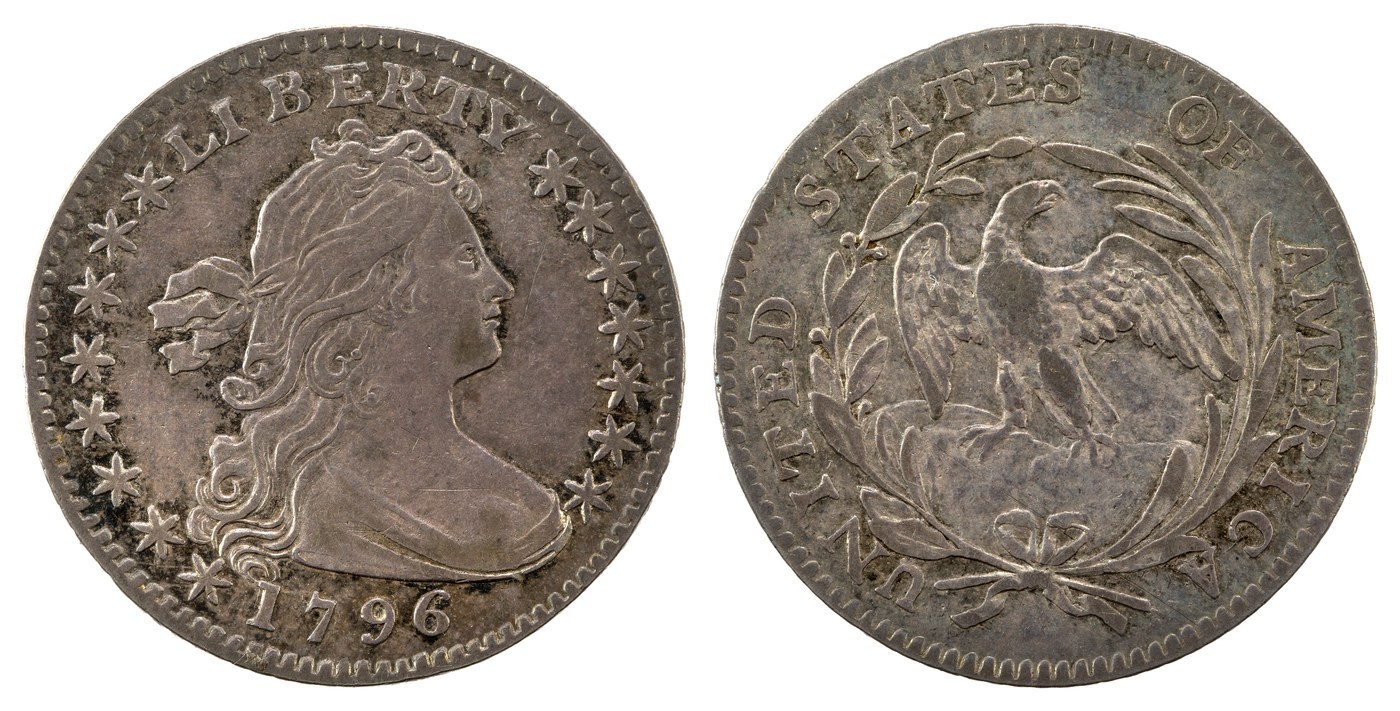
Start with size and metal. The Draped Bust half dime is a silver coin only about 16.5 mm across and very thin — noticeably smaller than a modern dime. If your coin is copper-colored, much larger, or reads FIVE CENTS or a value anywhere, it is not an early half dime. These pieces carry no stated denomination at all.
Read the obverse. Liberty appears as a draped bust with loose, flowing curls, LIBERTY curved above and a four-digit date below, with stars ringing the field. This distinguishes the Draped Bust type (1796–1805) from the earlier Flowing Hair half dime (1794–1795), whose hair streams behind without drapery, and from the later Capped Bust half dime (from 1829), where Liberty wears a cloth cap inscribed LIBERTY. On 1796 coins, count the stars — 15 and 16-star arrangements exist — and watch for the 1796/5 overdate and the LIKERTY spelling error.
Use the reverse to pin down the sub-type. A 1796–1797 half dime shows a small, slender eagle standing inside an open wreath; an 1800–1805 half dime shows a broad heraldic eagle with a shield on its breast. UNITED STATES OF AMERICA circles the rim in both cases. Because the denomination never appears, the eagle style plus the date is how specialists narrow the exact issue.
Be cautious about authenticity. Genuine early half dimes are hand-struck and often show adjustment file marks, minor off-centering, and natural gray-to-russet silver toning. Red flags include casting seams, a soft mushy strike, a wrong weight, bright unnatural whiteness, or evidence of a filled hole. Given the strong values these coins command, and the many counterfeits, third-party grading and variety attribution are the safest way to confirm a piece before buying or selling.
Frequently asked questions
How do I tell a Draped Bust half dime from a Draped Bust dime?
Size is the giveaway. The half dime is tiny, about 16.5 mm, while the Draped Bust dime is clearly larger at roughly 19 mm. Both share the same portrait style, so compare diameters directly.
What star counts and varieties should I look for on an 1796?
1796 half dimes are known with 15 and 16 stars, plus the prized 1796/5 overdate and the LIKERTY die blunder. Counting stars and checking the date closely is essential to attribution and value.
Should I clean my early silver half dime before identifying it?
No. Cleaning strips the natural toning collectors want and can sharply lower value while masking details used to judge authenticity. Identify and evaluate it as-is, then consult a specialist.