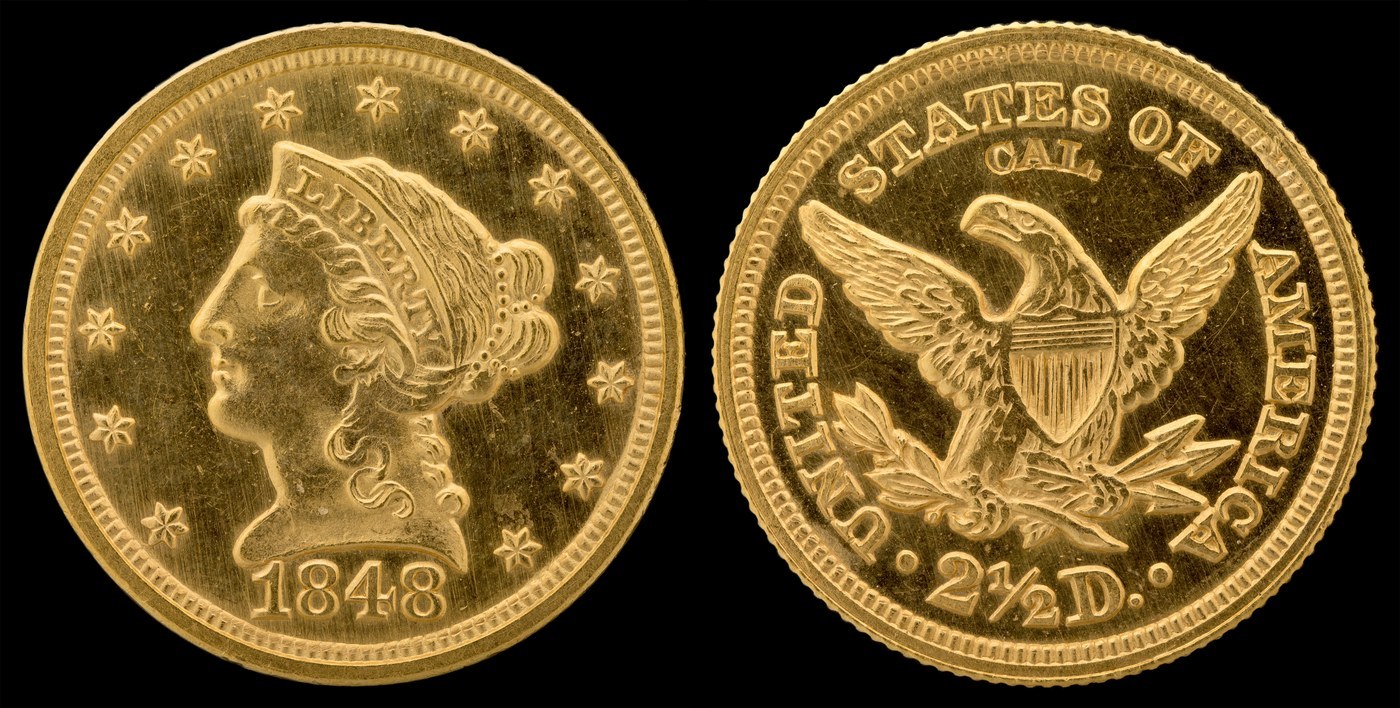
Liberty Head Quarter Eagle
U.S. $2.50 gold coin struck 1840–1907, with a coronet-crowned Liberty head obverse and a shield-breasted eagle reverse marked "2½ D."
- Country
- United States
- Denomination
- 2.5 dollars
- Metal
- 90% Gold, 10% Copper
Got a coin like this?
Identify any coin from a photo, free.
Overview
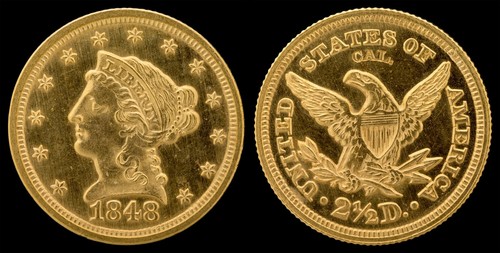
The Liberty Head Quarter Eagle is a United States two-and-a-half dollar gold coin produced from 1840 through 1907. Its obverse shows a left-facing Liberty wearing a coronet inscribed "LIBERTY," her hair in curls gathered behind, encircled by stars with the date below. The reverse depicts a bald eagle bearing a Union shield and clutching an olive branch and arrows, with the denomination expressed as "2½ D." The example shown here is dated 1848.
Struck in a gold-copper alloy at several U.S. mints, the quarter eagle was a small but genuine circulating gold coin of the 19th century. With a run of nearly seven decades, it is one of the longest-lived U.S. gold designs and a popular entry point for collectors of classic American gold.
History & Background
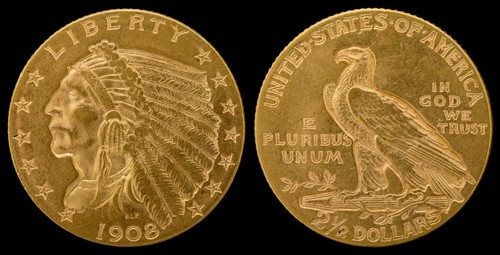
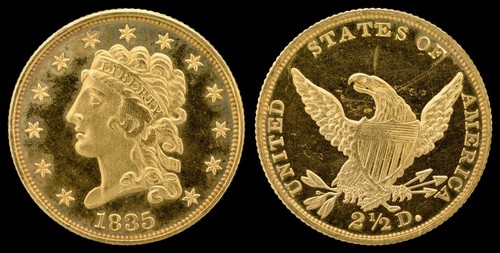
The Liberty Head, or Coronet, Quarter Eagle was designed by Mint engraver Christian Gobrecht and replaced the earlier Classic Head quarter eagle in 1840. The design followed the coinage standards set by the Act of 1837, giving the coin a gold content of about 90% gold and 10% copper. It was struck continuously, with only minor interruptions, until 1907, when it was replaced by Bela Lyon Pratt's incuse Indian Head quarter eagle.
Beyond Philadelphia, the series was struck at the Southern branch mints of Charlotte (C) and Dahlonega (D), as well as New Orleans (O) and San Francisco (S), making mint mark an important part of collecting the type. The 1848 date shown here is notable in the series: alongside regular Philadelphia and branch-mint coinage, a small group of 1848 quarter eagles was counterstamped "CAL." above the eagle to mark gold sent east from the newly discovered California fields—a famous and rare variety. Most 1848 coins, however, are ordinary circulating strikes without that mark.
How to Identify
The obverse shows Liberty facing left wearing a coronet lettered "LIBERTY," her hair drawn back in curls, surrounded by stars with the four-digit date beneath. The reverse displays a bald eagle with a striped Union shield on its breast, holding an olive branch and a bundle of arrows, with "UNITED STATES OF AMERICA" arcing above and the value "2½ D." below the eagle. Unlike the larger gold denominations of the era, this reverse carries no "E PLURIBUS UNUM" motto scroll.
This is a small coin: roughly 18 mm in diameter and about 4.18 grams, struck in an alloy of about 90% gold. Philadelphia issues carry no mint mark; coins from the branch mints show a small "C," "D," "O," or "S" on the reverse, below the eagle. The 1848 issue is a no-motto Coronet type; on genuine "CAL." examples the letters are punched into the field above the eagle.
Value & Collectibility
As a small classic gold coin, the Liberty Head Quarter Eagle carries a floor value tied to its gold content of roughly one-eighth of an ounce, and common later Philadelphia dates in circulated grades typically trade at a moderate premium over that bullion value. Demand for classic U.S. gold keeps even ordinary examples collectible.
Scarcity varies enormously by date and mint. Coins from the Charlotte and Dahlonega mints, low-mintage early Philadelphia dates, and the celebrated 1848 "CAL." counterstamp command strong premiums, ranging from significant multiples of bullion to values reserved for major rarities. As with all gold, cleaning, damage, mount marks, and repairs reduce value, and because scarce dates and the "CAL." variety are targets for alteration and counterfeiting, higher-value pieces are best purchased certified by a reputable grading service.
Frequently asked questions
What is a Liberty Head Quarter Eagle made of?
It is a U.S. gold coin struck in about 90% gold and 10% copper. It weighs roughly 4.18 grams and measures about 18 mm across, containing close to one-eighth of an ounce of gold.
What does "2½ D." on the reverse mean?
It stands for two and a half dollars, the coin's face value. The quarter eagle was the $2.50 denomination in the U.S. gold series.
Where is the mint mark on a Liberty Head Quarter Eagle?
On the reverse, below the eagle. Philadelphia coins have no mint mark, while branch-mint pieces show a small C (Charlotte), D (Dahlonega), O (New Orleans), or S (San Francisco).
Is an 1848 Quarter Eagle rare?
Regular 1848 coins are scarcer than many later dates but are collectible circulating strikes. The separate 1848 "CAL." counterstamped variety, made from early California gold, is a famous rarity worth far more.
Liberty Head Quarter Eagle guides
In-depth guides for identifying, valuing, and collecting Liberty Head Quarter Eagle.