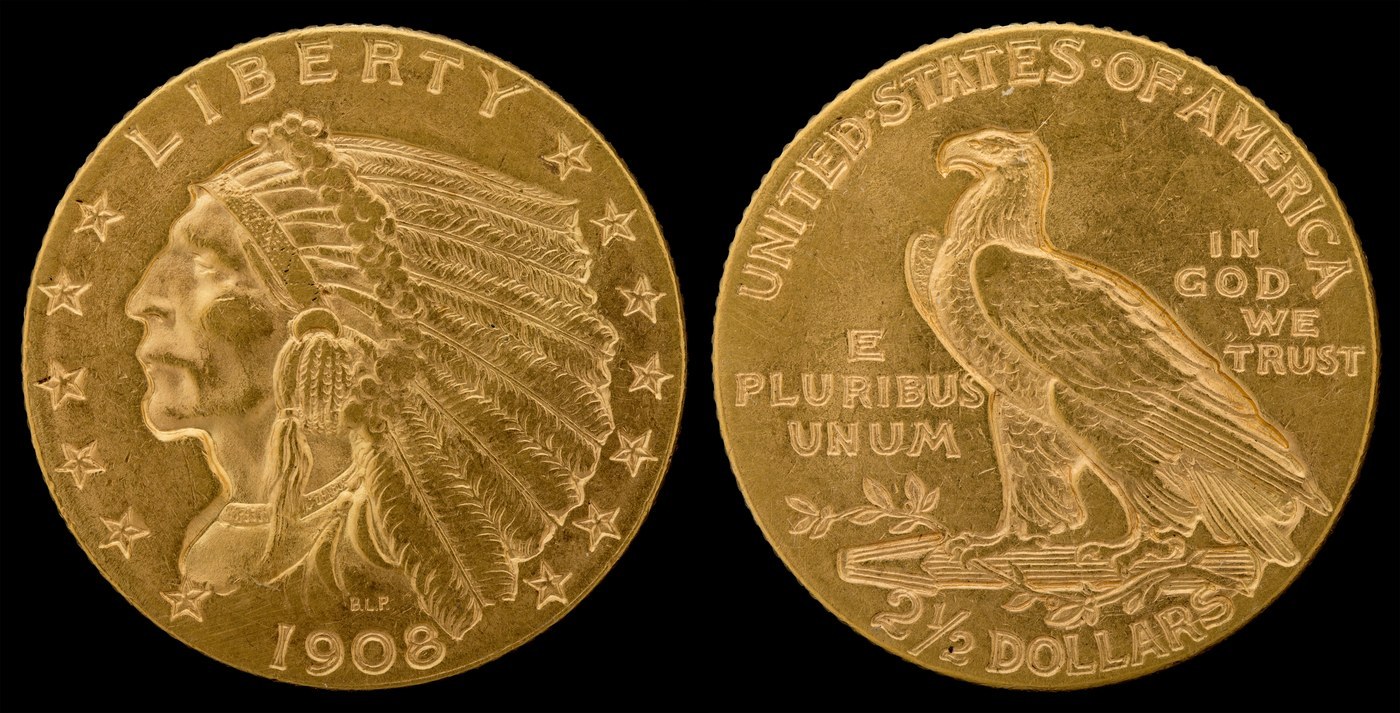
Indian Head Quarter Eagle
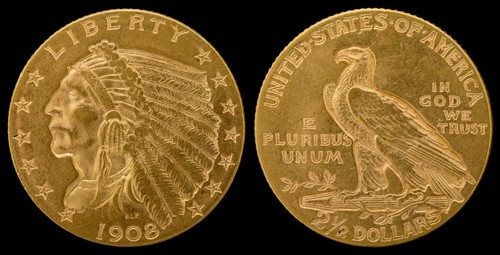
U.S. $2.50 gold coin of 1908–1929 with a sunken (incuse) design: an Indian in a feathered war bonnet on the obverse and a standing eagle reverse.
- Country
- United States
- Denomination
- 2.5 dollars
- Metal
- 90% Gold, 10% Copper
Got a coin like this?
Identify any coin from a photo, free.
Overview
The Indian Head Quarter Eagle is a United States $2.50 gold coin struck between 1908 and 1929. Its obverse shows the head of a Native American wearing a full feathered war bonnet and facing left, ringed by stars, while the reverse depicts a standing bald eagle. The coin is best known for its unusual incuse, or sunken-relief, design, in which the devices and lettering are recessed below a flat field rather than raised above it. The example pictured is dated 1911 and carries a "D" mint mark for Denver.
Struck in the same 90% gold alloy used for other U.S. gold coinage of the era, the quarter eagle is a small coin—about the size of a modern U.S. nickel but heavier and made of gold. It was designed by sculptor Bela Lyon Pratt and shares its distinctive incuse treatment with the larger Indian Head Half Eagle ($5). The 1911-D is the scarcest and most sought-after date in the series.
History & Background
The Indian Head Quarter Eagle was part of a broader early-20th-century effort to modernize American coinage. Boston sculptor Bela Lyon Pratt, working at the suggestion of collector and physician William Sturgis Bigelow, produced both the $2.50 and $5.00 gold designs in 1908 to replace the long-running Liberty Head (Coronet) quarter eagle. Pratt's most radical idea was to sink the design into the coin so that the highest points of the relief sat at or below the surrounding field, a technique inspired in part by ancient Egyptian sunken carving.
The series was struck from 1908 through 1915 and again from 1925 through 1929, with production interrupted during and after World War I. Only two mints made the coin: Philadelphia, which struck the bulk of the issues without a mint mark, and Denver. Denver produced quarter eagles of this type in a single year, 1911, and that 1911-D issue—with a mintage far smaller than any other date—became the recognized key of the series. U.S. gold coinage for circulation ended in the early 1930s, and no quarter eagles were struck after 1929.
How to Identify
The obverse shows the head of a Native American facing left, wearing a feathered headdress (war bonnet) inscribed "LIBERTY" on its band, with "UNITED STATES OF AMERICA" and thirteen stars around the border and the date below. Because the design is incuse, the portrait and lettering are cut into the coin rather than raised, and there is no raised rim—the field is the highest surface. The reverse shows a standing bald eagle, left-facing, perched on a bundle of arrows with an olive branch, alongside the mottoes "E PLURIBUS UNUM" and "IN GOD WE TRUST" and the denomination "2½ DOLLARS."
This is a small gold coin: about 18 mm in diameter and roughly 4.18 grams, struck in an alloy of 90% gold and 10% copper. The mint mark, when present, is on the reverse at the lower left, to the left of the arrow feathers; a "D" indicates Denver, while Philadelphia issues carry no mint mark. The coin pictured here, an 1911-D, is identified by that reverse "D."
Value & Collectibility
As a small gold coin, even a common-date Indian Head Quarter Eagle carries a base value tied to its gold content, and collectible examples trade at a premium above that depending on date, mint, and condition. Circulated common dates are relatively affordable type coins, while high-grade, fully original pieces command substantially more because the shallow incuse design shows wear and marks readily.
The 1911-D is the exception: as the key date of the series it brings a large premium over common issues in every grade, and prices climb sharply in higher grades. Within the 1911-D there is also a well-known distinction between coins showing a bold, "Strong D" mint mark and those with a weak or faint "D," with the strong variety more desirable. Because of its value and the design's popularity, the series—and the 1911-D in particular—has been heavily counterfeited and mint marks have been fraudulently added to Philadelphia coins, so authentication is essential before assigning value.
Frequently asked questions
What is an Indian Head Quarter Eagle made of?
It is a U.S. $2.50 gold coin struck in 90% gold and 10% copper. It measures about 18 mm across and weighs roughly 4.18 grams.
Why is the design sunken into the coin?
Designer Bela Lyon Pratt used an incuse (sunken-relief) technique so the devices sit below a flat field. This unusual approach is a hallmark of both the Indian Head quarter eagle and its companion $5 half eagle.
Where is the mint mark, and what does a "D" mean?
The mint mark is on the reverse at the lower left, next to the arrow feathers. A "D" indicates the Denver Mint; coins with no mint mark were struck at Philadelphia.
Is the 1911-D valuable?
The 1911-D is the key date of the series and commands a strong premium over common dates in all grades. Because of that, it is frequently counterfeited or has a false "D" added, so it should be authenticated by a professional grading service.
What years was the Indian Head Quarter Eagle made?
It was struck from 1908 to 1915 and again from 1925 to 1929. Denver struck it in only one year, 1911, producing the scarce 1911-D.
Indian Head Quarter Eagle guides
In-depth guides for identifying, valuing, and collecting Indian Head Quarter Eagle.