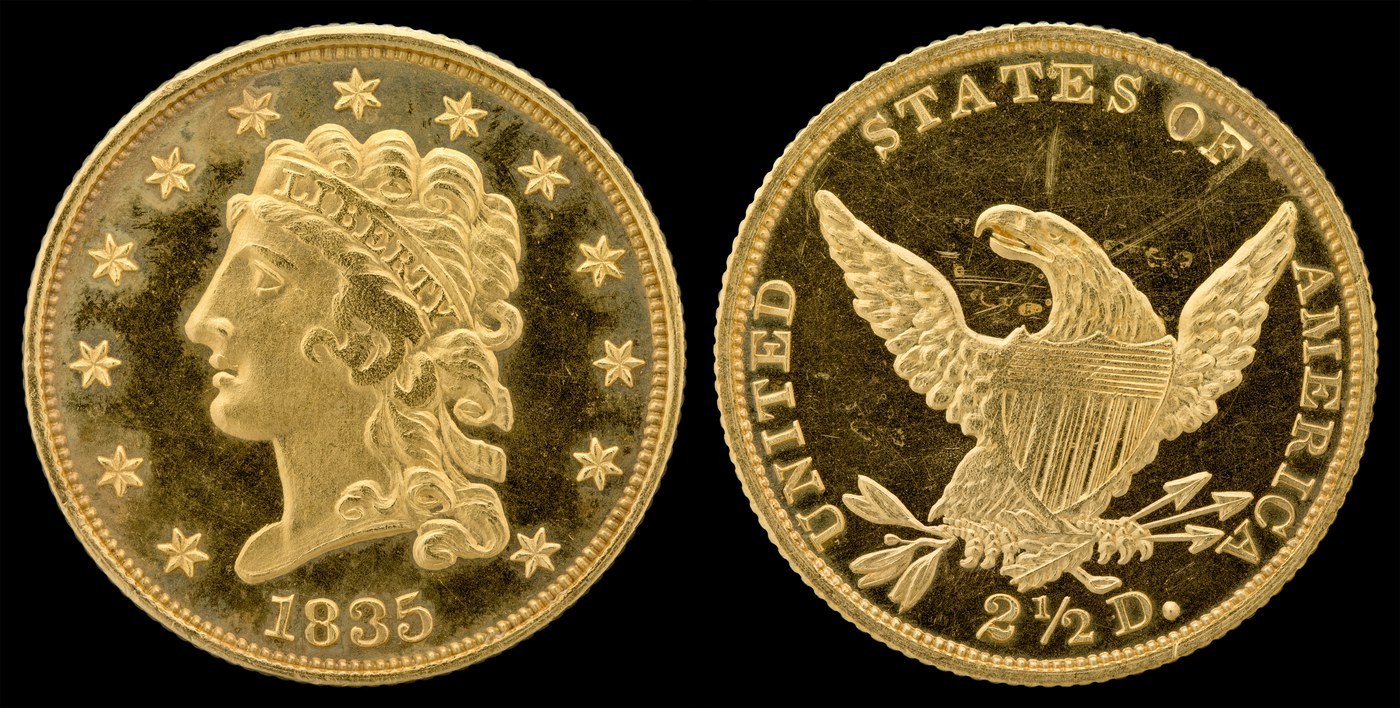
Classic Head Quarter Eagle
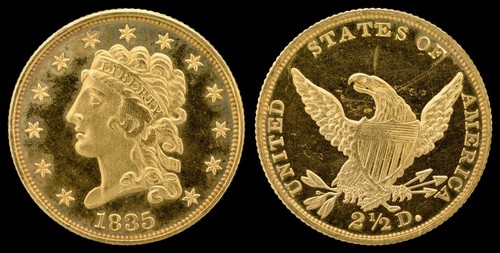
U.S. $2.50 gold coin struck 1834–1839, with a band-bound Liberty head obverse and a shield-breasted eagle reverse marked "2½ D."
- Country
- United States
- Denomination
- 2.5 dollars
- Metal
- About 90% Gold, balance Copper and Silver
Got a coin like this?
Identify any coin from a photo, free.
Overview
The Classic Head Quarter Eagle is a United States two-and-a-half dollar gold coin produced from 1834 through 1839. Its obverse shows a left-facing Liberty with her hair bound by a plain band or cord inscribed "LIBERTY," encircled by thirteen stars with the date below. The reverse depicts a bald eagle bearing a Union shield and clutching an olive branch and arrows, with the denomination expressed as "2½ D." The example shown here is dated 1835, an early Philadelphia issue of the type.
Struck in a gold alloy at the Philadelphia Mint and, in the type's final years, at Southern branch mints, this was the first small U.S. gold coin to actually circulate widely rather than being hoarded or melted. As a short-lived, scarce early gold series, it is prized both as a type coin and as a bridge between the old-tenor Capped Head gold and the long-running Coronet gold that followed.
History & Background
The Classic Head Quarter Eagle was engraved by William Kneass and introduced in 1834 following the Act of June 28, 1834, which reduced the weight of U.S. gold coins. Earlier Capped Head quarter eagles contained enough gold to be worth more than face value as bullion, so they were widely melted and rarely seen in commerce. The lighter Classic Head coins finally circulated, making the type historically important as the point at which small gold coins returned to everyday use.
To visually mark the new, reduced standard, the Mint removed the "E PLURIBUS UNUM" motto that had appeared above the eagle on the preceding Capped Head reverse; the Classic Head reverse carries no motto scroll. An 1835 coin like the one pictured is a Philadelphia strike with no mint mark. Branch-mint production came only at the very end of the series: Charlotte (C) and Dahlonega (D) in 1838–1839 and New Orleans (O) in 1839. The type was replaced in 1840 by Christian Gobrecht's Coronet (Liberty Head) quarter eagle.
How to Identify
The obverse shows Liberty facing left, her hair rolled and secured by a plain band or fillet lettered "LIBERTY"—there is no coronet and no cloth cap. Thirteen stars ring the border and the four-digit date sits at the bottom. The reverse displays a bald eagle with a striped Union shield on its breast, holding an olive branch and a bundle of arrows, with "UNITED STATES OF AMERICA" arcing above and the value "2½ D." below. A key diagnostic of the type is what is missing: unlike the earlier Capped Head quarter eagle, the Classic Head reverse has no "E PLURIBUS UNUM" motto.
This is a small coin—roughly 18 mm in diameter and about 4.18 grams—struck in an alloy of about 90% gold with the balance in copper and silver, giving it a warm yellow color and noticeable weight for its size. Philadelphia issues, including the 1835, carry no mint mark. On the scarce 1838–1839 branch-mint coins the mint mark (C, D, or O) is placed on the obverse, above the date—an unusual position that helps confirm the type.
Value & Collectibility
As a small classic gold coin, the Classic Head Quarter Eagle carries a floor value tied to its gold content of roughly one-eighth of an ounce, but strong collector demand for early U.S. gold means even well-worn Philadelphia dates trade at a substantial premium over bullion, commonly in the mid-hundreds to low-thousands of dollars depending on grade and eye appeal. The short six-year run and low survival rates keep the whole series comparatively scarce.
Values climb sharply for the branch-mint issues. The 1838 Charlotte, 1839 Charlotte, 1839 Dahlonega, and 1839 New Orleans coins are genuine rarities that command large premiums over common Philadelphia strikes. The 1835 shown here is one of the more available dates of the type but is still a scarce early gold coin. As with all classic gold, cleaning, jewelry mounting, bends, and rim damage reduce value, and because early gold is a target for alteration and counterfeiting, higher-value pieces are best bought certified by a reputable grading service.
Frequently asked questions
What is a Classic Head Quarter Eagle made of?
It is a U.S. gold coin struck in roughly 90% gold, with the balance copper and silver. It weighs about 4.18 grams and measures around 18 mm across, containing close to one-eighth of an ounce of gold.
What does "2½ D." on the reverse mean?
It stands for two and a half dollars, the coin's face value. The quarter eagle was the $2.50 denomination in the U.S. gold series.
Why does the reverse have no "E PLURIBUS UNUM" motto?
The Mint deliberately dropped the motto in 1834 to distinguish the new, lighter-weight gold coins from the earlier Capped Head issues. The absence of the motto scroll is a hallmark of the Classic Head type.
Does an 1835 Classic Head Quarter Eagle have a mint mark?
No. All 1834–1837 coins, including the 1835, were struck at Philadelphia and carry no mint mark. Only the 1838–1839 branch-mint coins show a C, D, or O, placed on the obverse above the date.
Is a Classic Head Quarter Eagle rare?
The whole type is scarce because it ran only from 1834 to 1839. Common Philadelphia dates like 1834–1836 are the most available, while the 1838–1839 Charlotte, Dahlonega, and New Orleans coins are true rarities.
Classic Head Quarter Eagle guides
In-depth guides for identifying, valuing, and collecting Classic Head Quarter Eagle.