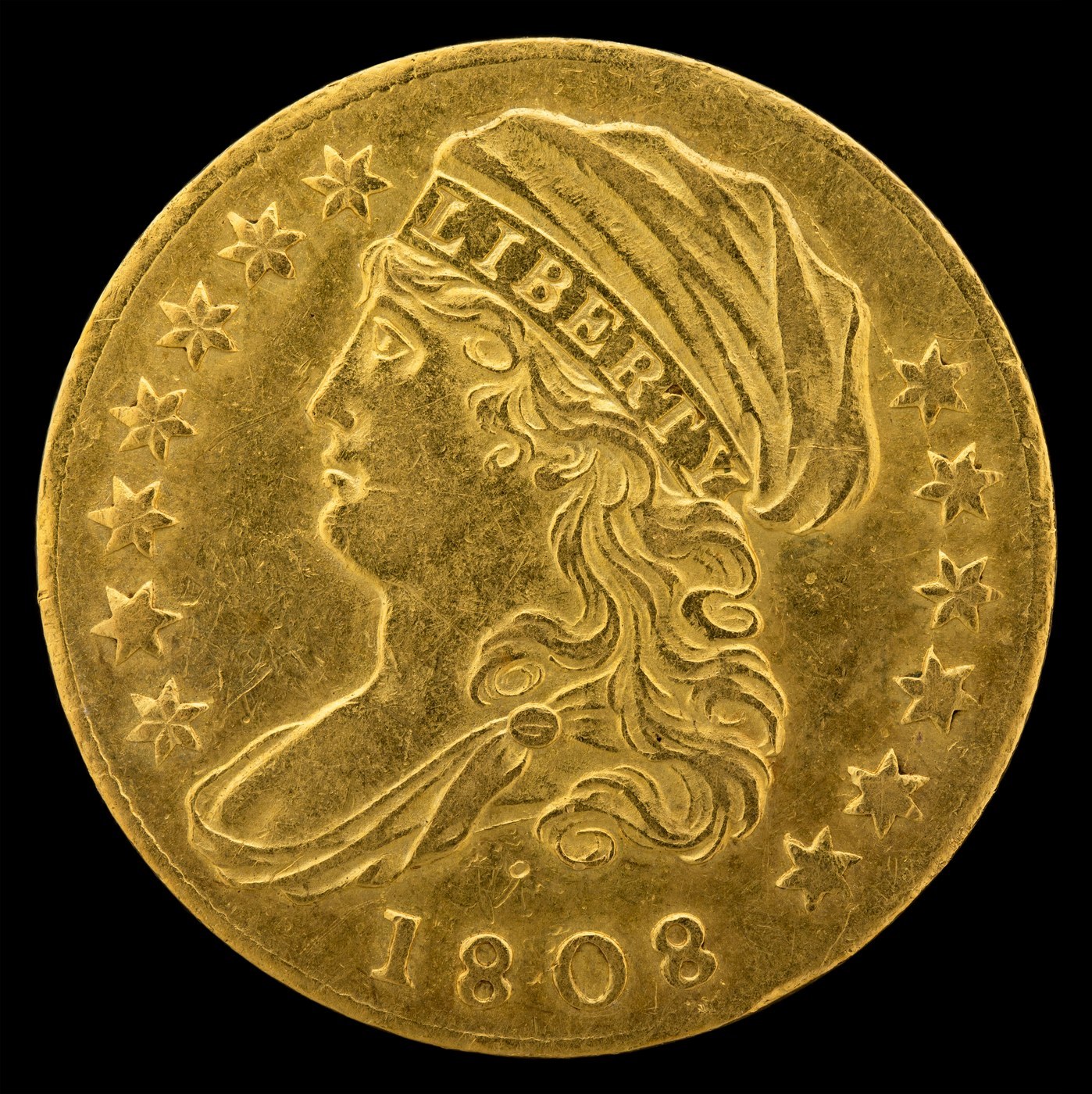
Capped Bust Quarter Eagle
A one-year U.S. gold $2.50 piece struck only in 1808, with John Reich's capped Liberty obverse and a heraldic eagle reverse. A classic rarity.
- Country
- United States
- Denomination
- 2.5 dollars
- Metal
- 91.67% Gold, balance Copper and Silver
Got a coin like this?
Identify any coin from a photo, free.
Overview
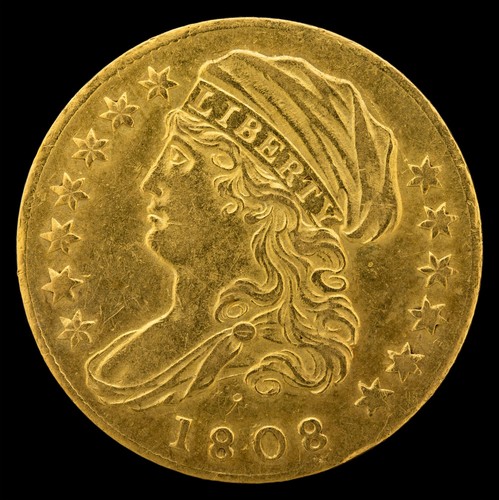
The Capped Bust Quarter Eagle is a United States $2.50 gold coin struck for a single year, 1808. It bears John Reich's capped-head Liberty on the obverse and a heraldic eagle on the reverse, with the value expressed as "2 1/2 D." The example shown here carries the 1808 date that defines the entire type.
Because it was minted in only one year and in very small numbers, the 1808 quarter eagle is one of the most famous and sought-after early American gold coins. It is a stand-alone type that any collector assembling a set of U.S. gold designs must account for, and genuine pieces are scarce in every grade.
History & Background
In 1808 Mint engraver John Reich adapted his Capped Bust motif—already used on silver denominations—to the quarter eagle, replacing the earlier Draped Bust design of the 1796–1807 issues. Liberty wears a soft cloth cap inscribed "LIBERTY," a look that gives the type its name.
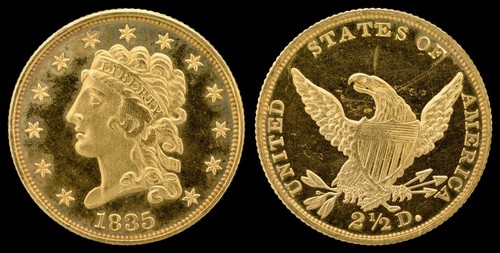
The coin was struck only in 1808 and then not again: the Mint suspended quarter eagle production and did not resume it until 1821, when a smaller, modified "Capped Head" design appeared. Reported production for 1808 was very small—on the order of a few thousand pieces—so the design exists as a true one-year type with no varieties of date. Its brief life and low output are the main reasons it is so prized today.
How to Identify
The obverse shows Liberty facing left wearing a cloth cap, with the word "LIBERTY" on the band, stars around the border, and the date 1808 below. The reverse depicts a heraldic eagle with a Union shield on its breast holding an olive branch and arrows, "UNITED STATES OF AMERICA" around the top, "E PLURIBUS UNUM" on a scroll, and the denomination "2 1/2 D." at the bottom.
The coin is small—about 20 mm in diameter—and weighs roughly 4.37 grams. It was struck in early U.S. gold standard of about 91.67% gold with a copper-silver balance, and it has a reeded edge. All were made at the Philadelphia Mint, so no genuine example carries a mint mark. The date 1808 is itself a key identifier, since it is the only year of the type.
Value & Collectibility
The 1808 Capped Bust Quarter Eagle is a recognized rarity and a key coin in the U.S. gold series. Even heavily worn, problem-free examples command strong four- to five-figure sums, and attractive higher-grade pieces reach well into five and six figures at auction. Exact prices vary widely with grade, eye appeal, and market conditions.
Because values are so high, this is a heavily counterfeited and altered date. Provenance, third-party certification, and originality matter enormously. Cleaning, tooling, rim damage, or repaired mounts can sharply reduce value, so condition and authenticity should be confirmed before any purchase or sale.
Frequently asked questions
How many years was the Capped Bust Quarter Eagle made?
Just one. The type was struck only in 1808, which makes it a one-year design with no other dates.
What is the 1808 quarter eagle made of?
It is a gold coin of the early U.S. standard—about 91.67% gold with a copper-silver balance—weighing roughly 4.37 grams and measuring about 20 mm across.
Does it have a mint mark?
No. Every genuine 1808 Capped Bust Quarter Eagle was struck at the Philadelphia Mint, which used no mint mark, so an authentic coin has none.
Why is the 1808 quarter eagle so valuable?
It was produced in only one year and in very small numbers, and it is the sole issue of its type. Its rarity and historical importance make even worn examples valuable.
Where does the denomination appear on the coin?
On the reverse, below the eagle, as "2 1/2 D."—the abbreviation for two and one-half dollars.
Capped Bust Quarter Eagle guides
In-depth guides for identifying, valuing, and collecting Capped Bust Quarter Eagle.