
How to Identify the Capped Bust Quarter Eagle
Identify the 1808 Capped Bust Quarter Eagle by its capped Liberty, heraldic eagle reverse, small gold planchet, "2 1/2 D." value, and one-year date.
Read the full Capped Bust Quarter Eagle encyclopedia entry →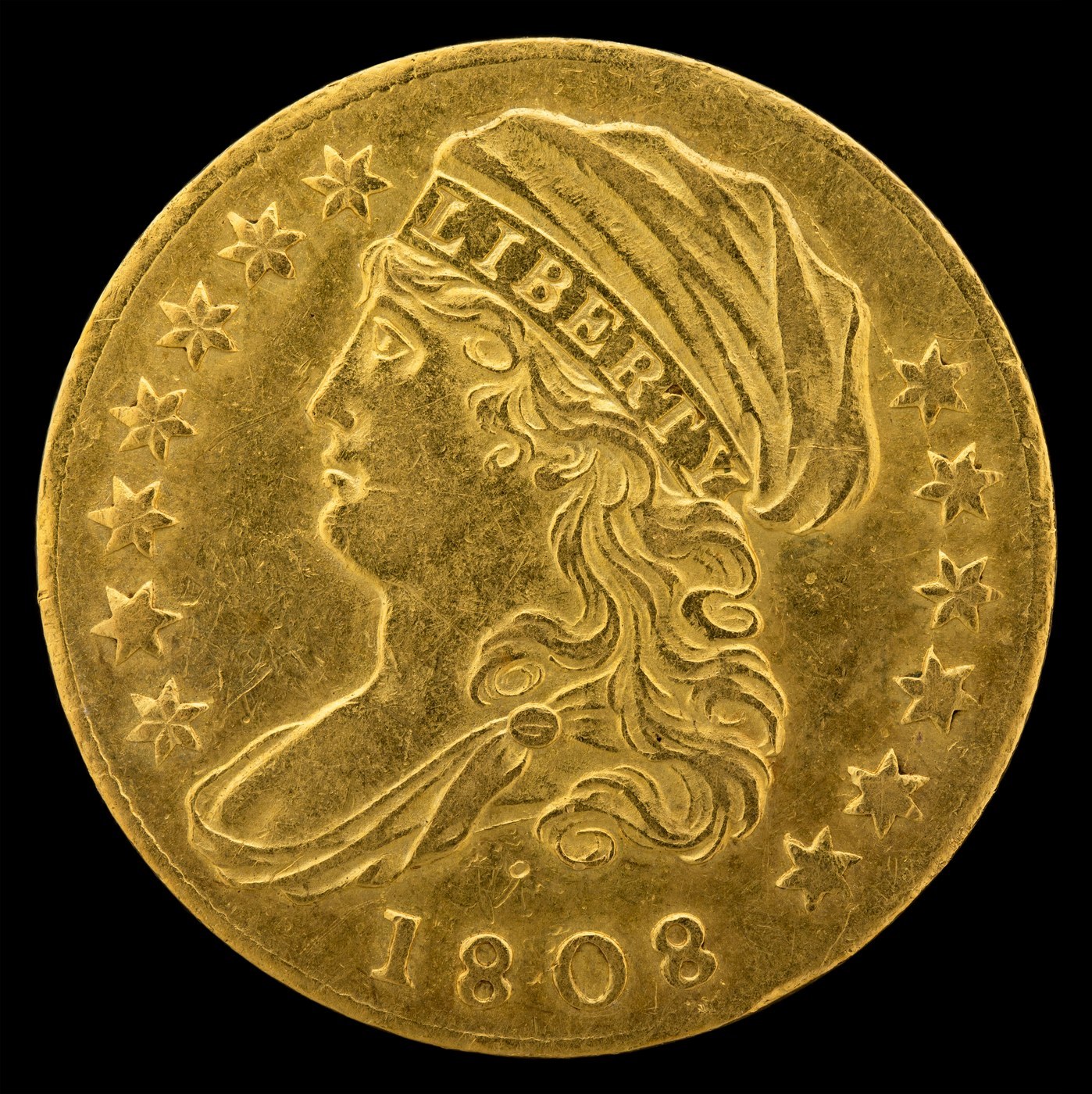
What It Is
The Capped Bust Quarter Eagle is a $2.50 U.S. gold coin struck only in 1808, designed by John Reich. Because it is a one-year type, the date 1808 is your single most reliable identifier: no other year exists for this design.
Obverse (Front)
Look for Liberty facing left in a soft cloth cap, with the word "LIBERTY" across a band on the cap. Stars ring the border and the date 1808 sits at the bottom. The cap-and-drapery bust distinguishes it from the earlier Draped Bust quarter eagles (1796–1807) and from the later, smaller Capped Head issues that begin in 1821.
Reverse (Back)
The reverse shows a heraldic eagle with a striped Union shield on its breast, clutching an olive branch and arrows. "UNITED STATES OF AMERICA" curves around the top, a scroll reads "E PLURIBUS UNUM," and the value "2 1/2 D." appears at the bottom. That "2 1/2 D." is the denomination tell for a quarter eagle.
Size, Metal, and Edge
This is a small gold coin: roughly 20 mm in diameter and about 4.37 grams, struck in the early U.S. gold standard of about 91.67% gold with a copper-silver balance. The edge is reeded. There is no mint mark on any genuine piece, since production was limited to the Philadelphia Mint.
Look-Alikes and Cautions
Because the 1808 date is extremely valuable, it is a prime target for counterfeits and alterations—including added or reshaped dates, cast copies, and coins pulled from jewelry mounts. Compare weight, diameter, and reeding against known specifications, and be wary of soft or mushy detail, seams, filed edges, or solder traces. Given the stakes, any suspected 1808 quarter eagle should be authenticated and graded by a reputable third-party service before it is bought, sold, or insured.
Frequently asked questions
How do I know a Capped Bust Quarter Eagle from other early gold $2.50 coins?
Check the date and the bust. The Capped Bust type exists only for 1808 and shows Liberty in a cloth cap facing left; the earlier Draped Bust quarter eagles run 1796–1807, and the later Capped Head coins (from 1821) are smaller with a different head.
What denomination markings should I look for?
The reverse shows "2 1/2 D." below the eagle, meaning two and one-half dollars. Together with the 1808 date, that confirms a Capped Bust Quarter Eagle.
How big and heavy should it be?
About 20 mm in diameter and roughly 4.37 grams, in approximately 91.67% gold with a reeded edge. Significant deviation is a warning sign of a fake or altered piece.
Should I get it authenticated?
Yes. The 1808 quarter eagle is valuable and frequently faked or altered, so certification by a recognized grading service is strongly recommended before any transaction.