
How to Identify the Classic Head Quarter Eagle
Spot a Classic Head Quarter Eagle (1834–1839) by its band-bound Liberty obverse, motto-free shield-eagle reverse, small gold size, and "2½ D." value.
Read the full Classic Head Quarter Eagle encyclopedia entry →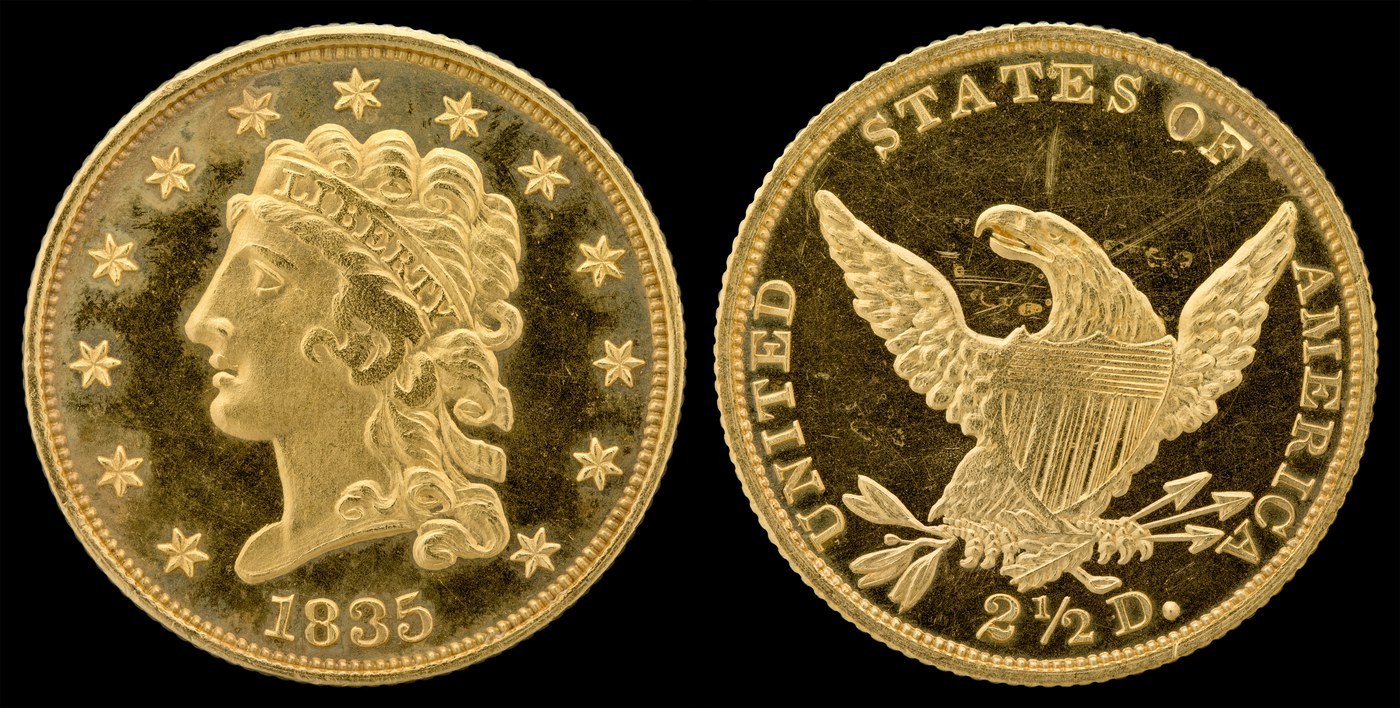
What It Is
The Classic Head Quarter Eagle is a small $2.50 gold coin struck by the U.S. Mint from 1834 to 1839, designed by William Kneass. A coin dated 1835, like the one pictured, is an early Philadelphia example of this short-lived type, which bridges the older Capped Head gold and the later Coronet gold.
Obverse (Front)
Look for Liberty facing left with her hair rolled and held by a plain band or cord inscribed "LIBERTY." There is no coronet and no cloth cap—the simple fillet is the key tell. Thirteen stars ring the border and the four-digit date sits at the bottom. On the rare 1838–1839 branch-mint coins, a small mint-mark letter (C, D, or O) appears on the obverse above the date; Philadelphia coins have no letter.
Reverse (Back)
The reverse shows a bald eagle with a striped Union shield on its breast, holding an olive branch and a bundle of arrows, with "UNITED STATES OF AMERICA" curving above and the value "2½ D." below. The single most useful diagnostic is the absence of the "E PLURIBUS UNUM" motto scroll: the Classic Head reverse omits it, which separates the type from the earlier Capped Head quarter eagle that carried the motto above the eagle.
Size, Metal, and Mint Marks
This is a small, dense coin—about 18 mm in diameter and roughly 4.18 grams—struck in an alloy of about 90% gold, so it has a warm yellow color and real heft for its size. Unlike most later U.S. gold, the mint mark (when present) is on the obverse above the date, not on the reverse. Only the 1838 (C), 1839 (C, D, O) coins carry mint marks; every 1834–1837 coin is a no-mint-mark Philadelphia strike.
Look-Alikes and Cautions
Don't confuse it with the earlier Capped Head quarter eagle (Liberty in a cloth cap, with an "E PLURIBUS UNUM" scroll on the reverse) or the later Coronet/Liberty Head quarter eagle of 1840–1907 (Liberty in a coronet band). Because these are scarce gold coins, be alert to added or altered dates and mint marks, tooling, and cast or struck counterfeits—the branch-mint dates are frequent targets. Genuine pieces show correct weight and diameter and crisp original detail; cleaning, mount marks, bends, and rim damage all reduce value. Have branch-mint coins and any questionable example authenticated by a reputable third-party grading service.
Frequently asked questions
How can I tell a Classic Head Quarter Eagle from a Coronet (Liberty Head) Quarter Eagle?
The Classic Head (1834–1839) shows Liberty's hair bound by a plain band with no crown, while the Coronet type (1840–1907) shows Liberty wearing a distinct coronet lettered "LIBERTY." The dates and headwear are the quickest tells.
How do I distinguish it from the earlier Capped Head Quarter Eagle?
The Capped Head (through 1834) shows Liberty in a soft cloth cap and keeps the "E PLURIBUS UNUM" motto on the reverse. The Classic Head uses a bare, band-bound head and removes the motto—no scroll appears above the eagle.
Where is the mint mark on a Classic Head Quarter Eagle?
On the obverse, above the date—an unusual position. Only the 1838–1839 Charlotte (C), Dahlonega (D), and New Orleans (O) coins carry one; all Philadelphia coins, including an 1835, have no mint mark.
How do I know mine is genuine gold and not altered?
Check for correct weight (about 4.18 g) and diameter (about 18 mm), sharp original detail, and an untampered obverse date and mint-mark area. Suspicious weight, added mint marks, or altered dates warrant certification by a reputable grading service.