
How to Identify the Indian Head Quarter Eagle
Identify the Indian Head $2.50 gold (1908–1929) by its sunken incuse design, feather-bonnet portrait, standing-eagle reverse, small size, and reverse mint mark.
Read the full Indian Head Quarter Eagle encyclopedia entry →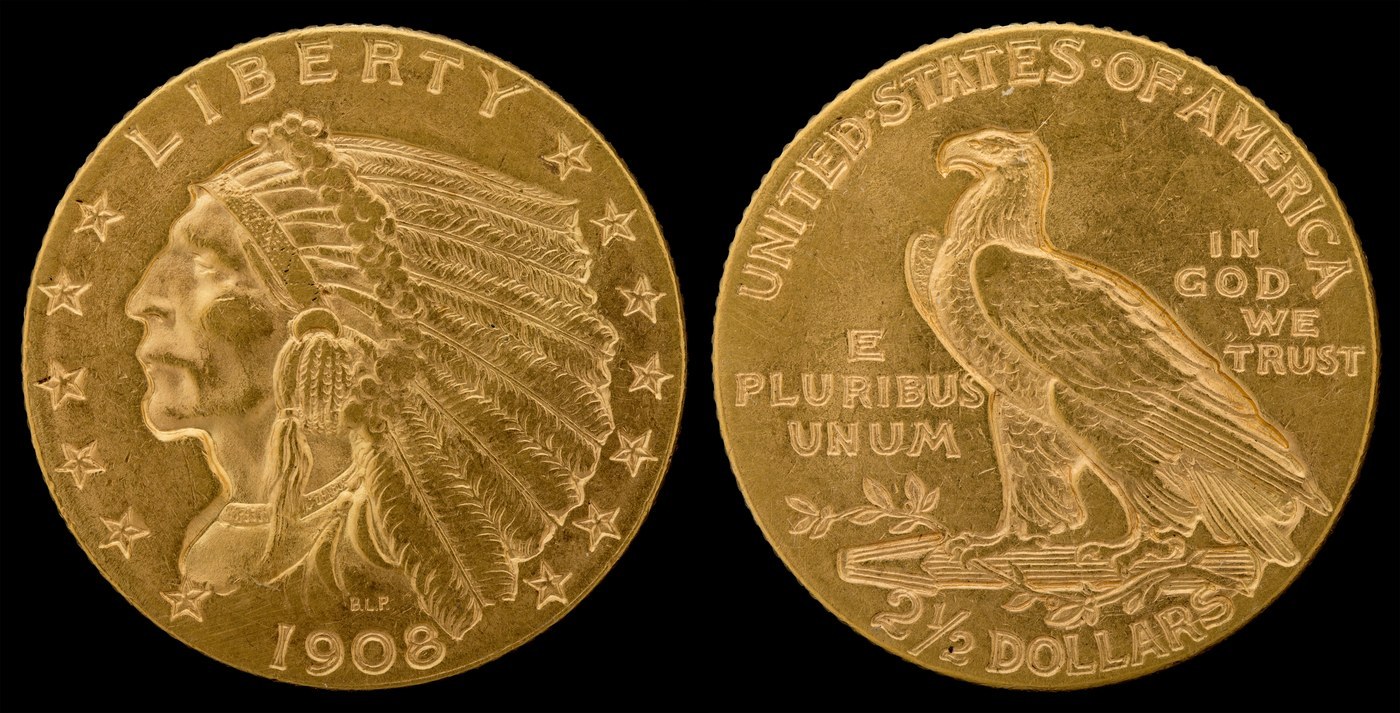
What It Is
The Indian Head Quarter Eagle is a small United States $2.50 gold coin struck from 1908 to 1915 and again from 1925 to 1929, designed by Bela Lyon Pratt. Its defining feature is that the design is incuse—cut into the coin so the portrait and lettering sit below a flat, level field, with no raised rim. If a small gold coin has a sunken design and a feathered-headdress portrait, this series is almost certainly what you are looking at.
Obverse (Front)
Look for the head of a Native American facing left, wearing a full feathered war bonnet with "LIBERTY" on the headband. "UNITED STATES OF AMERICA" arcs around the top and thirteen stars ring the border, with the four-digit date at the bottom. Because the relief is recessed, run a fingertip across the surface: the flat field, not the portrait, should be the highest point.
Reverse (Back)
The reverse shows a standing bald eagle facing left, perched on a bundle of arrows with an olive branch. Around it are "E PLURIBUS UNUM" and "IN GOD WE TRUST," with the denomination spelled "2½ DOLLARS" at the bottom. Note that the eagle stands rather than flies—this pose distinguishes the Pratt design from many other U.S. gold reverses.
Size, Metal, and Mint Marks
This is a small, dense coin: about 18 mm in diameter and roughly 4.18 grams, struck in 90% gold and 10% copper. The mint mark sits on the reverse at the lower left, beside the arrow feathers—a "D" is Denver and no mint mark means Philadelphia. Denver struck this type in only one year, 1911, so a "D" mint mark always indicates the scarce, key-date 1911-D.
Look-Alikes and Cautions
Don't confuse it with the earlier Liberty Head (Coronet) quarter eagle, which has a raised, conventional-relief profile of Liberty rather than a sunken Indian portrait, or with the larger Indian Head Half Eagle ($5), which uses the same design but is bigger and reads "5 DOLLARS." Because the coin is gold and the 1911-D is highly desirable, the series is frequently counterfeited, and false "D" mint marks are added to common Philadelphia coins. Verify weight and diameter, be wary of soft or mushy detail and edges, and have any 1911-D or high-value example authenticated by a reputable third-party grading service before buying or selling.
Frequently asked questions
How can I tell an Indian Head Quarter Eagle from a Liberty Head quarter eagle?
The Indian Head type has a sunken (incuse) design with a Native American in a feathered bonnet and no raised rim, while the older Liberty Head quarter eagle shows a conventional raised profile of Liberty with a coronet.
How is the $2.50 quarter eagle different from the $5 half eagle of the same design?
They share Pratt's incuse Indian design, but the half eagle is larger (about 21.6 mm) and reads "5 DOLLARS," whereas the quarter eagle is about 18 mm and reads "2½ DOLLARS."
Where do I look for the mint mark?
Check the reverse at the lower left, next to the arrow feathers. A "D" is Denver (only used in 1911); coins with no mint mark are from Philadelphia.
How do I know a 1911-D is genuine?
Confirm the coin weighs about 4.18 grams and measures roughly 18 mm, and inspect the "D" for signs of tooling or addition. Given how often this key date is faked, submit it to a professional grading service for authentication.