
How to Identify the Liberty Head Quarter Eagle
Spot a Liberty Head Quarter Eagle (1840–1907) by its coronet Liberty obverse, shield-eagle reverse, small gold size, and "2½ D." denomination.
Read the full Liberty Head Quarter Eagle encyclopedia entry →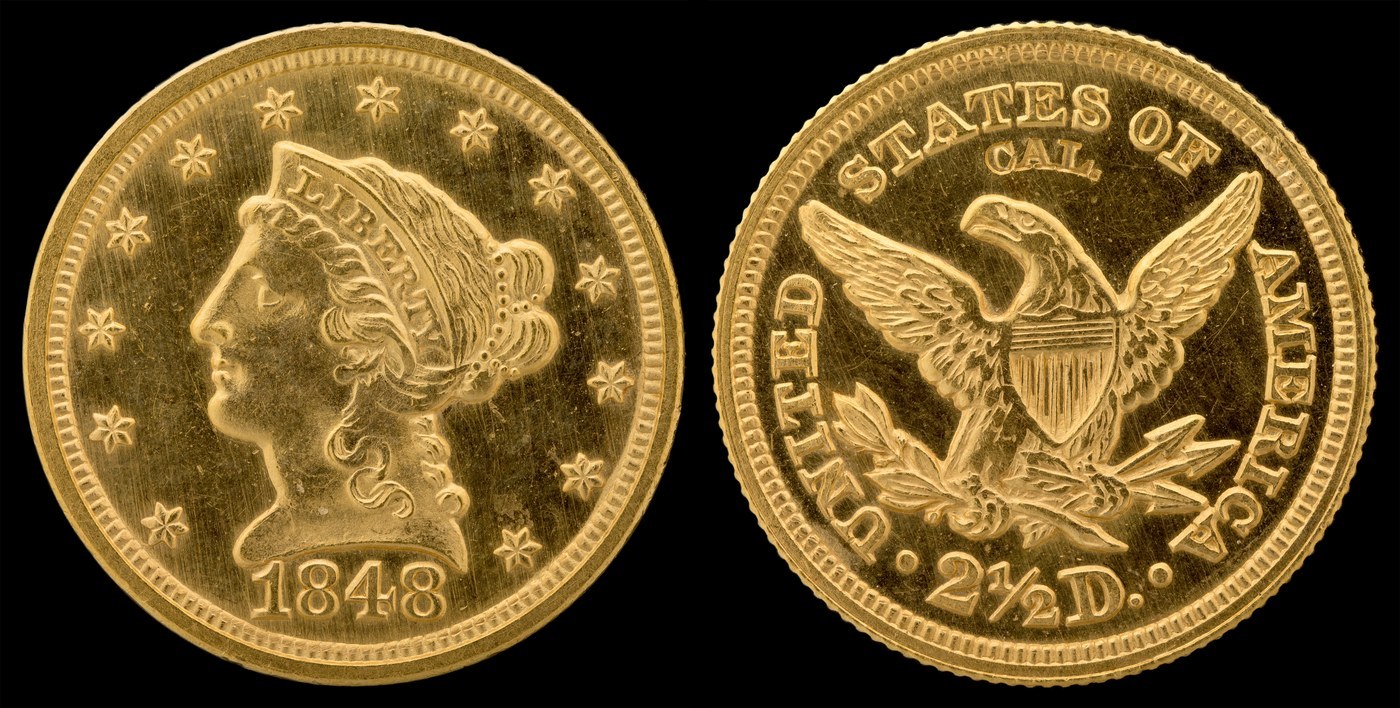
What It Is
The Liberty Head Quarter Eagle—also called the Coronet Quarter Eagle—is a small $2.50 gold coin struck by the U.S. Mint from 1840 to 1907, designed by Christian Gobrecht. A coin dated 1848, like the one pictured, is a mid-series example of this long-running type.
Obverse (Front)
Look for Liberty facing left wearing a coronet band inscribed "LIBERTY," with her hair gathered in curls behind the head. Stars ring the border and the four-digit date sits at the bottom. The coronet—rather than a cap, a laurel wreath, or a feathered headdress—is the key tell for this design.
Reverse (Back)
The reverse shows a bald eagle with a striped Union shield on its breast, holding an olive branch and a bundle of arrows. "UNITED STATES OF AMERICA" curves around the top and the value "2½ D." appears below the eagle. Note that this quarter eagle reverse has no "E PLURIBUS UNUM" motto scroll, which helps separate it from larger Liberty gold denominations.
Size, Metal, and Mint Marks
This is a small, light coin—about 18 mm in diameter and roughly 4.18 grams—struck in an alloy of about 90% gold, giving it a warm yellow color and real heft for its size. Check the reverse beneath the eagle for a mint mark: no letter means Philadelphia, while C, D, O, or S indicate Charlotte, Dahlonega, New Orleans, or San Francisco. On the rare 1848 "CAL." variety, those three letters are punched into the field above the eagle.
Look-Alikes and Cautions
Don't confuse it with the later Indian Head Quarter Eagle (1908–1929), whose design is recessed (incuse) with a Native American in a feathered headdress, or with the earlier Classic Head quarter eagle, which lacks the coronet. Because these are gold coins, be alert to added or altered mint marks, tooling, and cast or struck counterfeits—scarce branch-mint dates and the "CAL." mark are frequent targets. Genuine pieces show correct weight and diameter and crisp original detail; cleaning, jewelry mounting, bends, and rim damage all reduce value. Have scarce dates, "CAL." coins, and any questionable example authenticated by a reputable third-party grading service.
Frequently asked questions
How can I tell a Liberty Head Quarter Eagle from an Indian Head Quarter Eagle?
The Liberty Head (1840–1907) has a raised coronet-crowned Liberty and a normal raised design. The Indian Head (1908–1929) uses a sunken, incuse design with a Native American in a feathered headdress—very different in look and feel.
Where is the mint mark, and why does it matter?
It sits on the reverse below the eagle. Mint mark strongly affects value: Charlotte (C) and Dahlonega (D) gold and certain New Orleans (O) and San Francisco (S) dates are much scarcer than common Philadelphia coins.
What is the 1848 "CAL." quarter eagle?
It is a rare variety in which 1848 quarter eagles were counterstamped "CAL." above the eagle, marking coins made from gold shipped east after the California discovery. Most 1848 coins do not carry this mark.
How do I know mine is genuine gold and not altered?
Check for correct weight (about 4.18 g) and diameter (about 18 mm), sharp original detail, and an untampered reverse mint-mark area. Suspicious weight, added mint marks, or a questionable "CAL." punch warrant certification by a reputable grading service.