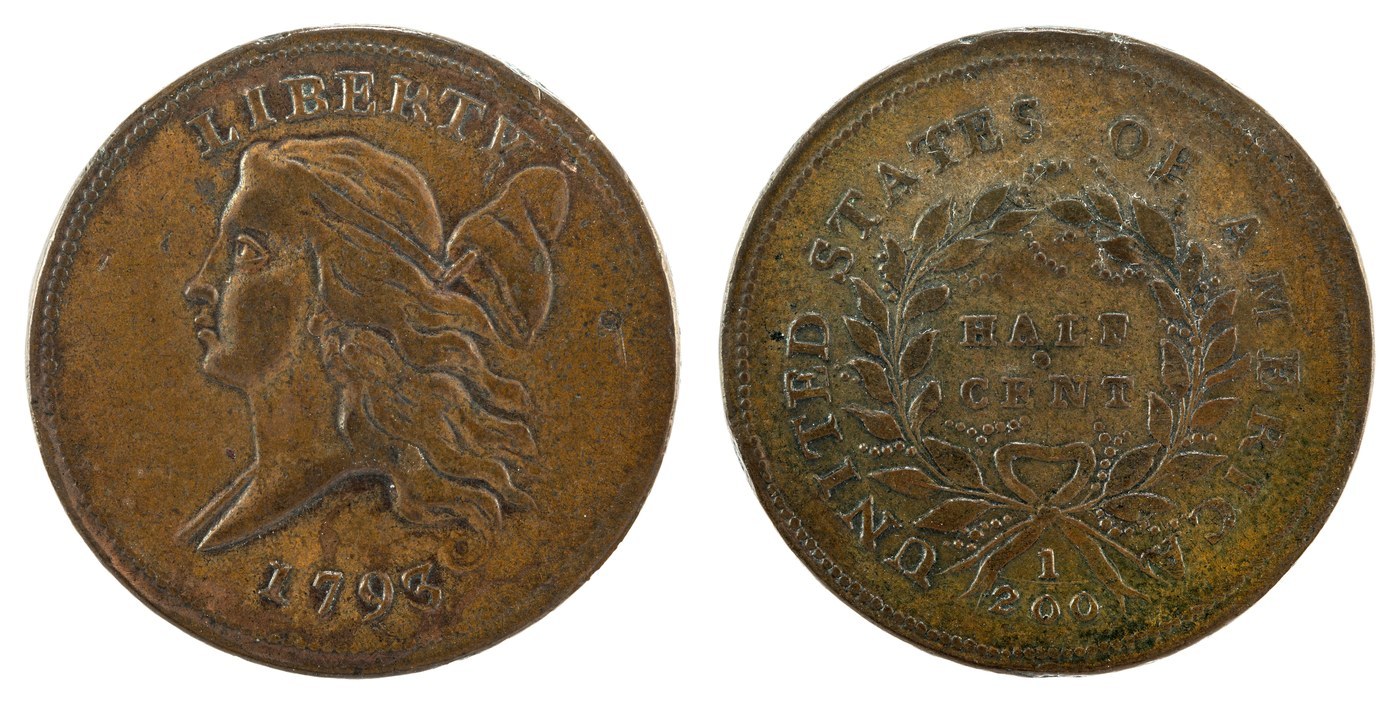
Liberty Cap Half Cent
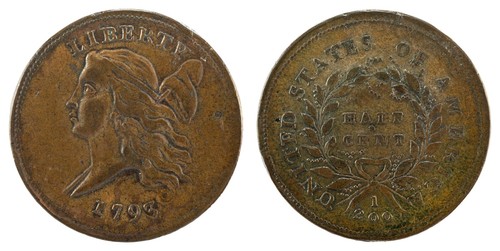
The first U.S. half cent, struck only in 1793, showing Liberty in a cap facing left with a wreath reverse. A famous one-year copper key date.
- Country
- United States
- Denomination
- 1/2 Cent
- Metal
- Copper
Got a coin like this?
Identify any coin from a photo, free.
Overview
The Liberty Cap Half Cent shown here is the 1793 issue, the very first half cent struck by the United States Mint and a cornerstone of early American copper collecting. The obverse depicts Liberty facing left, her hair flowing behind a Phrygian liberty cap set on a pole over her shoulder, with LIBERTY above and the date 1793 below. The reverse carries a wreath enclosing the words HALF CENT, ringed by UNITED STATES OF AMERICA.
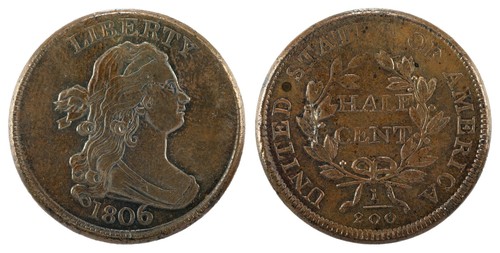
As a one-year design, the head-left 1793 half cent is distinct from the later Liberty Cap half cents of 1794–1797, on which Liberty faces to the right. It is a small copper coin, roughly the size of a modern nickel, and every genuine example is well over two centuries old.
Because it is both a first-year type and a single-year variety, the 1793 half cent is prized far beyond its face value and is considered a key date in the U.S. half cent series.
History & Background
Congress authorized the half cent under the Mint Act of 1792, and production began at the Philadelphia Mint in 1793, the same year the first federal copper cents were made. The half cent was intended to make small everyday transactions and precise pricing possible in a young nation short of small change.
The 1793 design is generally attributed to the Mint's early engravers, with Liberty's head modeled after the liberty-cap imagery popular in the era. Only a modest number were struck in that first year before the design was reworked for 1794, when Liberty was turned to face right. Reported 1793 production was in the tens of thousands of pieces, a tiny figure by later standards.
The half cent denomination continued in various designs until it was discontinued in 1857, but the 1793 Liberty Cap remains the celebrated first chapter of the series.
How to Identify
Look first for the year 1793 beneath a left-facing Liberty whose cap sits on a pole behind her head; this head-left orientation is unique to 1793 among Liberty Cap half cents. The obverse legend reads LIBERTY above the portrait. The reverse shows a single wreath tied with a bow, enclosing HALF CENT, surrounded by UNITED STATES OF AMERICA.
The coin is struck in copper, measures roughly 22 mm across, and has no mint mark, as all half cents were made in Philadelphia. The edge of authentic 1793 pieces is lettered with TWO HUNDRED FOR A DOLLAR, and the fraction 1/200 appears below the wreath on the reverse.
Surfaces on genuine coins typically show honest brown copper toning and centuries of wear. Because this is a high-value early type, identification should be confirmed against known die varieties and, ideally, professional authentication.
Value & Collectibility
The 1793 Liberty Cap Half Cent is a scarce and highly sought key date, so values run far above the coin's half-cent face value. Even heavily worn, corroded, or damaged examples typically trade in the high hundreds to low thousands of dollars, reflecting strong collector demand for any genuine 1793 half cent.
Problem-free coins in collectible circulated grades generally bring several thousand dollars, while sharp, well-preserved examples and higher grades can reach into the tens of thousands or more at auction. Exact prices vary widely with grade, die variety, surface quality, and eye appeal.
Because of the coin's value, counterfeits and altered dates exist. Meaningful appraisal should rely on authentication and current auction records rather than a fixed price.
Frequently asked questions
Why does this half cent face left when others face right?
The left-facing Liberty is unique to the 1793 half cent. Starting in 1794 the design was reworked so Liberty faces right, which is why the head-left 1793 is treated as its own one-year type.
Does the 1793 half cent have a mint mark?
No. All U.S. half cents were struck at the Philadelphia Mint, which did not use a mint mark, so a genuine 1793 half cent will have no mint letter.
What does '1/200' on the reverse mean?
It expresses the coin's value as one two-hundredth of a dollar, since a half cent equals half of one cent. The edge lettering 'TWO HUNDRED FOR A DOLLAR' states the same thing.
Is a worn 1793 half cent still valuable?
Yes. Because it is a first-year, one-year key date, even well-worn or damaged genuine examples typically carry substantial value, though condition strongly affects the price.
Liberty Cap Half Cent guides
In-depth guides for identifying, valuing, and collecting Liberty Cap Half Cent.