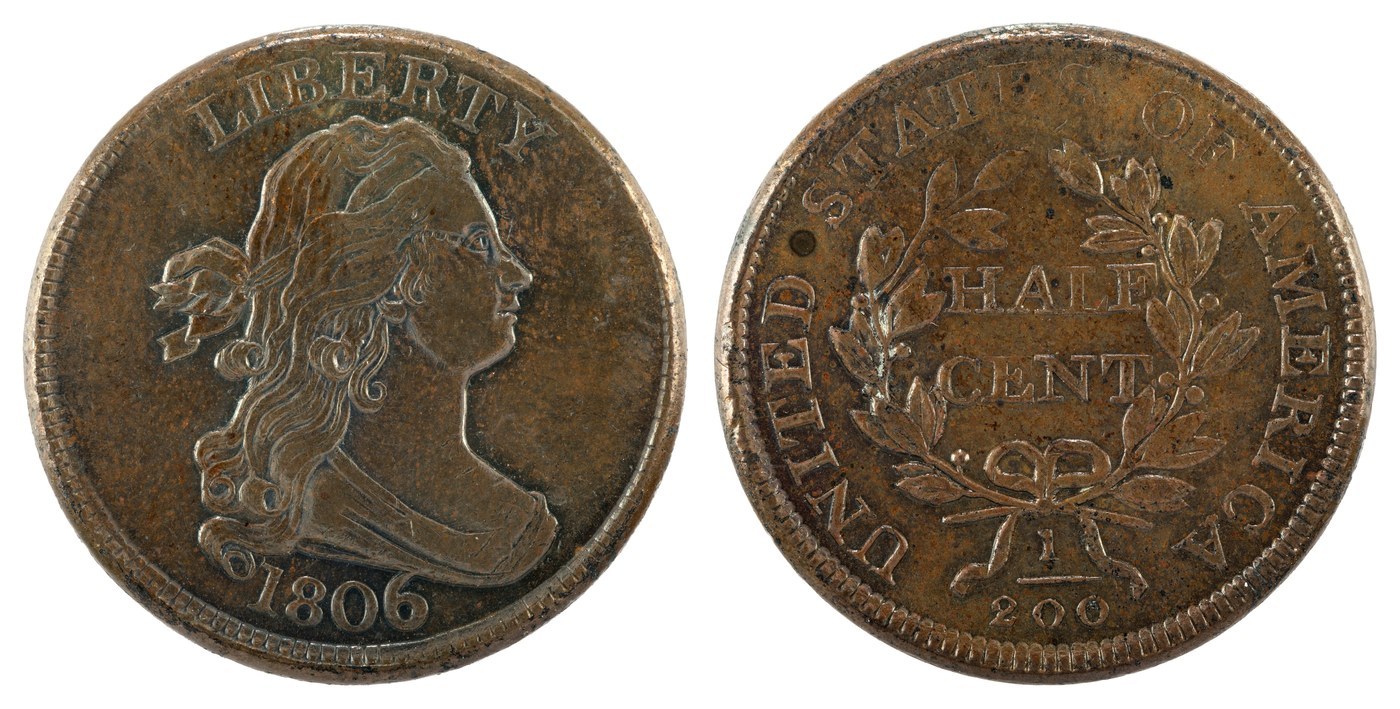
Draped Bust Half Cent
An early U.S. copper half cent showing draped Liberty with flowing hair; the smallest denomination the Mint ever struck, made 1800–1808.
- Country
- United States
- Denomination
- 1/2 Cent
- Metal
- Copper
Got a coin like this?
Identify any coin from a photo, free.
Overview
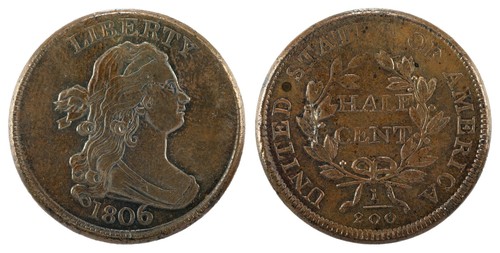
The Draped Bust half cent is an early United States copper coin worth one two-hundredth of a dollar, the smallest denomination the U.S. Mint has ever produced. The obverse shows a right-facing bust of Liberty with flowing hair and a draped shoulder, the word LIBERTY above and the date below; the 1806 example seen here is one of the more available dates in the series. The reverse carries a wreath enclosing the words HALF CENT, encircled by UNITED STATES OF AMERICA.
Because these coins were struck by hand on hand-made copper planchets, no two are exactly alike. Collectors prize them as affordable, tangible relics of the young republic, and the series is popular for its manageable range of dates and a well-documented set of die varieties.
History & Background
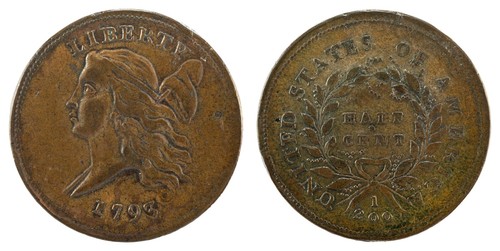
The Draped Bust design replaced the earlier Liberty Cap half cent and was used on the denomination from 1800 through 1808. The bust of Liberty follows the same general style introduced on other U.S. copper and silver coinage of the late 1790s, generally attributed to Mint engraver Robert Scot working from a Gilbert Stuart drawing. All half cents of this period were struck at the first Philadelphia Mint and therefore carry no mint mark.
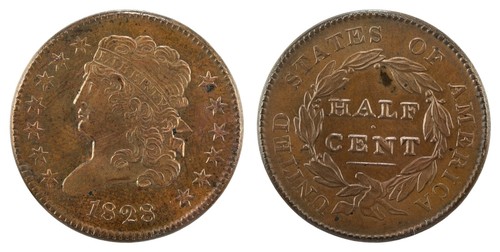
Half cents were never popular in daily commerce, and the Mint produced them irregularly, sometimes skipping years and reusing dies heavily. As a result, dates and varieties within the series vary considerably in how often they turn up today. The Draped Bust type was followed by the Classic Head half cent beginning in 1809.
How to Identify
Look for a small copper coin roughly the size of a modern U.S. quarter, about 23.5 mm across, showing Liberty facing right with loose, flowing hair and a draped bust. LIBERTY appears above the portrait and the four-digit date below — 1806 on the coin shown here. The absence of a mint mark is normal, since only Philadelphia struck these.
The reverse displays an open wreath tied with a ribbon at the bottom, the words HALF CENT stacked inside it, UNITED STATES OF AMERICA around the rim, and the fraction 1/200 beneath the wreath. Copper coins of this age are almost always brown to dark chocolate in color; bright orange or red surfaces on a common date usually indicate cleaning or a much scarcer high-grade piece. The 1806 date exists in recognized varieties, including small-6 and large-6 dates and stemless versus stemmed wreath reverses, which specialists identify with Cohen (C) and Breen (B) variety numbers.
Value & Collectibility
Value depends heavily on date, die variety, and condition. Well-worn but clearly identifiable Draped Bust half cents of common dates such as 1806 typically trade in the low tens to low hundreds of dollars, while sharp, problem-free examples with strong detail and original brown surfaces bring substantially more. Scarcer dates and sought-after varieties can command large premiums.
Eye appeal matters a great deal with early copper: corrosion, cleaning, scratches, and porous surfaces reduce value sharply, while smooth, evenly toned coins are favored. Because ranges are wide and variety-driven, it is best to attribute the exact date and variety and consult recent auction records or a specialist before assigning a firm figure.
Frequently asked questions
Is a half cent really half of one cent?
Yes. The half cent was worth one two-hundredth of a dollar, making it the lowest-value coin the U.S. Mint has ever issued. It was discontinued entirely in 1857.
Why doesn't my 1806 half cent have a mint mark?
All Draped Bust half cents were struck at the Philadelphia Mint, which did not use a mint mark at the time. The lack of one is expected and normal for the series.
What is the coin made of?
It is struck in copper, with no silver or gold content. Its value comes from age, rarity, and condition rather than metal content, and genuine examples show natural brown copper toning.
How can I tell it apart from a large cent?
A half cent is noticeably smaller (about 23.5 mm) and its reverse reads HALF CENT with the fraction 1/200, while an early large cent is bigger and reads ONE CENT with 1/100.
Draped Bust Half Cent guides
In-depth guides for identifying, valuing, and collecting Draped Bust Half Cent.