
How to Identify the Draped Bust Half Cent
A collector's walkthrough for confirming an 1800–1808 Draped Bust half cent by design, size, wreath details, and variety.
Read the full Draped Bust Half Cent encyclopedia entry →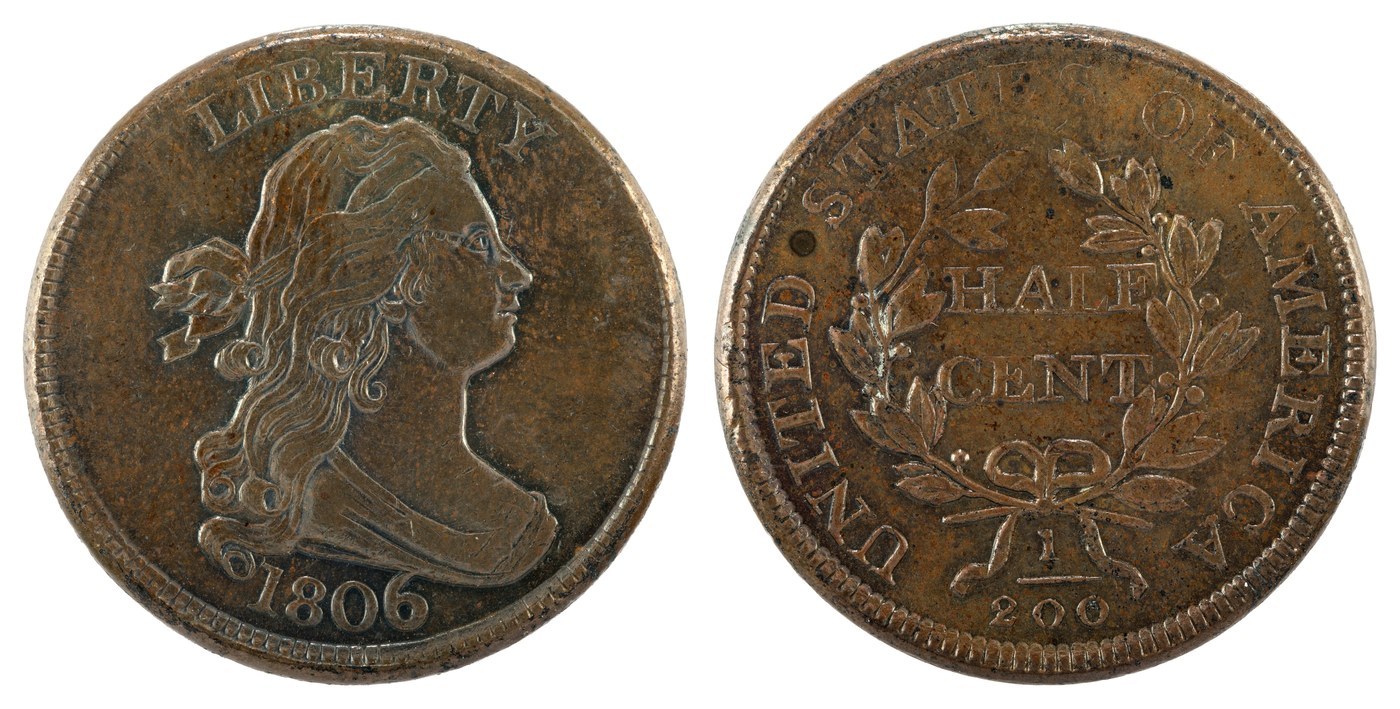
Start with size and metal. A Draped Bust half cent is a copper coin about 23.5 mm in diameter — close to a modern quarter but thinner and browner. If the coin is silver-colored, much larger, or reads ONE CENT, it is not a half cent. Confirm the denomination on the reverse: the words HALF CENT should sit inside the wreath, with the fraction 1/200 below it.
Check the obverse design carefully. Liberty must face right with loose, flowing hair and a draped shoulder, LIBERTY curved above and a four-digit date below. This distinguishes the Draped Bust type (1800–1808) from the earlier Liberty Cap half cents, which show a pole and cap, and from the later Classic Head half cents (from 1809), where Liberty wears a headband reading LIBERTY.
Do not look for a mint mark — there isn't one, because every coin in this series came from Philadelphia. Instead, use the date and reverse to narrow the variety. On 1806 pieces, note whether the 6 is a small or large numeral and whether the wreath has stems below the bow (stemmed) or not (stemless); these correspond to catalogued Cohen and Breen varieties that affect scarcity and value.
Watch for authenticity and condition red flags. Genuine early copper is brown to dark chocolate; a suspiciously bright, glossy, or uniformly red common-date coin may be cleaned, artificially colored, or a cast copy. Look for casting seams, a soft mushy strike, or an unnaturally smooth surface, and weigh the coin if possible — a full-thickness genuine planchet has real heft for its size. When value is significant, third-party grading and attribution are the safest confirmation.
Frequently asked questions
How do I separate a Draped Bust half cent from a Classic Head half cent?
The Draped Bust type (1800–1808) shows Liberty with flowing hair and a draped shoulder, while the Classic Head type (starting 1809) shows Liberty wearing a headband inscribed LIBERTY. The date and hair style settle it quickly.
What are the 1806 varieties I keep seeing referenced?
1806 half cents come in small-6 and large-6 date styles and in stemless or stemmed wreath reverses. Collectors track these with Cohen (C) and Breen (B) numbers, since some are far scarcer than others.
Should I clean a dirty early copper coin before identifying it?
No. Cleaning copper almost always lowers its value and can destroy the natural surfaces used to judge authenticity and grade. Identify and evaluate it as-is, then consult a specialist.