
How to Identify the Liberty Cap Half Cent
A collector's guide to confirming a 1793 head-left Liberty Cap half cent: diagnostics, edge lettering, size, and authentication cautions.
Read the full Liberty Cap Half Cent encyclopedia entry →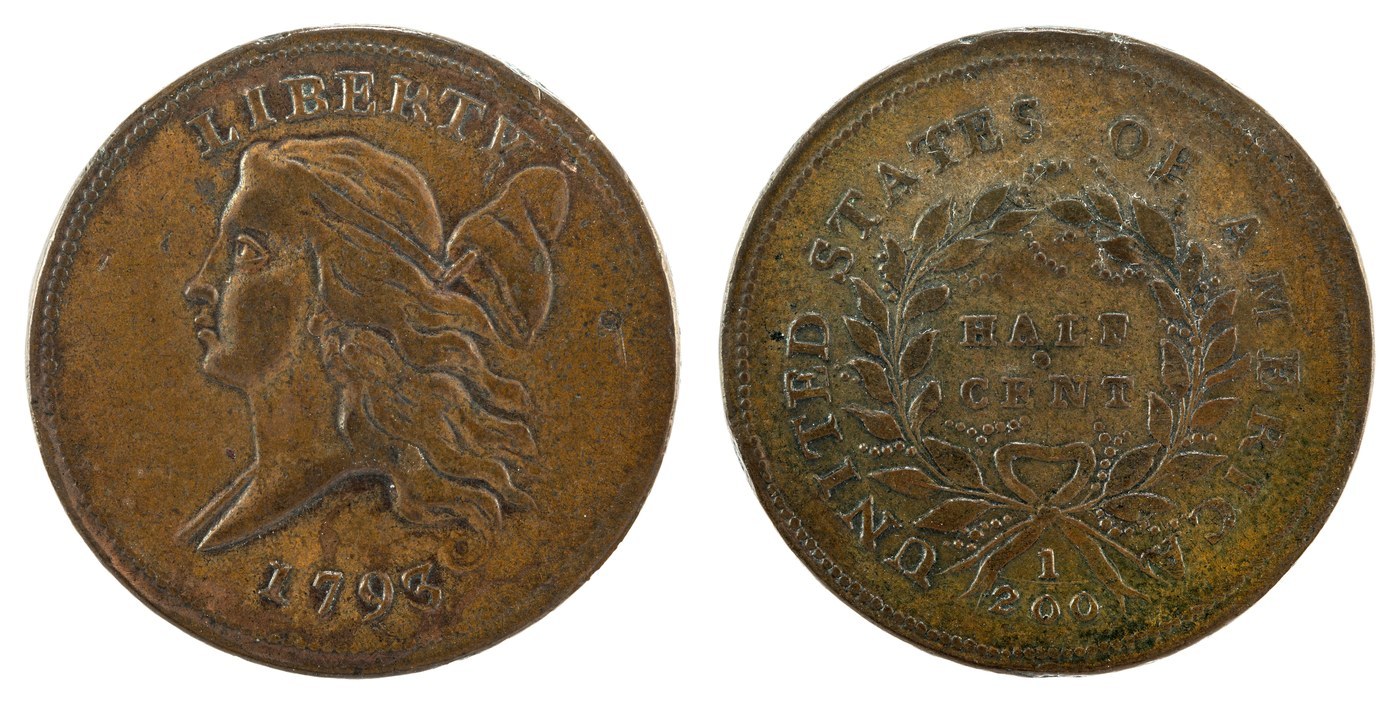
Start with orientation and date. A Liberty Cap half cent that shows Liberty facing left with the date 1793 below is the one-year head-left type. If Liberty faces right, you are looking at an 1794–1797 Liberty Cap half cent instead, not the 1793 issue. Confirm LIBERTY above the portrait and a liberty cap on a pole set behind Liberty's head.
Check the reverse carefully. It should display a single wreath tied at the base with a bow, enclosing the words HALF CENT, with UNITED STATES OF AMERICA around the rim and the fraction 1/200 beneath the wreath. Then inspect the edge: authentic 1793 half cents carry the incuse lettering TWO HUNDRED FOR A DOLLAR, an important diagnostic that many copies and casts fail to reproduce cleanly.
Verify the physical basics. The coin should be copper, about 22 mm in diameter and near the weight standard for the type, with no mint mark. Genuine pieces show honest brown copper color and wear consistent with age; unnaturally uniform surfaces, seams, filing, or a soft mushy strike are warning signs of a cast or tooled fake.
Be alert to look-alikes and alterations. The 1793 large cent is a larger coin with a chain or wreath reverse and should not be confused with the half cent's smaller size. Because the 1793 half cent is valuable, watch for added or re-cut dates on later half cents, electrotypes, and modern replicas often marked COPY. Cross-reference the coin against the recognized 1793 die varieties to confirm the marriage of dies.
Given the high value and the prevalence of counterfeits, treat home identification as a first pass only. Any candidate 1793 half cent that checks out on orientation, legends, edge lettering, and size should be submitted to a reputable grading and authentication service before purchase, sale, or insuring.
Frequently asked questions
What is the single fastest way to confirm a 1793 half cent?
Confirm Liberty faces left with the date 1793, then check the edge for the lettering 'TWO HUNDRED FOR A DOLLAR.' The left-facing head is unique to 1793, and the edge lettering is a strong authenticity clue.
How do I tell the 1793 half cent from the 1793 large cent?
The half cent is noticeably smaller (about 22 mm) and reads HALF CENT within its wreath, while the large cent is bigger and shows ONE CENT with a chain or wreath reverse.
Should I clean a suspected 1793 half cent before identifying it?
No. Cleaning early copper removes original surfaces and can sharply reduce value. Leave the coin as found and let an authentication service evaluate it.
Can I rely on weight and diameter alone to authenticate one?
No. Size and weight are useful screens but cast fakes can approximate them. Combine them with the design, edge lettering, die-variety match, and professional authentication.