Double Louis d'Or
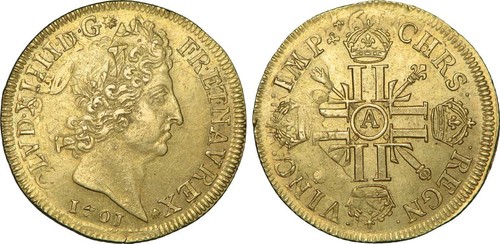
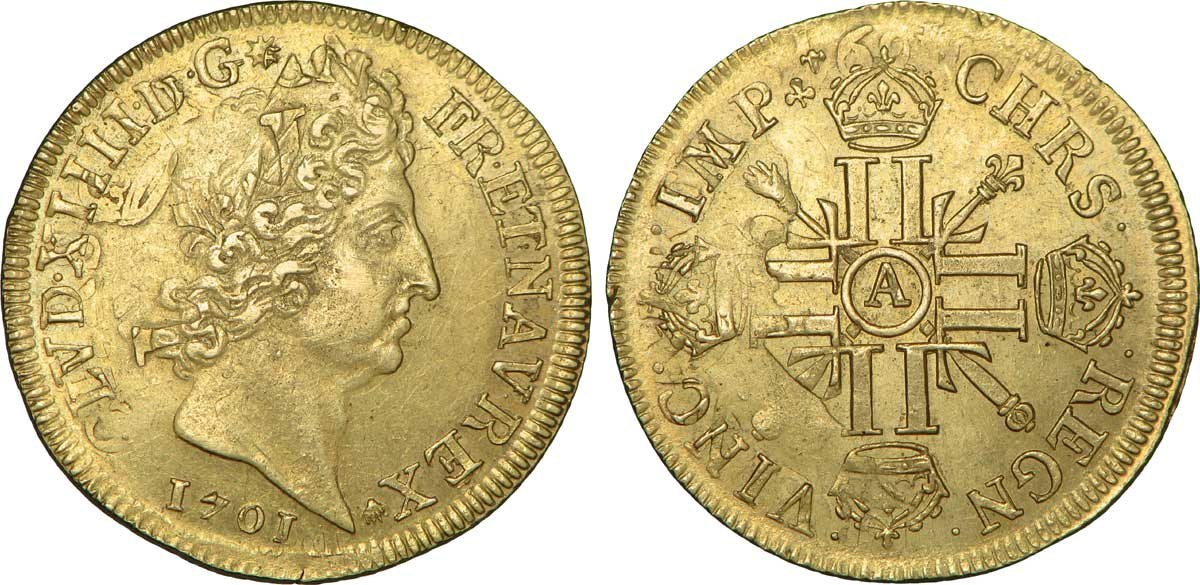
A large gold coin of Louis XIV dated 1701: the king's laureate profile and 'LUDOVICUS MAGNUS' obverse, an ornate cross of arms reverse.
- Country
- France
- Denomination
- Double Louis d'Or
- Metal
- Gold
Got a coin like this?
Identify any coin from a photo, free.
Overview
The Double Louis d'Or is a large gold coin of the French monarchy, worth two Louis d'Or. This example dates to 1701 and bears the profile of King Louis XIV facing right with long curled hair, encircled by the Latin legend 'LUDOVICUS MAGNUS' ("Louis the Great"). The reverse shows an ornate cross formed of crowned French coats of arms with floral ornaments in the angles.
As the double denomination of the standard Louis d'Or, it was one of the higher-value gold pieces of the reign, containing roughly twice the gold of a single Louis. Coins of this stature circulated among merchants, the wealthy and the crown rather than in everyday small change, and they rank today among the classic gold issues of the Ancien Régime.
History & Background
The Louis d'Or was introduced in 1640 under Louis XIII and became the principal gold coin of France for more than a century, struck in fractions and multiples including the double. By the later reign of Louis XIV (1643–1715) these coins carried the aging monarch's portrait and the proud legend 'LUDOVICUS MAGNUS', celebrating him as "Louis the Great."
A piece dated 1701 falls in the era of the great monetary réformations, when French coinage was periodically recalled and restruck to new types and standards to serve the crown's finances—Louis XIV's long wars were a constant drain on the treasury. Double Louis d'Or of this period were produced at various royal mints across France, each identified by its own mint letter beneath or beside the design.
The Double Louis d'Or continued under Louis XV and Louis XVI before the coinage of the Ancien Régime was swept away by the French Revolution. Surviving pieces from Louis XIV's reign are prized as tangible relics of the Sun King's France.
How to Identify
The defining features are the obverse portrait and legend: Louis XIV in profile facing right, with the characteristic long, curled flowing hair of his later portraits, surrounded by 'LUDOVICUS MAGNUS'. The full legend typically continues with a French royal title and the date—here 1701.
The reverse carries an ornate cross built from crowned shields of the French arms (fleurs-de-lis), with decorative floral or palm ornaments filling the spaces between the arms of the cross. A single letter placed in the design is the mint mark identifying which royal mint struck the coin.
The coin is gold and substantial—larger and heavier than a single Louis d'Or. Confirm the denomination as a double by weight and diameter against published specifications rather than by design alone, since the single and double share the same general types.
Value & Collectibility
As a gold coin of Louis XIV more than three centuries old, the Double Louis d'Or carries significant value driven both by its gold content and by its status as a sought-after Ancien Régime issue. Even a worn example is worth well above bullion because of its age, size and collector demand.
Condition, mint and eye appeal are the main value drivers. Well-circulated pieces are more affordable, while sharply struck coins with clear portraits and original surfaces command strong premiums; certain mints and dates are scarcer than others. Because these were large-value coins struck in limited numbers, prices span a wide range.
Gold coins of this importance are also frequently faked, so authenticity heavily affects value. Weigh any specific coin against recent auction results for the same type, date and grade rather than relying on metal value alone.
Frequently asked questions
What does 'LUDOVICUS MAGNUS' mean on the coin?
It is Latin for "Louis the Great," the honorific title of King Louis XIV of France, whose right-facing profile appears on the obverse of this 1701 Double Louis d'Or.
How much gold is in a Double Louis d'Or?
It contains roughly twice the gold of a single Louis d'Or, making it one of the larger gold pieces of the reign. Exact weight and fineness follow the standard in force in 1701; confirm against published specifications for the type.
Is the Double Louis d'Or rare?
Louis XIV gold survives in limited numbers, and some mints and dates are scarcer than others. Any genuine double Louis is a desirable coin, with rarity and value depending on mint, date and condition.
What is the cross on the reverse?
It is an ornate cross formed from crowned shields of the French royal arms (fleurs-de-lis), with floral ornaments in the angles—a characteristic reverse of the Louis XIV gold coinage.
Double Louis d'Or guides
In-depth guides for identifying, valuing, and collecting Double Louis d'Or.