Turban Head Half Eagle
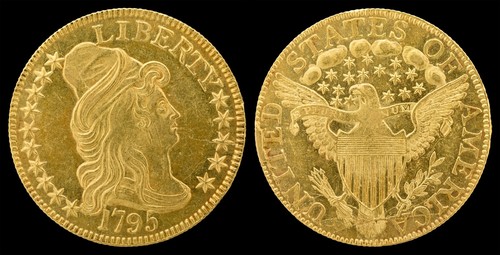
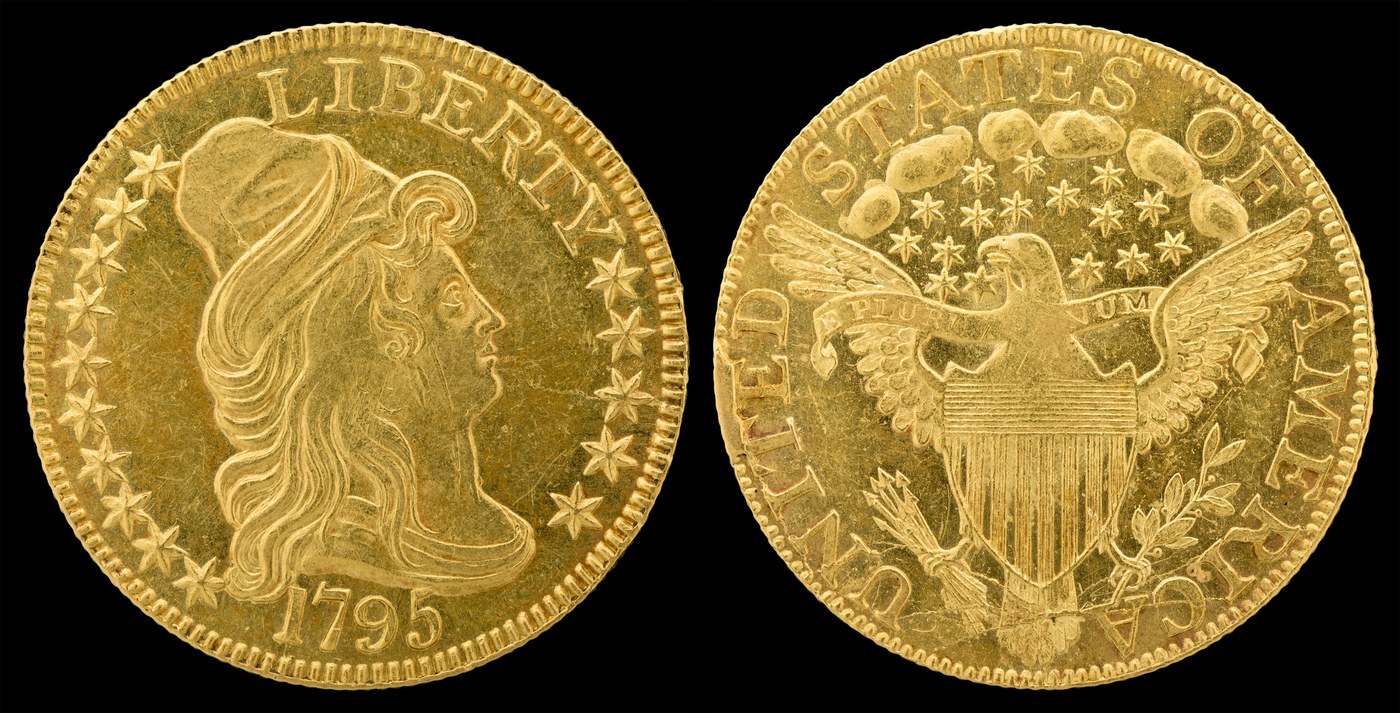
First U.S. gold $5 coin, 1795: Liberty in a soft cap facing right, with a heraldic shield-breasted eagle reverse struck in 22-karat gold.
- Country
- United States
- Denomination
- 5 dollars
- Metal
- Gold
Got a coin like this?
Identify any coin from a photo, free.
Overview
The Turban Head Half Eagle is the earliest United States five-dollar gold coin and one of the first gold pieces struck by the fledgling U.S. Mint in Philadelphia. Designed by Robert Scot, it shows Liberty facing right wearing a soft cloth cap — long nicknamed a "turban," though it is really a loose conical cap — which gives the type its popular name. Collectors also call it the Capped Bust to Right half eagle. The example shown is dated 1795.
The obverse carries Liberty's head with LIBERTY above, the date below, and stars flanking the portrait. The reverse of this coin is the Heraldic Eagle type: an eagle with a shield across its breast, holding an olive branch and arrows, with a ribbon inscribed E PLURIBUS UNUM and a cluster of clouds and stars above, all surrounded by UNITED STATES OF AMERICA. It is a small, thick gold coin with a reeded edge and no stated denomination on either face.
History & Background
Congress authorized federal gold coinage in the Mint Act of 1792, and the half eagle became the first gold denomination actually struck, beginning in 1795. These were hand-made coins produced in tiny numbers by a young mint still finding its footing, using screw presses and individually engraved dies. Because dies were cut by hand, the series is famous for its many varieties, with stars, letters, and eagle details differing from die to die.
Two reverse types appear on 1795 half eagles. The first coins used a "Small Eagle" reverse showing a slender eagle perched on a branch. Later the Mint adopted the "Heraldic Eagle" (Large Eagle) reverse, based on the Great Seal of the United States, which is the reverse seen on this coin. Some Heraldic Eagle pieces carry the 1795 date even though the design was introduced afterward, making the 1795 Heraldic Eagle half eagle one of the noted rarities of early American gold. The Capped Bust to Right type continued through 1807 before Scot's later Capped Bust designs replaced it.
How to Identify
Start with the obverse portrait: Liberty faces right wearing a soft, draped cap that bunches at the back of the head, with flowing hair beneath it. LIBERTY arcs above the head, the date sits below, and stars run along the sides. On this coin the date reads 1795. The "turban" cap and rightward-facing bust identify the Capped Bust to Right type at a glance.
The reverse is the diagnostic for this particular variety. It shows a heraldic eagle with a striped shield on its breast, an olive branch and a bundle of arrows in its talons, and a scroll reading E PLURIBUS UNUM in its beak, with stars and clouds above and UNITED STATES OF AMERICA around the rim. This differs sharply from the earlier Small Eagle reverse, where a thin eagle stands on a palm branch inside a wreath. Neither reverse states the value; there is no "5 DOLLARS" legend, which is normal for the type.
Physically the coin is small and dense: about 25 mm in diameter and roughly 8.75 grams, struck in early U.S. gold of approximately 22 karat (about .9167 fine) with a reeded edge. Any 1795-dated half eagle is a significant early coin, so precise attribution of the die variety is best confirmed against reference plates.
Value & Collectibility
The Turban Head Half Eagle is a scarce and highly sought early American gold type, and the 1795 dates are among the most desirable of all U.S. gold coins. Values run from strong four figures for heavily worn, problem examples of more available die pairings up into very substantial five- and six-figure sums for high grades and the rarer varieties such as the 1795 Heraldic Eagle. Grade, eye appeal, and the specific die variety drive price enormously within this single date.
Because the coins are valuable and old, they are frequently cleaned, repaired, or counterfeited, and altered dates exist. No responsible valuation can be made from a photograph alone. Any coin believed to be a genuine 1795 half eagle should be authenticated, graded, and variety-attributed by a leading service such as PCGS or NGC. Treat the figures here as general context rather than a quote.
Frequently asked questions
Why is it called a "Turban Head" half eagle?
Liberty wears a soft, draped cloth cap that early observers thought resembled a turban. It is actually a loose conical cap, and numismatists more precisely call the type the Capped Bust to Right half eagle.
Is the Turban Head Half Eagle really gold?
Yes. It is an early U.S. gold coin of roughly 22 karat (about .9167 fine), weighing near 8.75 grams and about 25 mm across. The five-dollar half eagle was the first gold denomination the U.S. Mint struck.
Why doesn't the coin say "5 dollars" anywhere?
Early U.S. gold coins did not mark their denomination on the coin. The value was understood from the type and its gold weight; a stated denomination was not added to half eagles until later designs.
What is the difference between the Small Eagle and Heraldic Eagle 1795 half eagles?
The Small Eagle reverse shows a thin eagle on a palm branch within a wreath; the Heraldic Eagle reverse shows a shield-breasted eagle with arrows, an olive branch, and E PLURIBUS UNUM. This coin has the Heraldic Eagle reverse, a noted early rarity.
How rare is a 1795 half eagle?
Very. It is a first-year issue of the first U.S. gold denomination, struck in small numbers by hand, and it is one of the classic key coins of early American gold. Genuine examples are prized and always warrant professional authentication.
Turban Head Half Eagle guides
In-depth guides for identifying, valuing, and collecting Turban Head Half Eagle.