Clark & Co Territorial Gold Half Eagle
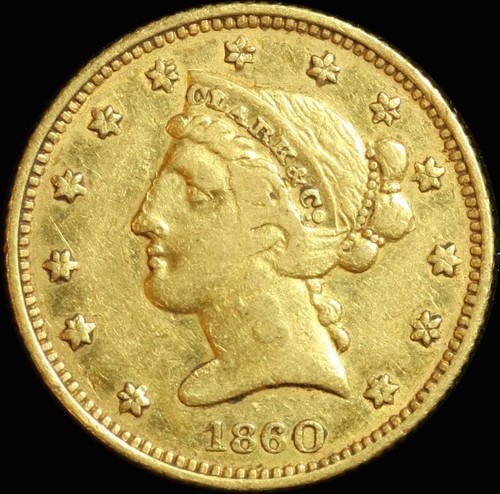
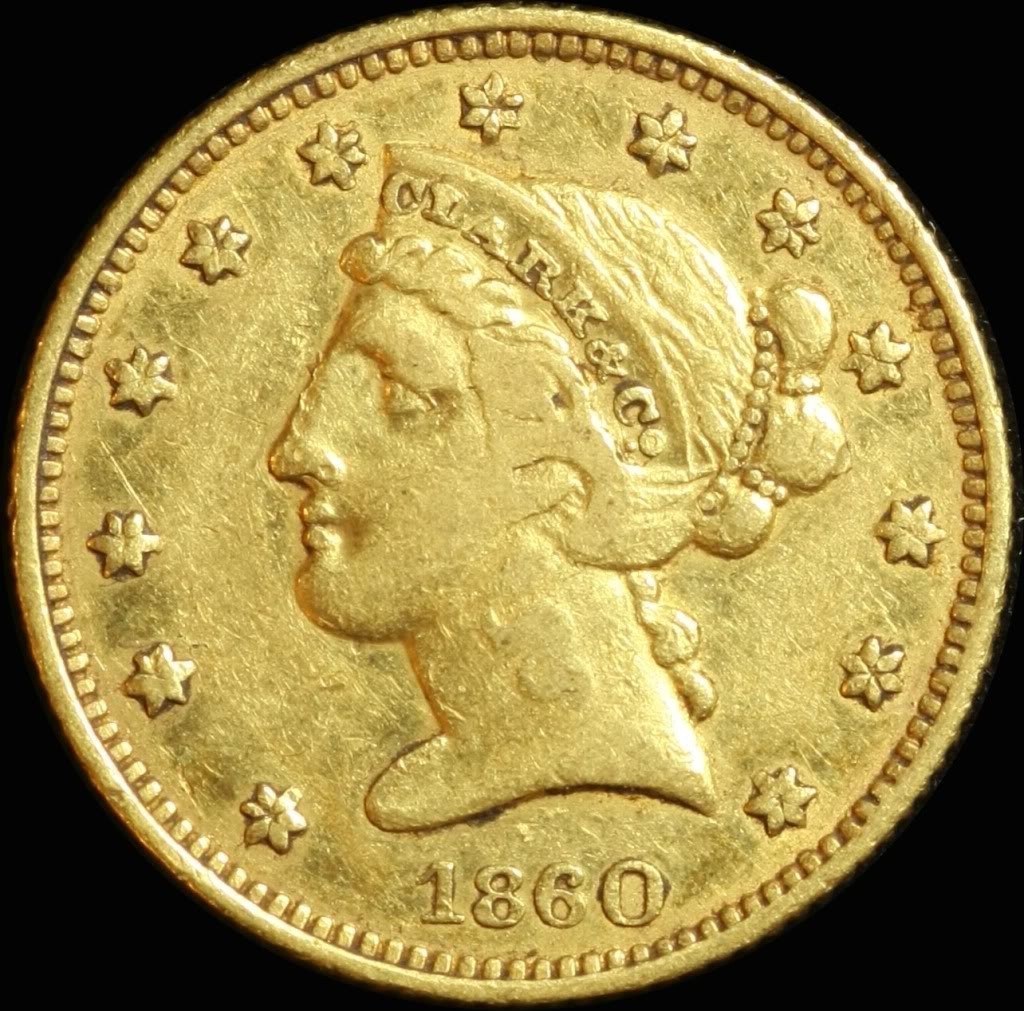
An 1860 privately struck $5 gold piece from Clark, Gruber & Co. of Denver, coined from Pikes Peak gold during the Colorado gold rush.
- Country
- United States
- Denomination
- 5 dollars
- Metal
- Gold
Got a coin like this?
Identify any coin from a photo, free.
Overview
The Clark & Co Territorial Gold Half Eagle is a privately issued five-dollar gold coin struck in 1860 by Clark, Gruber & Company, a Denver banking and assaying firm that operated its own mint during the Pikes Peak Gold Rush. It belongs to the family of "territorial" or "private" gold coins produced in the American West before federal mints served the region, when local firms turned raw placer and lode gold into ready coin. The piece pictured shows the classic Liberty head facing left on the obverse and an eagle with spread wings on the reverse, closely imitating the contemporary U.S. Mint half eagle so that miners and merchants would accept it readily.
Rather than the word LIBERTY, the 1860 quarter eagle and half eagle carry the legend "PIKES PEAK" on Liberty's coronet, with the firm name "CLARK, GRUBER & CO." and the date 1860 around the design. The reverse eagle is accompanied by wording that identifies the denomination and the Denver origin. These coins circulated as money on the frontier and are today prized as historic artifacts of Colorado's early mining economy.
History & Background
Clark, Gruber & Co. was formed by brothers Austin and Milton Clark together with Emanuel Henry Gruber, who ran a banking house in Leavenworth and then opened operations in Denver. As gold poured out of the Pikes Peak region in 1859–1860, transporting dust and nuggets east for coining was slow and costly, and privately assayed gold traded at a discount. To solve this, the firm built a small mint in Denver and began striking gold coins in July 1860 in denominations of $2.50, $5, $10, and $20.
The 1860 half eagle and quarter eagle copied the federal Coronet Liberty Head design, while the larger 1860 ten- and twenty-dollar pieces bore a stylized mountain meant to represent Pikes Peak. The firm deliberately placed slightly more gold in its coins than the equivalent federal pieces to build public confidence and keep them circulating at full value. In 1861 the mountain motif was dropped and all denominations adopted Liberty head designs. Clark, Gruber & Co. sold its minting operation to the United States government in 1863; the facility became a federal assay office and was a forerunner of the Denver Mint, which opened for coinage decades later.
How to Identify
The obverse shows a left-facing Liberty head with a coronet, in the style of the U.S. Mint's Coronet (Liberty Head) half eagle. On the 1860 issue the coronet is inscribed "PIKES PEAK" in place of the usual "LIBERTY," and the surrounding legend includes the firm's name, "CLARK, GRUBER & CO.," with the date 1860 below. The reverse depicts a heraldic-style eagle with spread wings, wording that names the Denver origin, and the five-dollar denomination expressed as "FIVE D."
As a private-issue half eagle it approximates the size and weight of a federal $5 gold piece—on the order of about 21–22 mm across and roughly 8 grams of gold-colored metal—though private strikes can vary. There is no U.S. Mint mint mark; instead, the maker's name and place stand in for a mint identifier. Because the design intentionally mimics regular-issue federal coinage, the reliable diagnostics are the "PIKES PEAK" coronet, the "CLARK, GRUBER & CO." legend, and the Denver-related reverse inscription rather than the general Liberty-and-eagle motif alone.
Value & Collectibility
Genuine Clark, Gruber & Co. gold is scarce and historically important, and authentic examples command strong prices—commonly ranging from several thousand dollars for worn, lower-grade pieces to tens of thousands or more for choice, well-preserved survivors, with exact figures depending heavily on grade, eye appeal, and demand at the time of sale. As with all rare territorial gold, condition and third-party certification make an enormous difference in value.
Because these coins are famous and valuable, replicas, souvenir copies, and outright counterfeits are common; many "Pikes Peak gold" pieces offered casually are modern reproductions or gold-plated fantasies rather than 1860 originals. Anyone considering a purchase or valuing an inherited piece should have it authenticated and graded by a reputable service such as PCGS or NGC before assuming it is genuine or paying a premium. Do not rely on weight or color alone.
Frequently asked questions
Is the Clark & Co half eagle real gold?
Yes. Authentic 1860 Clark, Gruber & Co. half eagles were struck from Colorado gold and actually carried slightly more gold than a comparable federal $5 coin. Be aware, though, that many pieces on the market are plated or non-gold replicas.
Why does the coin say "Pikes Peak" instead of "Liberty"?
The firm modeled its design on the U.S. Mint half eagle but replaced LIBERTY on the coronet with PIKES PEAK to advertise the Colorado gold-rush origin of the metal. It is a key diagnostic of the 1860 issue.
Who was Clark, Gruber & Co.?
It was a Denver banking and assaying firm run by the Clark brothers and Emanuel Gruber that operated a private mint in 1860–1861, coining local gold. The U.S. government bought the plant in 1863 and it became a forerunner of the Denver Mint.
Does it have a mint mark?
No. As a private territorial issue it carries no U.S. Mint mint mark. Instead the maker's name, "CLARK, GRUBER & CO.," and the Denver reference serve to identify who struck it and where.
How much is one worth?
Authentic examples are rare and can range from several thousand dollars in low grade to tens of thousands or more for high-grade pieces. Values swing widely with condition, so professional grading is essential before relying on any figure.
Clark & Co Territorial Gold Half Eagle guides
In-depth guides for identifying, valuing, and collecting Clark & Co Territorial Gold Half Eagle.