
How to Identify the Clark & Co Territorial Gold Half Eagle
Confirm an 1860 Clark, Gruber & Co. $5 gold piece by its "PIKES PEAK" coronet, firm-name legend, Denver reverse, and half-eagle size.
Read the full Clark & Co Territorial Gold Half Eagle encyclopedia entry →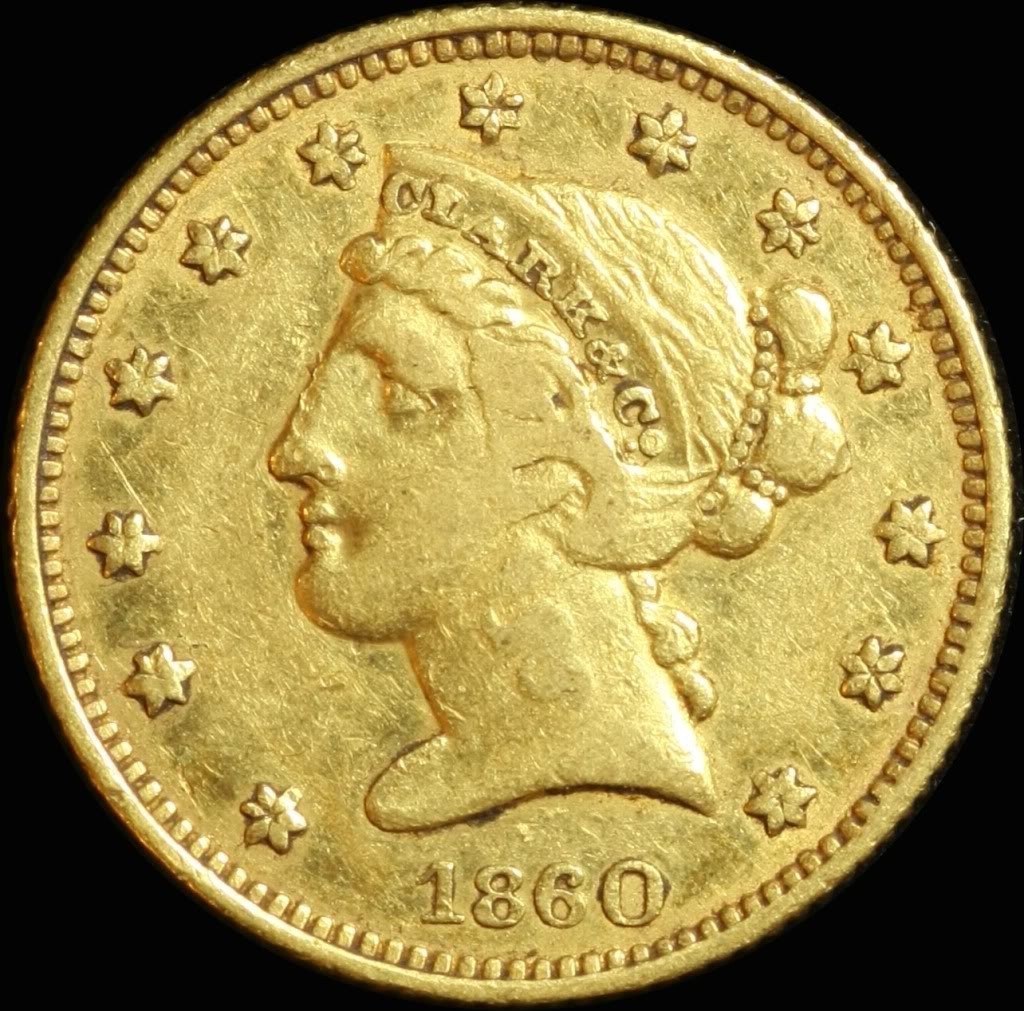
What It Is
The Clark & Co Territorial Gold Half Eagle is an 1860 private five-dollar gold coin from Clark, Gruber & Co. of Denver, struck during the Pikes Peak Gold Rush. It deliberately imitates the federal Coronet Liberty Head half eagle, so identification depends on spotting the specific inscriptions that mark it as a private territorial issue rather than a U.S. Mint coin.
Obverse (Front)
Look for a left-facing Liberty head wearing a coronet. The tell is the coronet lettering: on the 1860 half eagle it reads "PIKES PEAK," not "LIBERTY." The legend around the head names the maker, "CLARK, GRUBER & CO.," and the date 1860 appears below the portrait. If the coronet says LIBERTY and there is no firm name, you are likely looking at a regular U.S. Mint half eagle instead.
Reverse (Back)
The reverse shows an eagle with spread wings in the style of federal gold coinage, together with inscriptions that state the five-dollar value ("FIVE D.") and tie the coin to Denver. Because the eagle motif itself is generic, read the surrounding wording: the Denver reference and denomination text distinguish a Clark, Gruber piece from a federal eagle reverse.
Size, Metal, and Marks
Expect a gold-colored coin roughly the size of a U.S. half eagle—about 21–22 mm in diameter and around 8 grams—though private strikes can vary slightly. There is no U.S. Mint mint mark; the firm name substitutes for one. Weight and diameter alone are not proof of authenticity, since counterfeits are often made to the right size.
Look-Alikes and Authentication Cautions
The biggest confusions are (1) a genuine federal Coronet half eagle, which lacks the "PIKES PEAK" coronet and firm legend, and (2) modern replicas, souvenir tokens, and plated fantasy pieces that copy the Pikes Peak wording. Because authentic Clark, Gruber gold is rare and valuable, treat any casually offered example with skepticism. Have the coin examined and certified by a reputable grading service (such as PCGS or NGC) before accepting it as an 1860 original or paying a collector price.
Frequently asked questions
What single feature confirms it is a Clark, Gruber piece?
The "PIKES PEAK" inscription on Liberty's coronet, combined with the "CLARK, GRUBER & CO." legend and the 1860 date. A standard federal half eagle reads LIBERTY on the coronet and carries no firm name.
How do I tell it apart from a regular U.S. $5 gold coin?
Both share a Liberty head and eagle, so read the inscriptions. The private issue names the maker and Denver origin and says PIKES PEAK; a U.S. Mint half eagle shows LIBERTY, UNITED STATES OF AMERICA, and a mint mark rather than a firm name.
Are most "Pikes Peak gold" coins I see online genuine?
No. Replicas, souvenir copies, and plated counterfeits are common. Genuine 1860 Clark, Gruber half eagles are scarce, so assume a casual offering needs professional authentication before you trust it.
Should I clean or test the coin myself?
Do not clean it—cleaning can sharply reduce value—and avoid destructive metal tests. If you need to verify gold content or authenticity, submit it to a reputable third-party grading service that can assess it non-destructively.