Turban Head Eagle
The first U.S. ten-dollar gold coin, struck 1795–1804, with a right-facing Liberty in a soft cap and an eagle reverse.
- Country
- United States
- Denomination
- 10 dollars
- Metal
- Gold
Got a coin like this?
Identify any coin from a photo, free.
Overview
The Turban Head Eagle is the first ten-dollar gold coin of the United States, produced from 1795 through 1804. It was the largest denomination struck by the young U.S. Mint and shows Liberty facing right, her hair gathered under a soft cloth cap. The "turban" name is a long-standing misnomer — the headgear is a loose cap, not an actual turban.
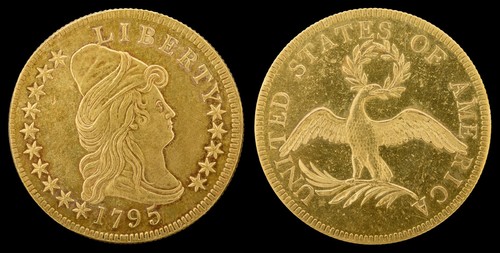
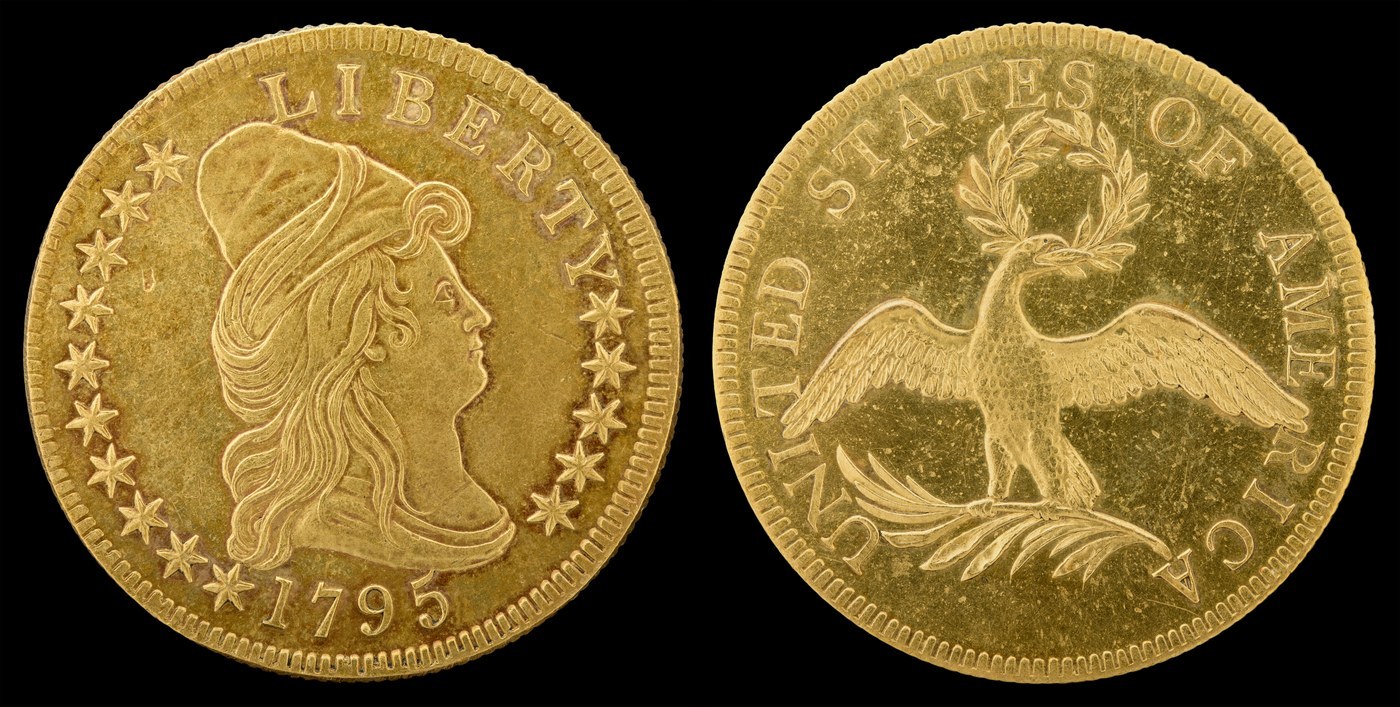
The coin is a substantial gold piece, struck in an early gold alloy of roughly 22 karat (about .9167 fine) with copper, measuring near 33 mm across and weighing about 17.5 grams. Two reverse types exist across the series: an early Small Eagle (1795–1797) showing a slender eagle holding a wreath, and a Heraldic Eagle (1797–1804) with a shield on its breast clutching an olive branch and a bundle of arrows, modeled on the Great Seal. The example shown here is dated 1795, the first year of issue.
History & Background
Authorized by the Coinage Act of 1792, the eagle was the top denomination of the new federal coinage and the standard for larger gold transactions. The U.S. Mint at Philadelphia struck the first eagles in 1795, using an obverse traditionally attributed to Mint engraver Robert Scot. The design pairs Liberty in a soft cap with a reverse eagle, echoing the motifs used on the silver coinage of the same era.
The reverse changed during the series. The earliest eagles of 1795–1797 carry the Small Eagle, a naturalistic bird perched and holding a wreath. Beginning in 1797 the Mint adopted the Heraldic Eagle, with a shield, an olive branch, and arrows drawn from the Great Seal of the United States. Production of the eagle was halted in 1804: with gold rising in value, the coins were being exported and melted, and President Jefferson ordered the denomination suspended. The ten-dollar gold piece did not return until the Liberty Head (Coronet) Eagle debuted in 1838.
How to Identify
The obverse shows Liberty facing right, her hair bound up under a soft, rounded cap, with the word LIBERTY above and the date below, and stars arranged around the border. The number and arrangement of stars varies within the series and is one way specialists attribute individual issues, so count them carefully. The 1795-dated coin shown here is a first-year piece.
The reverse depends on the date. On 1795–1797 issues you will see the Small Eagle — a slim eagle holding a wreath, standing on a palm branch. From 1797 the Heraldic Eagle appears, with an eagle bearing a shield on its breast, an olive branch in one talon and a bundle of arrows in the other, and an arc of stars and clouds above. The legend UNITED STATES OF AMERICA surrounds the reverse. There is no denomination or mint mark on the coin; all were struck at Philadelphia, and the value was understood by the coin's size and gold content.
Physically this is a large early gold coin, roughly 33 mm in diameter and about 17.5 grams, with a reeded edge. The hand-struck appearance, the gold color, the correct diameter and weight, and the period-appropriate reverse type are the key diagnostics that separate a genuine Turban Head eagle from a later coin or a reproduction.
Value & Collectibility
Turban Head Eagles are scarce, historically significant early gold coins, and even well-worn examples command large premiums far above their gold content. Value is driven by the date, the reverse type, the die variety, and the state of preservation, with sharp detail, original surfaces, and strong eye appeal all adding to desirability. First-year 1795 coins and low-mintage dates are especially sought after.
Because these coins are old, valuable, and heavily counterfeited — including cast fakes, altered dates, and modern replicas — any Turban Head eagle should be authenticated and graded by a reputable third-party service before it is bought, sold, or insured. Treat any figures you encounter as general context rather than firm prices, since condition and variety can change the value dramatically.
Frequently asked questions
What years was the Turban Head Eagle made?
It was struck from 1795 through 1804. Production was then suspended because the coins were being exported and melted, and the ten-dollar gold piece did not return until 1838.
Why is it called a "turban" head?
The name is a misnomer. Liberty is wearing a soft cloth cap, not a turban, but the nickname stuck. Collectors also call it the Capped Bust to Right Eagle.
Is the Turban Head Eagle real gold?
Yes. It is a large gold coin of roughly 22 karat (about .9167 fine) gold with copper, near 33 mm across and about 17.5 grams, so it carries significant intrinsic and collector value.
What is the difference between the Small Eagle and Heraldic Eagle reverse?
The Small Eagle (1795–1797) shows a slim eagle holding a wreath. The Heraldic Eagle (1797–1804) shows an eagle with a shield on its breast holding an olive branch and arrows, based on the Great Seal.
Does a Turban Head Eagle have a mint mark?
No. All were struck at the Philadelphia Mint, which used no mint mark in this period, so a genuine coin carries no mint mark.
Turban Head Eagle guides
In-depth guides for identifying, valuing, and collecting Turban Head Eagle.