Indian Head Eagle
U.S. $10 gold eagle struck 1907–1933, designed by Augustus Saint-Gaudens, with a feathered-headdress Liberty and a standing eagle reverse.
- Country
- United States
- Denomination
- 10 dollars
- Metal
- Gold
Got a coin like this?
Identify any coin from a photo, free.
Overview
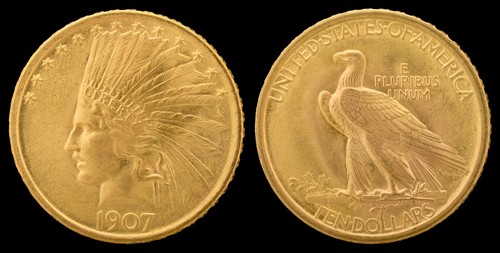
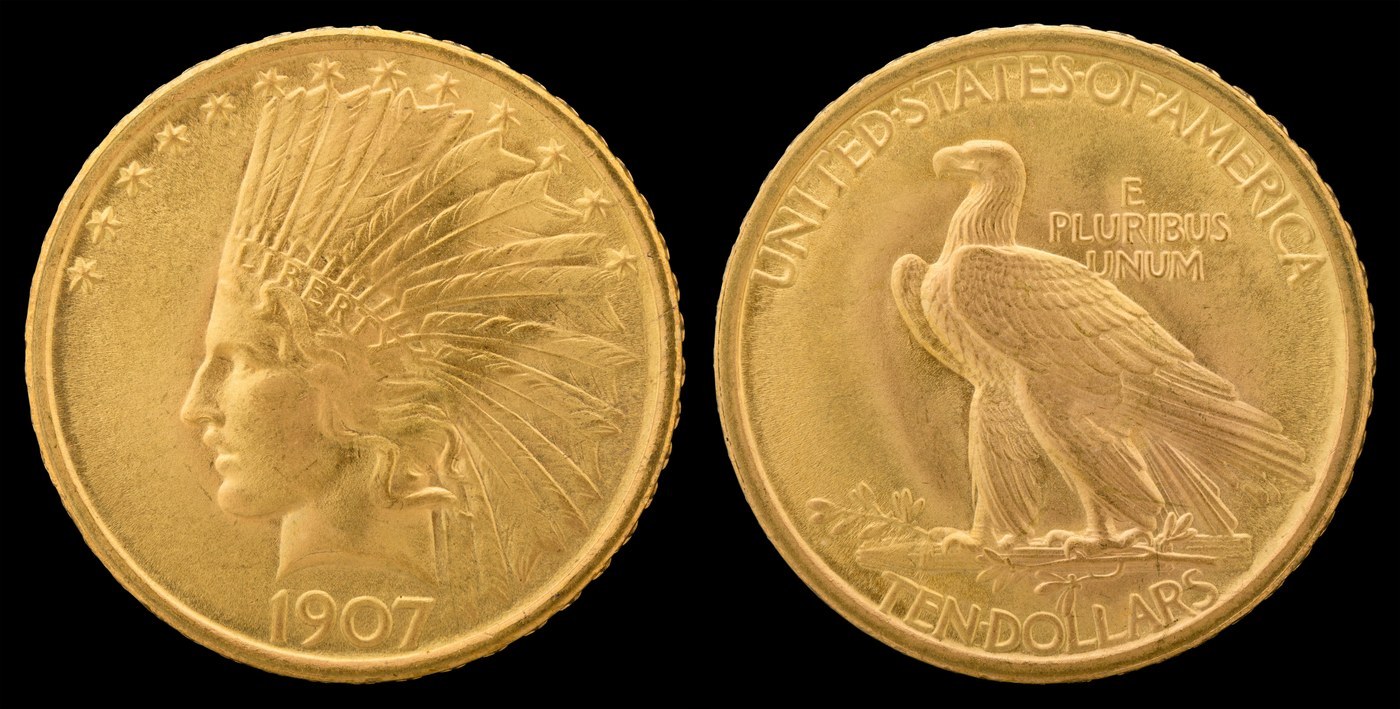
The Indian Head Eagle is a United States ten-dollar gold coin struck from 1907 through 1933. It was designed by the sculptor Augustus Saint-Gaudens as part of a redesign of American gold coinage championed by President Theodore Roosevelt. The obverse shows a head wearing a feathered war bonnet with the word LIBERTY across the headband, while the reverse depicts a standing eagle.
The coin is struck in 90% gold (0.900 fine) and measures about 27 mm in diameter, weighing roughly 16.7 grams and containing close to a half ounce of gold. The example shown here is dated 1911 and is housed in a third-party grading slab, which is common for surviving pieces of this scarce and valuable series.
History & Background
President Theodore Roosevelt famously disliked the workmanlike look of contemporary U.S. coins and pushed for artistically ambitious replacements. He turned to Augustus Saint-Gaudens, one of the leading sculptors of the age, to reimagine the nation's gold. The result for the ten-dollar denomination was the Indian Head Eagle, introduced in 1907, the same year Saint-Gaudens died. The choice of a Native American headdress on a classically modeled head was unusual and gave the coin its enduring nickname.
Early 1907 issues appeared with periods (dots) flanking the legends and with a wire-thin rim, before the design was modified for regular production. The motto IN GOD WE TRUST was absent from the first coins — Roosevelt believed it inappropriate on money — but Congress ordered it added, and it appears on the reverse from 1908 onward. The series was struck at Philadelphia (no mint mark), Denver (D), and San Francisco (S) until 1933, when the United States left the gold standard and gold coinage ended; the 1933 eagle is a celebrated rarity.
How to Identify
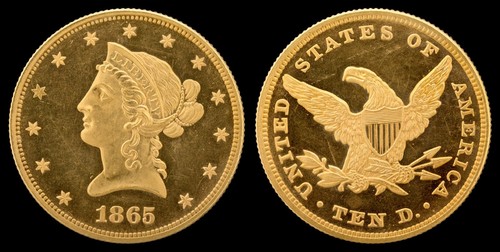
The obverse depicts a head facing left wearing a Native American feathered headdress (war bonnet), with the headband inscribed LIBERTY. Stars arc around the top and the date sits below the neck. This headdress motif is the coin's signature feature and separates it at a glance from the earlier Liberty Head (Coronet) eagle.
The reverse shows a standing eagle perched on a bundle of arrows with an olive branch, facing left, with UNITED STATES OF AMERICA above and the denomination TEN DOLLARS below. On coins from 1908 onward the motto IN GOD WE TRUST appears to the left of the eagle. Mint marks, when present, are found on the reverse near the arrow points at the lower left; no mint mark indicates Philadelphia.
Specifications are a reliable check: 90% gold, about 27 mm across, roughly 16.7 g, with a distinctive raised-star edge rather than reeding. Because these are high-value gold coins, most authentic examples today are encapsulated by grading services, as in the slabbed 1911 piece shown here.
Value & Collectibility
As a nearly half-ounce gold coin, an Indian Head Eagle carries substantial intrinsic (bullion) value that moves with the gold market, and collector demand adds a premium on top of that. Common dates in circulated to lower mint-state grades trade largely on their gold content plus a modest numismatic markup, while high-grade and scarce dates command significant premiums.
Certain issues are notably rare — early varieties, low-mintage branch-mint dates, and especially the 1933 eagle, which is a major rarity. Values swing widely with date, mint mark, grade, and gold prices, so figures should be treated as general context rather than fixed prices. Given the coin's value and its appeal to counterfeiters, meaningful purchases are best made in certified holders from reputable grading services.
Frequently asked questions
Who designed the Indian Head Eagle?
Augustus Saint-Gaudens, at the urging of President Theodore Roosevelt, as part of an effort to give U.S. gold coinage a more artistic look. The design debuted in 1907.
How much gold does an Indian Head Eagle contain?
It is struck in 90% gold and weighs about 16.7 grams, containing close to a half ounce (roughly 0.4838 troy oz) of pure gold.
Why does a U.S. coin show a Native American headdress?
The obverse is a classically modeled Liberty head wearing a feathered war bonnet, a stylistic choice by Saint-Gaudens. Despite the nickname, it represents Liberty rather than a specific person.
Where is the mint mark on the Indian Head Eagle?
On the reverse near the arrow points at the lower left. You may see D (Denver) or S (San Francisco); no mint mark means the coin was struck at Philadelphia.
Why is my Indian Head Eagle in a plastic slab?
Because these are valuable gold coins, most are encapsulated by third-party grading services like PCGS or NGC to certify authenticity and grade, as with the 1911 example shown here.
Indian Head Eagle guides
In-depth guides for identifying, valuing, and collecting Indian Head Eagle.