
How to Identify the Indian Head Eagle
A collector's walkthrough for confirming a $10 Indian Head Eagle: the headdress obverse, standing-eagle reverse, gold specs, mint marks, and authentication cautions.
Read the full Indian Head Eagle encyclopedia entry →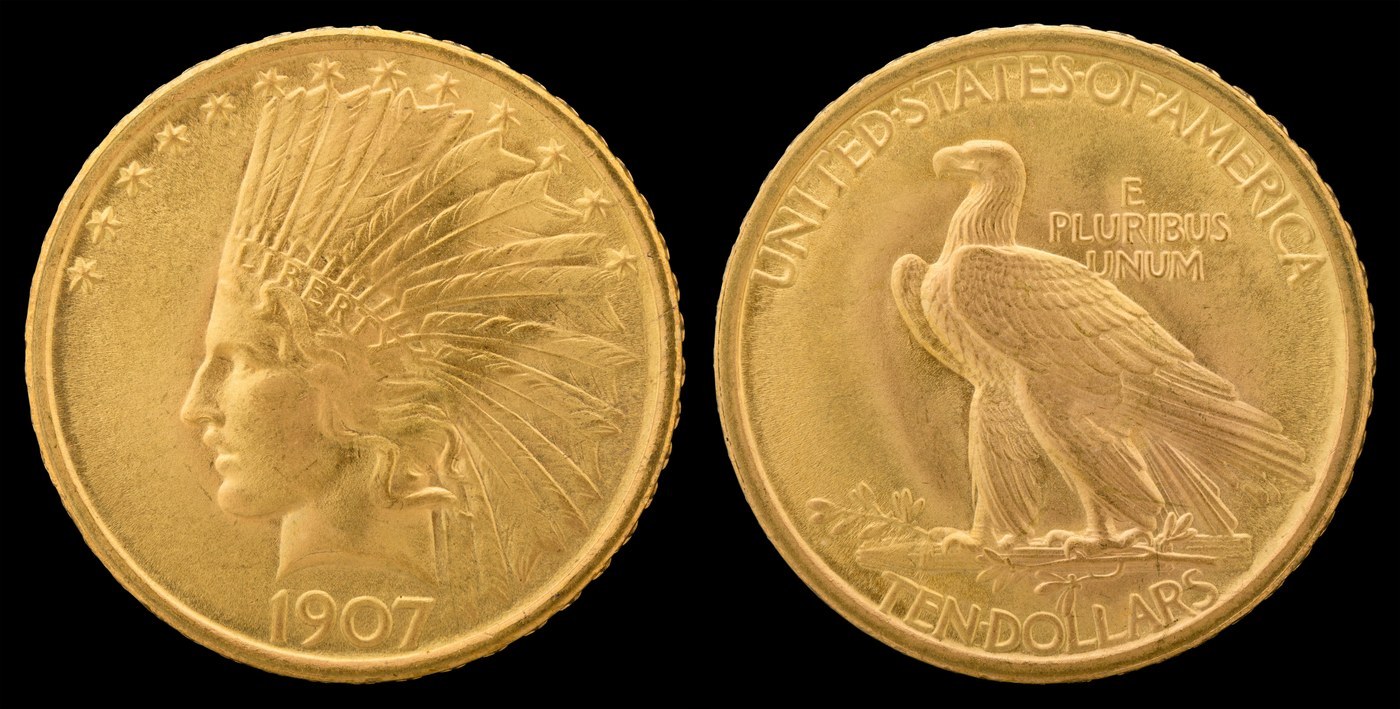
Begin with the obverse. An Indian Head Eagle shows a head facing left wearing a full feathered headdress, with LIBERTY inscribed on the headband and stars arcing around the top. This war-bonnet portrait is the fastest confirmation of the type and immediately distinguishes it from the older Coronet (Liberty Head) eagle, which shows Liberty in a plain coronet.
Turn to the reverse, which carries a standing eagle perched on arrows and an olive branch, with UNITED STATES OF AMERICA above and TEN DOLLARS below. Look for IN GOD WE TRUST to the left of the eagle: it is absent on the first 1907–1908 coins and present from 1908 onward, which can help place an undated-looking piece. The mint mark, if any, sits near the arrow points at the lower left — D or S, or none for Philadelphia.
Verify the physical specs. A genuine coin is 90% gold, about 27 mm in diameter and roughly 16.7 g, with a raised-star edge rather than the reeded edge of many silver coins. Weight and diameter that fall short, a wrong edge, or a non-gold color are strong warnings. Because the denomination is ten dollars, do not confuse it with the smaller Indian Head quarter eagle ($2.50) or half eagle ($5), which share the headdress theme at smaller sizes and lighter weights.
Finally, treat authentication seriously. High gold value makes this series a target for counterfeits, cast copies, and altered dates or mint marks — the 1933 date in particular. Whenever possible, buy and hold examples certified by a reputable grading service such as PCGS or NGC, and be skeptical of raw coins offered as rare dates. The slabbed 1911 coin pictured here reflects the norm for the series.
Frequently asked questions
How do I tell an Indian Head Eagle from the older Liberty Head eagle?
Look at the obverse. The Indian Head Eagle wears a feathered war bonnet, while the earlier Coronet type shows Liberty in a plain coronet inscribed LIBERTY. Both are $10 gold, but the headdress is unmistakable.
How can I distinguish the $10 eagle from the smaller $2.50 and $5 Indian coins?
Check the denomination on the reverse — TEN DOLLARS — and the size and weight. The eagle is about 27 mm and 16.7 g, noticeably larger and heavier than the quarter eagle and half eagle, whose designs are also incused rather than raised.
Does the presence of IN GOD WE TRUST help date the coin?
Yes. The motto is missing on the earliest 1907–1908 coins and present on the reverse from 1908 through 1933, so its absence points to the first year or two of the series.
Should I remove the coin from its grading slab to examine it?
No. The slab certifies authenticity and grade and protects the surfaces. Breaking it out can reduce value and expose the coin to damage; examine it through the holder instead.