
How to Identify the Turban Head Eagle
A collector's walkthrough for confirming a Turban Head Eagle: the capped Liberty portrait, eagle reverse types, gold size and weight, and authentication cautions.
Read the full Turban Head Eagle encyclopedia entry →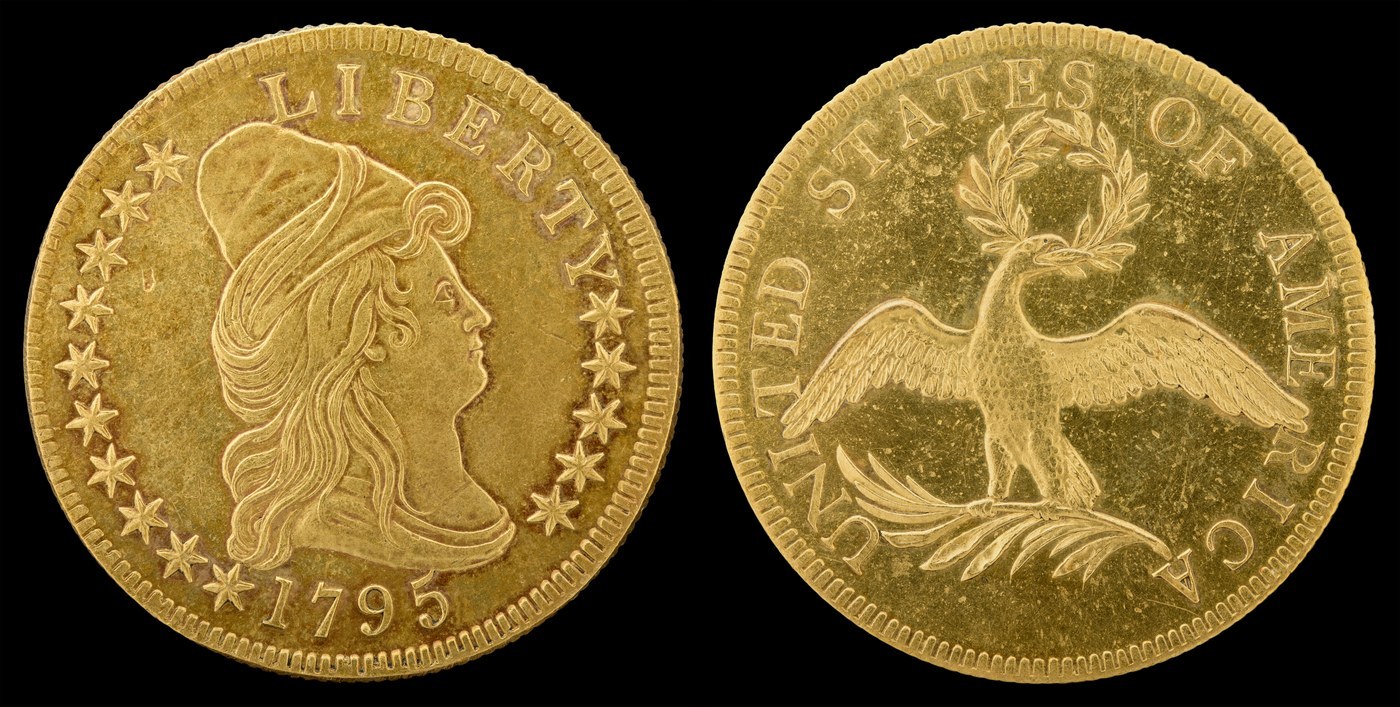
Start with the obverse portrait. A Turban Head eagle shows Liberty facing right with her hair gathered under a soft, rounded cap, LIBERTY arced above and the date below, and stars around the border. Despite the "turban" nickname, the headgear is a plain cloth cap. Count the stars carefully — their number and arrangement vary across the series and are a primary way to attribute a specific issue, such as the 1795 first-year coin.
Turn the coin over and read the reverse type against the date. Coins of 1795–1797 carry the Small Eagle: a slim bird holding a wreath and standing on a palm branch. Coins of 1797–1804 carry the Heraldic Eagle, with a shield on the breast, an olive branch and arrows in the talons, and an arc of stars and clouds above. The reverse type should match the date — a Heraldic Eagle reverse belongs to 1797 or later, so a mismatch between the reverse and the date is a warning sign worth investigating.
Confirm the physical coin. This is a large gold piece — roughly 33 mm across and about 17.5 grams — with a reeded edge. There is no stated denomination and no mint mark, since every example was struck at Philadelphia. Verify diameter and weight against reference figures: a coin that is underweight, the wrong size, or non-magnetic-but-clearly-not-gold in color deserves suspicion.
Because these are high-value early gold coins, treat authentication as essential. Watch for cast fakes with soft or mushy detail, added or altered dates, tooled fields, filed or replaced edges, and gold-plated base-metal replicas. Genuine coins were hand-struck from individually cut dies, so minor die differences are normal, but wrong weight, wrong reverse-for-date, or seams from casting are not. Submit any candidate to a reputable grading service such as PCGS or NGC before buying, selling, or insuring it.
Frequently asked questions
How do I tell which reverse type I have?
Look at the eagle. A slim eagle holding a wreath is the Small Eagle (1795–1797). An eagle with a shield on its breast holding an olive branch and arrows is the Heraldic Eagle (1797–1804). The type should agree with the date.
Is there a mint mark or denomination to check?
No. Turban Head eagles carry neither a mint mark nor a stated denomination. All were struck at Philadelphia, so any mint mark would indicate a problem coin.
What size and weight should a genuine coin be?
About 33 mm in diameter and roughly 17.5 grams of 22-karat gold, with a reeded edge. A coin that is notably off in size, weight, or color should be treated with suspicion.
Why should I have it authenticated?
These are scarce, high-value early gold coins and a frequent target for fakes and altered dates. A reputable grading service can confirm authenticity, date, and variety before you buy, sell, or insure it.